
Our Short List of 3

- Best for: Owners maintaining several 12V batteries, including an RV or boat with a LiFePO4 house battery.
- Rated power: 20W
- System voltage: 12V
- Controller: built-in intelligent MPPT charge controller
- Charging stages: bulk, absorption, float
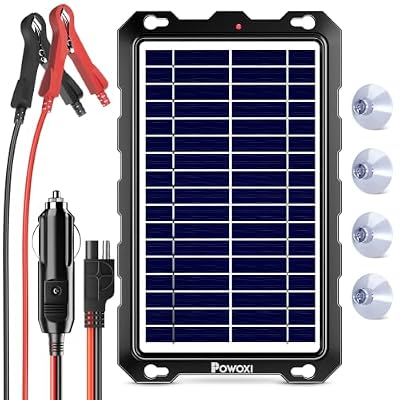
- Best for: A single car or motorcycle parked outdoors that needs steady top-ups between regular uses.
- Rated power: 7.5W
- System voltage: 12V
- Controller: smart charge controller
- Protections from listing: intelligent safety protections including overcharge protection

- Best for: A stored car, boat or ATV that needs basic, clearly described overcharge and reverse protection.
- Rated power: 10W
- System voltage: 12V
- Panel type: monocrystalline
- Protection from listing: built-in blocking diode against reverse charging, plus reverse and overcharge protection after board upgrade
All 4 Picks at a Glance
| Product | Specs | Action |
|---|---|---|
| SUNER POWER 20W 12V Solar Battery Trickle Charger & Maintainer PRO |
| Check price on Amazon |
| POWOXI Upgraded 7.5W Solar Battery Trickle Charger Maintainer 12V |
| Check price on Amazon |
| ECO-WORTHY 10W 12V Solar Battery Charger Trickle Maintainer Kit |
| Check price on Amazon |
 Topsolar 10W 12V Solar Car Battery Charger |
| Check price on Amazon |
The real decision with a solar car battery charger is not the size of the panel. It is what happens on the third sunny week, when the battery reaches full and the panel keeps producing. Without proper charge control, a panel connected directly to a battery can keep pushing current into a battery that no longer needs it. With a controller that stops, floats and resumes on its own, the same panel becomes a fit-and-forget maintainer you can leave connected all season.
This guide is for owners of cars, boats, RVs and motorcycles that sit unused for weeks at a time — a second car, a stored convertible, a trailer battery — and who want sunlight to offset natural self-discharge. Every product below was selected from its Amazon listing, and each one states its overcharge protection method on that listing, whether that is a built-in MPPT controller, a smart controller, or protection built into the panel circuitry.
Quick Picks
As an Amazon Associate we earn from qualifying purchases.
| Product | Best for | Key spec from title |
|---|---|---|
| SUNER POWER 20W 12V Solar Battery Trickle Charger & Maintainer PRO | Larger batteries and mixed vehicle fleets | 20W, built-in intelligent MPPT controller |
| POWOXI Upgraded 7.5W Solar Battery Trickle Charger Maintainer 12V | One car or motorcycle kept outdoors | 7.5W, waterproof portable panel kit |
| ECO-WORTHY 10W 12V Solar Battery Charger Trickle Maintainer Kit | Simple maintenance with a blocking diode | 10W monocrystalline panel |
| Topsolar 10W 12V Solar Car Battery Charger | Lightweight panel for occasional use | 10W, 12V trickle charger |
How to Choose
Overcharge Protection Is the Whole Point of the Controller
A bare panel produces whatever the sun gives it, regardless of battery state. Protection comes in three grades, and the listing tells you which one you are buying. A built-in MPPT or smart charge controller actively manages stages of charging, stops when the battery is full and resumes when it drains — the strongest form, and the one to choose for a battery left connected for months. A blocking diode is a simpler safeguard: it stops current flowing back out of the battery at night and, paired with trickle output and protection circuitry, suits gentle maintenance. The weakest option is a panel with no stated protection at all. For this keyword, that third category is excluded entirely; every pick here names its method.
Wattage Decides Maintenance Speed, Not Magic
Panel watts describe output in strong sun, and they set realistic expectations. A panel in the 5W to 10W range offsets self-discharge on a healthy battery and little more. Around 20W, a maintainer also recovers a battery that has dipped during storage, given enough sunny days. None of these products is a jump starter or a rescue charger for a deeply discharged battery, and listings that frame their role as trickle charging and maintaining are being honest with you. Match the panel to the battery size and the parking spot: a shaded driveway halves what any panel can do, so a higher-wattage panel is the practical compensation when sun hours are limited.
Battery Chemistry Must Appear on the Listing
Not every solar maintainer suits every battery. Lead-acid family types — flooded, AGM, gel and sealed — are the baseline almost all of these panels support. Lithium iron phosphate, common in newer RV and marine setups, needs a controller profile written for it, and only some listings claim it. Read the compatibility line on the product page before ordering and match it to the label on your battery, not to the vehicle it sits in. Connecting a lead-acid-only maintainer to a lithium battery because both say 12V is the most expensive mistake in this category, and it is entirely avoidable at the reading stage.
Connection Kits Decide Whether You Will Actually Use It
A maintainer only works while connected, so the hardware in the box shapes the habit. Alligator clips suit occasional hookups under an open bonnet. Ring or eyelet terminals bolt on semi-permanently and turn each use into a single plug, which is the setup most likely to survive a whole winter. A cigarette lighter or 12V socket cable is the easiest route of all, but only works if your vehicle’s socket stays live with the ignition off — many do not. Check which cables the listing includes, whether an SAE quick connector is part of the system, and whether suction cups or a bracket are supplied for holding the panel where the sun actually falls.
The 4 Best Options
SUNER POWER 20W 12V Solar Battery Trickle Charger & Maintainer PRO
- Best for: Owners maintaining several 12V batteries, including an RV or boat with a LiFePO4 house battery.
- Rated power: 20W
- System voltage: 12V
- Controller: built-in intelligent MPPT charge controller
- Charging stages: bulk, absorption, float
Owners maintaining several 12V batteries, including an RV or boat with a LiFePO4 house battery.
At 20W it still maintains rather than rescues; a deeply discharged battery needs a mains charger first.
This is the most complete maintainer in the group, built around a built-in intelligent MPPT controller rather than a simple diode. The listing describes three-stage charging — bulk, absorption and float — with charging that stops when the battery is full and resumes automatically as it drains, which is exactly the overcharge behaviour this purchase is about. Its stated protection list is the longest here, covering over-charge, over-discharge, over-voltage, over-current, over-load, short circuit, reverse polarity and over-temperature. Compatibility spans flooded, gel, AGM and sealed lead-acid batteries plus LiFePO4, so one panel can serve a car, a boat and an RV across a household.
POWOXI Upgraded 7.5W Solar Battery Trickle Charger Maintainer 12V
- Best for: A single car or motorcycle parked outdoors that needs steady top-ups between regular uses.
- Rated power: 7.5W
- System voltage: 12V
- Controller: smart charge controller
- Protections from listing: intelligent safety protections including overcharge protection
A single car or motorcycle parked outdoors that needs steady top-ups between regular uses.
Confirm your 12V socket stays live with the ignition off before relying on the lighter plug instead of the clips.
The POWOXI kit takes the opposite approach: a modest panel, a smart charge controller, and a box of connection options that make a single-vehicle routine painless. The listing presents it as a waterproof portable kit for cars, motorcycles, boats and RVs, with suction cups for mounting the panel against glass and both alligator clips and a cigarette lighter plug among its cables. Its controller provides the intelligent safety protections the listing names, including overcharge protection, so the panel can stay connected between drives. At 7.5W it is honestly a maintainer, best matched to a healthy battery on a vehicle used every week or two rather than a fleet.
ECO-WORTHY 10W 12V Solar Battery Charger Trickle Maintainer Kit
- Best for: A stored car, boat or ATV that needs basic, clearly described overcharge and reverse protection.
- Rated power: 10W
- System voltage: 12V
- Panel type: monocrystalline
- Protection from listing: built-in blocking diode against reverse charging, plus reverse and overcharge protection after board upgrade
A stored car, boat or ATV that needs basic, clearly described overcharge and reverse protection.
Protection here is diode and board based rather than a staged charge controller, so it suits maintenance of a healthy battery best.
ECO-WORTHY’s kit is the straightforward middle option, and its protection story is written plainly on the listing. A built-in blocking diode prevents reverse charging at night, when a panel would otherwise draw from the battery, and an upgraded board adds reverse and overcharge protection. The 10W monocrystalline panel is described as working even on cloudy days, with a frosted, waterproof surface that needs no protective film. An indicator light shows the charging state, and the SAE cable keeps connection simple. This is the pick for a buyer who wants named, understandable safeguards without paying for a full MPPT controller they do not need.
Topsolar 10W 12V Solar Car Battery Charger
- Best for: Owners who move one small panel between a car, a trailer and a motorcycle across the year.
- Rated power: 10W
- System voltage: 12V
- Panel type: monocrystalline silicon
- Protection from listing: built-in junction-box safety preventing over-charge and reverse-charge
Owners who move one small panel between a car, a trailer and a motorcycle across the year.
The protection is built into the junction box rather than a programmable controller, so check your battery type against the listing carefully.
The Topsolar panel is the lightest route into solar maintenance in this set. Its listing describes a 10W monocrystalline charger whose built-in junction-box safety prevents over-charge and reverse-charge, giving it the named protection this category requires in a simpler form than a separate controller. The waterproof build suits a panel left on a dashboard, mounted by a stored trailer, or moved between vehicles as seasons change. With output in the same class as the ECO-WORTHY, expectations should match: this is a maintainer for batteries that start healthy, not a recovery tool. Choose it when portability between several occasionally used vehicles matters more than staged charging.
Which One Fits Your Situation
Your RV or Boat Sits for Months Between Trips
Choose the SUNER POWER 20W Pro. Long storage is where staged charging earns its keep: the controller floats a full battery instead of pushing at it, resumes on its own, and covers the lithium house batteries many RVs now carry. The higher wattage also compensates for short winter days, when a small panel barely keeps pace with self-discharge.
Your Second Car Lives on the Driveway
The POWOXI was designed for exactly this pattern. Suction cups hold the panel where the sun lands, the smart controller handles overcharge protection, and either the clips or the lighter plug keep setup under a minute. A car driven every week or two does not need more panel than this; it needs a routine you will not abandon by February.
You Want the Simplest Protected Setup for One Stored Vehicle
Take the ECO-WORTHY. Its safeguards are easy to verify on the listing, the indicator light confirms at a glance that the system is working, and the SAE connection makes a monthly check trivial. For a healthy battery in a garaged car or a boat on a trailer, that simplicity is the feature, not a compromise.
Several Vehicles Share One Panel
The Topsolar suits rotation duty. It is light enough to move weekly, its built-in protection travels with the panel, and its output class matches the maintenance needs of ordinary car and motorcycle batteries. Keep a simple note of which vehicle was connected when; the panel cannot help a battery it is not attached to, however good its protection is.
Common Mistakes
- Buying a panel with no stated overcharge protection and leaving it connected to a full battery all summer.
- Expecting a trickle maintainer to revive a deeply discharged battery that needs a proper mains charge first.
- Connecting a lead-acid-only maintainer to a LiFePO4 battery because both are labelled 12V.
- Using the cigarette lighter cable in a vehicle whose socket switches off with the ignition.
- Mounting the panel where shade covers it for most of the day, then blaming the wattage.
Frequently Asked Questions
Can a solar charger really overcharge a car battery?
Yes, if it has no charge control. A panel in strong sun keeps producing current whether the battery needs it or not, and over weeks that can stress a full battery. That is why every product in this guide names its protection method on the listing: a staged controller, a smart controller, or diode and board protection that limits what reaches the battery.
How many watts do I need to maintain a car battery?
For a healthy battery, a panel in the 5W to 10W range offsets normal self-discharge in decent sun. Step toward 20W if the battery is large, the vehicle has background electrical drain, or the parking spot gets limited daylight. More wattage shortens recovery after a dip, but no maintainer in this class replaces a mains charger for a flat battery.
Can I leave a solar maintainer connected all winter?
That is the use these products are built for, provided the protection is real and the connections are sound. A controller that floats and resumes automatically handles the changing battery state without visits. Still check the setup occasionally: confirm the indicator or controller behaves as the listing describes, keep terminals clean, and make sure the panel has not been buried, shaded or dislodged.
Will these chargers work through a windscreen?
A panel behind glass receives less light than one outside, so output falls, sometimes noticeably. Suction-cup kits are designed for windscreen mounting and remain useful for maintenance in that position, but the same panel outdoors will do more. If your only option is inside the car, favour a higher-wattage model to offset the loss, and park facing the sun where you can.




Write Your Review
No reviews yet. Be the first to share your experience!