
Our Short List of 3

- https://www.amazon.com/dp/B0C6XK77HJ

- https://www.amazon.com/dp/B0CB1FW5FC
- https://www.amazon.com/dp/B0B466YTT3
All 3 Picks at a Glance
| Product | Specs | Action |
|---|---|---|
| Anker Nano Power Bank (22.5W, Built-In USB-C Connector) |
| Check price on Amazon |
| INIU Portable Charger 10000mAh (P41) |
| Check price on Amazon |
| Anker 622 Magnetic Battery (MagGo) |
| Check price on Amazon |
A portable battery only helps if you actually carry it. That simple fact is why weight, not capacity, is the deciding factor for most iPhone owners: the heavy high-capacity brick stays in a drawer, while the light one lives in a jacket pocket and saves the day at an airport, a festival, or the end of a long commute. A lightweight portable iPhone battery is therefore a specific kind of product, not just any power bank described kindly. It has to be light enough to forget you are carrying it, shaped so it does not fight your phone for space in a pocket, and honest about the trade-off that a smaller battery refills your iPhone rather than replacing its charger for a week.
This guide compares three genuinely light options sold on Amazon US, each under roughly two hundred grams and each taking a different approach. One plugs straight into the phone with no cable at all. One doubles the capacity while keeping a slim, flat shape. One snaps on magnetically and doubles as a stand. Between them they cover the realistic lightweight range, from an emergency top-up to a full day of heavy use, and the sections below explain the capacity maths, the connector question that now splits the iPhone range in two, and how to pick the right one for the way you actually carry your phone.
As an Amazon Associate we earn from qualifying purchases.
What Counts as Lightweight
Power bank weight tracks capacity closely, because the battery cells inside are most of the mass. As a working guide, packs around 5,000mAh usually land near one hundred grams, roughly the weight of a small bar of soap, and disappear into a pocket. Packs around 10,000mAh usually land between one hundred eighty and two hundred thirty grams, noticeable in a trouser pocket but fine in a jacket or bag. Beyond that, weight climbs quickly and the product stops being a lightweight carry, whatever the listing calls it.
Thickness matters as much as the scale reading. A flat, slim pack rides against the phone in the same pocket; a short, chunky one of the same weight creates a lump and competes with keys and cards. When two packs weigh about the same, the thinner one almost always carries better.
Capacity Maths, Honestly
The milliamp-hour figure on the box is measured at the battery cell’s internal voltage, not at the voltage your iPhone receives. Conversion losses mean a 5,000mAh pack typically delivers around half to two thirds of that headline number to the phone. In practical terms, a 5,000mAh lightweight pack is a substantial top-up: enough to take a fading iPhone through the rest of a day, a long evening, or a delayed journey home, but not a guaranteed full recharge for the largest Pro Max models. A 10,000mAh pack is the class that comfortably delivers one full recharge for most iPhones with something left over.
Manufacturers state this openly in their own specifications when you read closely. Anker, for example, notes for its 5,000mAh Nano pack that the expected delivered capacity is lower than the headline figure because of normal energy loss during charging. Plan around delivered energy, not the box number, and a lightweight pack will meet your expectations instead of disappointing you.
The Connector Question: USB-C or Lightning
The iPhone range is now split. iPhone 15 models and later charge over USB-C, while iPhone 14 and earlier use Lightning. That split decides which lightweight designs are even available to you.
Built-in connector packs, which plug directly into the phone with no cable, are made for one connector or the other, so check the version before buying. Magnetic snap-on packs sidestep the issue for charging, since MagSafe-compatible wireless charging works on iPhone 12 and later regardless of the port, though their wired port still matters for recharging the pack itself. Classic cabled packs work with everything, provided you carry a cable that matches your phone, which is their one inconvenience and their one great flexibility.
The Picks
Anker Nano Power Bank (22.5W, Built-In USB-C Connector)
- https://www.amazon.com/dp/B0C6XK77HJ
The Anker Nano, model A1653, is the lightest complete answer in this guide at 3.5 ounces, about one hundred grams, and it achieves that by removing the cable from the equation entirely. A foldable USB-C connector is built into the pack, so it plugs straight into the bottom of a USB-C iPhone and sits there like a small extension of the phone itself. There is nothing to tangle, nothing to forget, and nothing extra in your pocket.
Capacity is 5,000mAh, and the published specifications list 22.5W maximum output, which is brisk for a pack this size, plus a second USB-C port so the pack can charge another device or be recharged without unplugging rituals. Anker notes the connector is designed to fit with phone cases up to 4.9 mm thick, which covers most everyday cases but not the bulkiest rugged ones. The honest limits are the connector itself: this version is for USB-C iPhones, meaning iPhone 15 and later, and a plug-in pack changes how the phone feels in the hand while it charges, which suits a bag, a desk, or a train table better than a tight pocket.
Choose the Nano if you own a recent iPhone, hate carrying cables, and want the lightest possible safety net for days that run long.
INIU Portable Charger 10000mAh (P41)
INIU’s P41 is the pick for readers who want lightweight to still mean a full recharge. It carries 10,000mAh in a slim body listed at 5.26 by 2.7 by 0.5 inches and about one hundred eighty-two grams, which is light for its capacity class; INIU attributes the size to its high-density TinyCell battery design. Output is listed at 45W over USB-C, comfortably fast for an iPhone, and the pack includes a short detachable USB-C cable that doubles as a carry strap, so the one accessory you need travels with the pack rather than in another pocket.
Because it is a cabled design, it works across the whole iPhone range: USB-C models use the included cable, and Lightning models just need a USB-C to Lightning cable of your own. The trade-offs are the expected ones. At roughly double the Nano’s weight it is a jacket-pocket or bag product rather than something you forget in a shirt pocket, and a cable, however neatly it straps on, is still a cable to manage while the phone charges.
Choose the P41 if your days regularly run a battery to empty, if you share a pack with a partner or a second device, or if you own a Lightning iPhone and want one pack that keeps working when you eventually upgrade.
Anker 622 Magnetic Battery (MagGo)
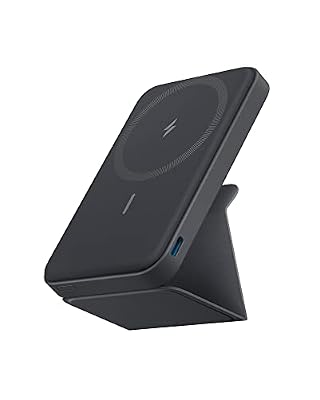
The Anker 622 MagGo takes the third route: no plug and no loose cable, because it snaps magnetically to the back of a MagSafe-compatible iPhone, meaning iPhone 12 and later, and charges wirelessly. It is a 5,000mAh pack in a shell about half an inch thick, and its party trick is a foldable stand built into the back, so the phone props itself up for video calls, FaceTime, or watching something while it charges. A USB-C port on the side handles recharging the pack and offers a wired option when you want one.
Wireless charging through a magnetic pack is slower than a cable, and Anker’s listing positions this model around convenience rather than speed, so think of it as a top-up that rides on the phone through the afternoon rather than a rapid refill. The magnetic format also means case choice matters: a MagSafe-compatible case keeps the snap secure, while a thick non-magnetic case weakens both the hold and the charging alignment. Within those limits, it is the most effortless carry here, because the pack and phone travel as one object.
Choose the 622 if you value the snap-on convenience and the stand, own an iPhone 12 or later, and want a top-up that never involves a cable at all.
How to Choose Between Them
Start with your connector. If your iPhone charges by Lightning, the plug-in Nano in this version is not for you, and the choice narrows to the cabled INIU or the magnetic Anker 622. If your iPhone is a USB-C model, all three are open to you.
Then decide what a bad day looks like. If the problem is the last two hours of a long day, a 5,000mAh pack solves it at the lowest weight, and the only remaining question is whether you prefer the Nano’s plug-in simplicity or the 622’s magnetic stand. If the problem is a full day of maps, photos, hotspot use, and no wall socket, the 10,000mAh INIU is the one that finishes the day with you, at a still-modest weight.
Finally, think about where the pack will live. A pack that lives in a pocket should be the Nano. A pack that lives on the phone itself should be the 622. A pack that lives in a bag and serves everything should be the INIU. Matching the pack to its home is what keeps it carried, and a carried pack is the only kind that works.
Caring for a Small Battery
Lightweight packs ask for the same simple care as any lithium battery. Avoid leaving one in a hot car, where heat ages cells quickly. Recharge it after use rather than storing it empty for months, and top it up before a trip even if it sat in a drawer, since packs slowly self-discharge. If a pack will be stored for a long stretch, keeping it partly charged is kinder to the cells than storing it completely full or completely empty. None of this is complicated, but it is the difference between a pack that is ready on the one day you need it and a light, slim, useless rectangle.
Lightweight Packs and Travel
These small packs are also the easiest batteries to travel with. Airline rules generally require spare lithium batteries and power banks to ride in cabin baggage rather than checked luggage, and packs in the sizes covered here sit far below the capacity ceiling airlines apply to carry-on batteries, so none of the three needs special approval or a second thought at the gate. Their low weight matters again here: a travel kit built around a phone, a pack this size, and one short cable covers a long-haul day of delays and connections without adding meaningful bulk to a personal item. If you fly often, that combination of cabin-legal capacity and pocket weight is exactly why a lightweight pack, rather than a larger travel brick, earns its permanent place in the bag.
Verdict
The best lightweight portable iPhone battery depends on the shape of your day. The Anker Nano is the lightest and simplest for USB-C iPhone owners who want a cable-free top-up. The INIU P41 is the choice when lightweight still has to mean a full recharge, and it serves Lightning and USB-C owners alike. The Anker 622 MagGo is the effortless option, snapping on magnetically and standing the phone up while it charges. All three respect the point of the category: power you will genuinely carry, every day, without thinking about it.

Write Your Review
No reviews yet. Be the first to share your experience!