
Our Short List of 3
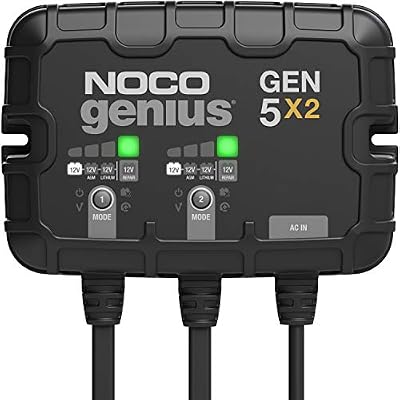
- Model: GEN5X2
- Banks: 2
- Total output: 10 amps (5 amps per bank)
- System voltage: 12V

- Model: GENPRO10X2
- Banks: 2
- Total output: 20 amps (10 amps per bank)
- System voltage: 12V

- Model: 44012 (ProSportHD 12, Generation 4)
- Banks: 2
- Total output: 12 amps, shared between banks (Distributed On-Demand)
- System voltage: 12V / 24V
All 4 Picks at a Glance
| Product | Specs | Action |
|---|---|---|
| NOCO GEN5X2 Genius 2-Bank Onboard Charger |
| Check price on Amazon |
| NOCO GENPRO10X2 2-Bank Onboard Charger |
| Check price on Amazon |
| ProMariner ProSportHD 12 (44012) |
| Check price on Amazon |
 Guest ChargePro 8A (2707A) |
| Check price on Amazon |
A two-battery boat lives or dies by its charger. One bank usually cranks the engine while the second runs the trolling motor, the fish finder, the livewell pump and the lights, and when both banks are AGM, the charger has to respect what absorbed glass mat batteries actually need: a proper absorption stage at the voltage the maker publishes, a float stage that holds them without cooking them, and temperature awareness so a hot engine compartment does not skew the charge. A 2 bank onboard charger handles all of that permanently. It bolts down in the battery compartment, stays wired to both banks, and goes to work the moment the boat connects to shore power, so every trip starts with two full batteries instead of one strong bank and one quiet question mark.
The four chargers in this guide are all true 2-bank onboard units with published AGM support. Two come from NOCO, a brand built around selectable charging modes, and they differ mainly in output: 5 amps per bank on the smaller unit, 10 amps per bank on the larger one. The ProMariner entry takes a different approach, sharing its 12 amps between the banks on demand rather than fixing an amount per side. The Guest entry is the gentle option, a low-output maintainer-style charger for flooded and AGM banks that stay on shore power for long stretches. Between them they cover most two-battery setups, from a small fishing boat with a pair of group 24 AGMs to a heavier rig running large group 31 banks that come home deeply discharged.
One note before the picks: AGM support is not a marketing label here. Each charger below publishes AGM in its supported battery types or offers a dedicated AGM mode the user selects per bank, and the buying guide after the product sections explains why that distinction matters, how to size amps per bank against battery capacity, and what waterproof sealing is worth on a unit that lives inches from bilge water.
Disclosure: As an Amazon Associate, we earn from qualifying purchases made through links on this page, at no extra cost to you.
NOCO GEN5X2 Genius 2-Bank Onboard Charger
- Model: GEN5X2
- Banks: 2
- Total output: 10 amps (5 amps per bank)
- System voltage: 12V
The GEN5X2 is the compact member of NOCO’s Genius onboard line, delivering 10 amps in total split evenly as 5 amps per bank. Each bank is controlled independently and carries its own mode selection, so the starting bank and the house bank can run different profiles at the same time. The published modes are 12V for standard flooded batteries, 12V AGM for absorbed glass mat banks, 12V Lithium for LiFePO4, and a 12V Repair mode intended for older or deeply discharged lead-acid batteries. For a boat running two AGM banks, both sides simply sit on the AGM mode and the charger handles bulk, absorption and maintenance automatically from there.
The unit is fully sealed and published as waterproof to IP68, which suits the reality of a battery compartment that sees spray, washdowns and damp air all season. An integrated thermal sensor feeds temperature compensation into the charge, adjusting output as compartment temperatures swing between a cold morning launch and a sun-baked afternoon at the dock. That matters for AGM banks in particular, because their makers publish charge voltages against a reference temperature and expect the charger to correct away from it. NOCO backs the GEN5X2 with a 3-year warranty, and the fully automatic design means it can stay connected to shore power indefinitely, holding both banks at full without overcharging them.
NOCO GENPRO10X2 2-Bank Onboard Charger
- Model: GENPRO10X2
- Banks: 2
- Total output: 20 amps (10 amps per bank)
- System voltage: 12V
The GENPRO10X2 doubles the GEN5X2’s output, putting 10 amps into each bank for 20 amps in total, and it is the pick here for larger AGM banks that come back to the dock deeply run down. A pair of group 31 AGMs feeding a 24-volt trolling motor through a series connection, or two big house banks on a center console, will take noticeably less time to recover on 10 amps per bank than on 5, and the per-bank mode selection works the same way: 12V, 12V AGM, 12V Lithium and 12V Repair, chosen independently for each side. Boats that mix chemistries, an AGM starting battery beside a lithium house bank, can charge both correctly from the one unit.
NOCO adds a Force Mode on this model, which allows charging to begin on a battery that has fallen to an extremely low voltage, a situation where many automatic chargers refuse to start at all. The housing is fully sealed to IP68, temperature compensation is built in, and the published cable length is 72 inches per side, which gives more freedom in where the unit mounts relative to the batteries. Like its smaller sibling it carries a 3-year warranty and is designed to remain connected and maintain the banks between trips. For AGM owners the headline remains the dedicated AGM mode per bank combined with the higher output, since a deeply discharged AGM bank accepts charge well when the charger can actually supply the current.
ProMariner ProSportHD 12 (44012)
- Model: 44012 (ProSportHD 12, Generation 4)
- Banks: 2
- Total output: 12 amps, shared between banks (Distributed On-Demand)
- System voltage: 12V / 24V
The ProSportHD 12 takes a different engineering route from the NOCO units. Instead of fixing an output figure per bank, its 12 amps are shared between the two banks through what ProMariner calls Distributed On-Demand technology: the bank that needs current gets the larger share, and when one bank reaches full, the other can draw on more of the total. On a real boat that is often how charging actually goes, since the starting battery usually returns nearly full while the trolling or house bank comes home empty, so a shared pool can put the amps where the work is rather than stranding half the output on a bank that needs almost nothing.
The charger covers 12-volt and 24-volt systems and publishes support for flooded, AGM, HP AGM and gel batteries in group 24 through 31 sizes, with three digitally selectable performance charge profiles and five-stage charging. The Generation 4 housing uses a tri-surface heatsink design for cooling and is built as a waterproof marine unit with a charge completion monitor and per-bank full and fault indicators on the face, so a glance at the charger tells you which bank is still working and which is done. ProMariner publishes a 3-year warranty for the model. For AGM banks there is no mode dial to set in the NOCO sense; the selectable profiles and the published AGM support do the job, which makes this a set-and-forget option for owners who would rather not manage per-bank settings.
Guest ChargePro 8A (2707A)
- Model: 2707A (ChargePro 8A)
- Banks: 2
- Total output: 8 amps (4 amps per bank)
- System voltage: 12V / 24V
The Guest ChargePro 8A is the mild-mannered entry in this group, and for the right boat that is exactly the point. It delivers 8 amps in total, 4 amps to each of its two banks, through a fully automatic five-stage program, and it is published for 12-volt flooded and AGM lead-acid batteries only, with no lithium support. Boats that live on shore power, a marina slip with the charger connected for weeks at a time, often need maintenance more than speed, and a gentle 4 amps per bank keeps two healthy AGM banks topped up without pushing current they do not need. It also suits smaller batteries, where a high-output charger is simply more than the bank calls for.
The housing carries an IP67 waterproof figure and a shock resistant build, with a published protection set that includes reverse polarity, over-current, over-voltage and over-temperature protection plus ignition protection, the last of which matters for a charger mounted in a compartment anywhere near fuel vapors. The AC cord runs 6 feet, the unit works on 12-volt and 24-volt systems, and it weighs 4.5 pounds, light enough for tight compartments on smaller boats. Guest has built marine chargers for decades, and the ChargePro line follows the traditional onboard pattern: wire it in once, plug in at the dock, and let the five-stage cycle analyze, condition, bulk charge, absorb and then maintain each bank on its own schedule.
How to Choose a 2 Bank Onboard Charger for AGM Batteries
Start with the AGM profile, not the amp figure. Absorbed glass mat batteries are sealed, and unlike a flooded battery they cannot be topped up with water to replace what overcharging boils away. Their makers publish an absorption voltage window, commonly around 14.4 to 14.8 volts at room temperature, and a float level below that. A charger with a dedicated AGM mode, like the NOCO units above, holds its program to those published AGM targets. A charger that lists AGM among its supported types, like the ProMariner and the Guest, applies a profile the maker has built for the chemistry. Either approach works; what you want to avoid is a charger that publishes no AGM support at all and runs a single flooded-only program, because repeated charging at the wrong absorption voltage shortens AGM life quietly, long before the battery actually fails.
Size amps per bank against bank capacity. A widely used rule of thumb puts healthy charging current at roughly 10 to 20 percent of a battery’s amp-hour capacity. A group 24 AGM of about 75 amp-hours sits comfortably on 5 to 10 amps, which covers every charger here. A pair of large group 31 banks near 100 amp-hours each will recover fastest on the GENPRO10X2’s 10 amps per bank. The Guest’s 4 amps per bank is a maintainer’s pace: fine for keeping healthy banks full and for gentle overnight recovery of modest batteries, slow for refilling a big bank that a trolling motor drained by evening. The ProSportHD 12 sits between the two ideas, since its shared 12 amps flow toward whichever bank is emptier.
Think about how the banks are wired. Two 12-volt banks in parallel, a starting battery and a house battery, are the simple case: one charger lead set per bank. A 24-volt trolling motor runs two 12-volt batteries in series, and a 2-bank charger handles that by connecting one bank output across each individual battery, charging them one at a time inside the series string; chargers that publish 12/24-volt system support, like the ProMariner and the Guest, are built with that arrangement in mind. Confirm your wiring against the charger manual before mounting anything, and keep each bank’s leads on their own battery rather than across the full string.
Waterproofing is a working spec, not a decoration. Onboard chargers live in compartments that get hosed out, splashed and left damp. An IP68 figure, as on both NOCO units, means the housing is sealed against continuous immersion under the maker’s stated conditions; IP67, as on the Guest, covers temporary immersion. Either is a genuine step above a splash-resistant portable unit with a fan and open vents, which has no place mounted permanently in a bilge-adjacent space. Ignition protection, published on the Guest, is the other compartment spec worth checking on gasoline boats.
Temperature compensation earns its place. Battery charge voltages are published against a reference temperature near 77 degrees Fahrenheit, and the correct absorption voltage falls as the battery gets hotter and rises as it gets colder. A charger with a thermal sensor adjusts automatically. In a compartment that bakes in afternoon sun or sits near freezing in early spring, that adjustment is the difference between the AGM bank getting the charge its maker specified and getting a close approximation of it.
Frequently Asked Questions
Can one 2-bank charger handle an AGM starting battery and a flooded house battery?
Yes, if the charger selects its profile per bank. The NOCO GEN5X2 and GENPRO10X2 let each bank run its own mode, so the AGM side sits on the AGM setting while the flooded side runs the standard 12V program. Chargers with a single shared profile should be matched to the more sensitive battery, and mixing chemistries on one profile is a compromise rather than an ideal.
How long will a 5-amp-per-bank charger take to refill a drained AGM bank?
Divide the amp-hours you used by the charger’s per-bank output, then add time for the absorption stage, which tapers current as the battery fills. A 75 amp-hour bank discharged by half needs roughly 38 amp-hours back; at 5 amps that is about seven to eight hours of bulk charging plus a slower absorption tail, so an overnight connection is the realistic plan. Doubling to 10 amps per bank cuts the bulk portion close to half.
Can a 2-bank onboard charger charge the two batteries of a 24-volt trolling motor setup?
Yes. The two batteries in a series pair are still individual 12-volt batteries, and each bank of the charger connects across one of them. The ProMariner ProSportHD 12 and the Guest ChargePro 8A both publish 12/24-volt system support for this arrangement. Follow the wiring diagram in the charger’s manual, since connecting a bank across the whole 24-volt string instead of across a single battery is the classic installation mistake.
Should an onboard charger stay plugged in all winter?
That is what automatic onboard chargers are designed for. Once the banks reach full, the chargers here drop into a maintenance or float stage that holds the batteries at a safe standing voltage, which suits AGM banks in storage because it offsets self-discharge without continuous full-voltage charging. Check the boat periodically, confirm the charger shows its maintain indication on both banks, and make sure the compartment stays dry and ventilated.
Conclusion
For most two-bank AGM setups, the NOCO GEN5X2 is the balanced choice: a dedicated AGM mode on each bank, honest 5-amp-per-bank output, IP68 sealing and temperature compensation in a unit that can live on shore power full time. Boats with large banks that come home empty should step up to the GENPRO10X2 and its 10 amps per bank. The ProMariner ProSportHD 12 suits owners who like the shared-output idea and want flooded, AGM and gel support across 12- and 24-volt systems without managing mode settings, while the Guest ChargePro 8A is the gentle maintainer for smaller flooded and AGM banks that sit connected for long stretches. Match the charger’s AGM support and per-bank output to your banks, wire each bank to its own battery, and the pair will be full every time the boat leaves the dock.


Write Your Review
No reviews yet. Be the first to share your experience!