
A car battery charger is one of those tools that earns its keep quietly. Most of the year it sits on a shelf, and then one cold morning, or one long stretch of storage, it becomes the difference between a car that cranks and a car that does nothing at all. A good charger does more than push current into a flat battery. It reads the battery, chooses a safe charge curve, and then holds the battery at full charge without cooking it. A crude charger does none of that, and a battery left on one for weeks can come back worse than it went in.


This guide covers three car battery chargers that are all the same type of product: mains-powered smart chargers and maintainers for 12-volt car batteries, with one of them also handling 6-volt batteries. Every pick below is a charger and maintainer in one box, not a jump pack, not a solar panel, and not a set of jumper cables. A jump pack is built to crank an engine for a few seconds, while a charger is built to refill a battery over hours and then keep it healthy for months, so this guide stays inside one type from the first pick to the last.
No unit was bought or installed for this guide. Every specification below comes from the maker specification set or from listing data, and where a figure is not published, this guide says so instead of guessing. The three picks differ mainly in output current, in the battery chemistries they support, and in how much they can do for a neglected battery. A small maintainer suits a stored car with a healthy battery, a five-amp smart charger suits a battery that needs real refilling, and an eight-step charger with a reconditioning stage suits a battery that has sat flat for a long time.
Before ordering, confirm the listing shows a live buy box and a new unit, and confirm the charger fits the battery in the car: battery voltage, battery capacity in amp-hours, and battery chemistry.
What to Look For
Output current is the first figure to check, and it should be matched to the battery, not to the vehicle. A charger is sized to the battery in amp-hours, and the common rule of thumb is that the charge current should sit near one tenth of the battery capacity. A typical car battery holds around 45 to 80 amp-hours, so a charger between 4 and 8 amps refills it in a sensible time. A 1.25-amp maintainer will still get there, but a large flat battery can take a full day or more, which is fine for storage but slow for a battery that needs to be back in service by morning.
Voltage comes next. Nearly every car on the road uses a 12-volt battery, so a 12-volt charger covers the whole job. A 6-volt mode is a bonus for owners of older cars, motorcycles, and garden equipment, and only one pick below carries it. Check the battery label before ordering, because a 12-volt charger connected to a 6-volt battery will ruin a good battery.
Chemistry decides whether a charger is safe for the battery at all. Most car batteries are flooded lead-acid, and many newer cars use AGM, which needs a slightly higher charge voltage. Gel batteries need a lower one. Lithium iron phosphate batteries, used in some performance and lightweight applications, need a dedicated lithium mode and a different charge curve entirely. A charger that lists only lead-acid chemistries must never be connected to a lithium battery, and a charger with a lithium mode must be switched into that mode before charging begins.
Charge steps and modes are where smart chargers earn their name. A basic charger has bulk, absorption, and float stages: bulk pushes current in, absorption tops the battery off gently, and float holds it at full charge without overcharging. Better chargers add desulfation, which breaks down the sulfate crystals that build up on plates in a battery that has sat flat, and a repair or reconditioning stage, which uses a controlled higher voltage to recover a neglected battery. A force mode lets the charger begin charging a battery that has dropped so low that a normal charger refuses to see it at all. None of these modes is magic: a battery with a shorted cell or a cracked case cannot be recovered by any mode.
Temperature compensation matters more than most buyers expect. A battery charges at a different voltage in cold weather than in warm weather, and a charger without temperature compensation can overcharge a battery in summer and undercharge it in winter. All three picks below carry temperature compensation, and that is one of the reasons they are in this guide.
Safety features are the next check. Spark-proof clamps, reverse polarity protection, and short-circuit protection are the three that matter, and all three picks carry them. Reverse polarity protection is the one that saves a battery from a tired owner connecting clamps in the dark.
Connectors and cables decide how the charger fits into daily use. Alligator clamps are the standard for occasional use. Eyelet terminals, fitted permanently to the battery posts, are better for a car that sits in storage, because the charger can be plugged in and unplugged in seconds without opening the hood and fumbling with clamps. Check the cable length too: a short DC cable means the charger must sit close to the battery, which is not always possible in a crowded garage.
Housing and weatherproofing decide where the charger can live. An IP65 housing keeps out dust and water jets, which is enough for a damp garage. A splash-proof case is enough for a dry shelf. None of these chargers is meant to be left out in rain, and none of them should be used in standing water.
Warranty is the last check, and it is a useful signal of how much the maker trusts the unit. The three picks below carry warranties from three years to ten years. A long warranty does not make a slow charger fast, but it does make a simple charger a safer long-term buy.
Minimum voltage to begin charging is a small figure with a large effect. A charger that needs the battery to hold at least 3 volts will refuse a battery that has dropped below that, while a charger with a force mode can begin from as low as 1 volt. If the battery in the car is deeply discharged, this one figure decides whether the charger can even begin the job.
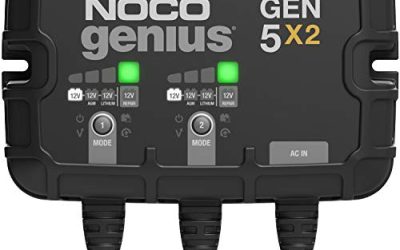
NOCO GENIUS5 5A Smart Battery Charger and Maintainer
The NOCO GENIUS5 is the strongest pick in this guide, because it covers the widest range of batteries with the most useful set of modes. It is a 5-amp smart charger and maintainer for 6-volt and 12-volt batteries, and it handles up to 120 amp-hours, which covers nearly every car battery on the road and most light truck batteries as well. Five amps is enough to refill a flat car battery in hours rather than days, and it is also gentle enough to leave connected as a maintainer through storage.
The chemistry list is the widest published in this guide. The maker manual lists wet, gel, maintenance-free, calcium, enhanced flooded, AGM, and lithium, and the unit carries seven modes, including AGM, lithium, repair, and force. The force mode is the one that sets it apart: it lets the charger begin charging a battery that has dropped to 1 volt, where most chargers would refuse to see the battery at all. The repair mode works on a neglected AGM battery, and the desulfator breaks down the sulfate that builds up in a battery that has sat flat. Temperature compensation is built in, and the housing carries an IP65 seal, which keeps out dust and water jets in a damp garage. The published working range runs from minus 4 degrees Fahrenheit to 104 degrees Fahrenheit, and back current drain is stated as under 0.5 milliamps, so a battery left connected through storage loses almost nothing to the charger itself.
In the box are a 72-inch AC cable, an 80-inch DC cable with clamps, eyelet terminals, and a mounting bracket. The eyelets matter for storage use: fit them once to the battery posts, and the charger can be plugged in and unplugged in seconds. The unit weighs 1.59 pounds and measures 3.43 by 4.61 by 7.95 inches. The warranty is a 3-year limited warranty.
Two honest flags belong here. First, the maker manual does not publish a stage count or a float voltage, so the charge algorithm itself cannot be checked against a published figure. Second, the GENIUS5 is the charger for a car battery rather than a small powersport battery: NOCO states only a 120 amp-hour ceiling, with no stated minimum, so a very small battery is better served by a smaller charger with a published lower bound.
CTEK MXS 5.0 Fully Automatic 4.3 Amp Battery Charger and Maintainer
The CTEK MXS 5.0 is the recovery charger in this guide. It is a fully automatic eight-step charger and maintainer for 12-volt lead-acid and AGM batteries, and the eight steps run from desulfation through bulk charge to a patented float and pulse maintenance that can stay connected for months. The reconditioning stage is the reason to buy it: a dedicated stage that works on a battery that has sat flat and that other chargers give up on.
One figure needs care. The North American version delivers 4.3 amps, not 5, so do not call it a 5-amp charger. The model number is 40-206, and the 4.3-amp output is the figure on the North American listing. At 4.3 amps it still refills a car battery in a sensible time, and the eight steps make better use of that current than a simpler charger does. Battery capacity for charging runs from 1.2 to 110 amp-hours, and maintenance covers up to 160 amp-hours. Chemistries are 12-volt lead-acid in wet, maintenance-free, calcium, AGM, enhanced flooded, and gel forms, with a dedicated AGM mode and a reconditioning stage. Charge voltages are 14.4 volts in normal mode, 14.7 volts in cold and AGM mode, and 15.8 volts in recondition mode. Temperature compensation is built in, and the case is splash, dust, spark, and shock proof. The minimum battery voltage to begin charging is 2.0 volts. In the box are clamps, eyelets, and a storage bag. The warranty is a 5-year limited warranty, per the manual.
Two honest flags belong here. First, the standard model carries no lithium mode, so a lithium iron phosphate battery needs a different charger. Second, owner reports widely note that the push-button mode selector microswitch can fail or become unresponsive after two to four years of regular use, and the sonically welded enclosure makes do-it-yourself repair difficult. For an AGM battery that needs reconditioning, and for a car that sits for weeks at a time, this is the pick.
Battery Tender Plus 12V 1.25 Amp Battery Charger and Maintainer
The Battery Tender Plus is the simple maintainer in this guide, and it is the pick for a stored car with a healthy battery. It is a 12-volt, 1.25-amp charger and maintainer from Deltran, part number 021-0128, and it runs a named four-step ISM program: Initialization, Bulk Charge, Absorption, and Float Maintenance. The program is published in full, stage by stage, which is more than most maintainers disclose, and the float stage holds the battery at storage voltage without overcharging it.
Supported battery capacity runs from 14 to 80 amp-hours at 12 volts, which covers most car batteries and larger motorcycle and ATV batteries. Chemistries are flooded, AGM, gel, and sealed maintenance-free lead-acid, with no lithium chemistry named, so a lithium battery must never be connected to it. A two-color LED shows the charging state, and the unit carries reverse polarity detection, shown by flashing red and green lights, plus temperature compensation. The warranty is a 10-year limited warranty, the longest in this guide.
Two honest flags belong here. First, 1.25 amps is slow for a large flat battery: a deeply discharged car battery can take a full day or more to refill, so this is a maintainer first and a recovery charger second. Second, the battery must hold at least 3 volts for the charger to begin, so a battery that has dropped below that needs a charger with a force mode instead. The gap in the published figures is environmental: no working temperature range and no weatherproof figure appear on the maker page, so a cold or damp garage is a guess rather than a published fact. For a stored 14 to 80 amp-hour lead-acid battery, in a car, a larger motorcycle, or an ATV, where the maintenance sequence matters more than raw speed, this is the pick.
Comparison Table
| Product | Output | Voltages | Battery size | Chemistries | Warranty |
|---|---|---|---|---|---|
| NOCO GENIUS5 | 5A | 6V and 12V | Up to 120Ah | Wet, gel, AGM, calcium, lithium | 3-year limited |
| CTEK MXS 5.0 | 4.3A | 12V | 1.2 to 110Ah charging, up to 160Ah maintenance | Lead-acid and AGM | 5-year limited |
| Battery Tender Plus | 1.25A | 12V | 14 to 80Ah | Flooded, AGM, gel, sealed lead-acid | 10-year limited |
Frequently Asked Questions
How long does a car battery charger take to refill a flat battery?
The time depends on the battery size and the charger output. A 5-amp charger refills a typical 60 amp-hour car battery in roughly half a day from flat, while a 1.25-amp maintainer can take a full day or more on the same battery. A charger with a bulk stage moves quickly at first and then slows as the battery fills, so the last stretch always takes longer than the first. If the car must be back in service by morning, a 5-amp charger is the practical minimum.
Can one charger handle both a car battery and a motorcycle battery?
Yes, if the charger covers the battery size and chemistry of both. A 5-amp charger with a published range up to 120 amp-hours covers most car batteries, and the same charger can maintain a motorcycle battery if the maker states a low enough minimum or if the charger has a dedicated small-battery mode. The Battery Tender Plus covers 14 to 80 amp-hours, which suits a car and a larger motorcycle battery but not a very small one. Check the amp-hour figure on each battery label, and check the chemistry: a charger that lists only lead-acid must never be connected to a lithium battery.
What should I do if the charger refuses to charge a deeply discharged battery?
First check the battery voltage with a meter. Most smart chargers need the battery to hold a minimum voltage before they begin, and the three picks here differ: the Battery Tender Plus needs at least 3 volts, the CTEK MXS 5.0 needs 2.0 volts, and the NOCO GENIUS5 has a force mode that can begin from 1 volt. If the battery is below the charger minimum, use a charger with a force mode, or have the battery checked by a shop before charging. A battery with a shorted cell, a cracked case, or a swollen case should not be charged at all.
How to Choose
Begin with the three figures on the battery label: voltage, capacity in amp-hours, and chemistry. A 12-volt flooded or AGM car battery between 45 and 80 amp-hours is the common case, and all three picks cover it. A 6-volt battery narrows the choice to the NOCO GENIUS5. A lithium battery narrows it to the same pick, because it is the only one of the three with a lithium mode. A battery below 14 amp-hours narrows the choice toward the CTEK, which publishes a 1.2 amp-hour lower bound for charging.
Then decide what the charger must do. If the car sits in storage with a healthy battery, the Battery Tender Plus is the simple answer: a named four-step program, a 10-year warranty, and a float stage that can stay connected for months. If the battery needs real refilling after a flat episode, the NOCO GENIUS5 is the answer: five amps, the widest chemistry list, and a force mode for a battery that has dropped to 1 volt. If the battery has sat flat for a long time and needs recovery rather than routine maintenance, the CTEK MXS 5.0 is the answer: eight steps, a dedicated reconditioning stage, and a 5-year warranty.
Then check the practical details. Measure the distance from the outlet to the battery and confirm the cable length fits. Decide whether eyelets or a quick-disconnect harness would make storage charging easier, and fit them once if so. Finally, confirm the listing shows a live buy box and a new unit before ordering, and confirm the model number on the listing matches the model in this guide: GENIUS5, MXS 5.0 model 40-206, and Battery Tender Plus part number 021-0128.
Disclosure: As an Amazon Associate, we may earn a commission from qualifying purchases made through links in this article, at no additional cost to you.






Write Your Review
No reviews yet. Be the first to share your experience!