
Our Short List of 3
All 5 Picks at a Glance
| Product | Specs | Action |
|---|---|---|
 1. NOCO GENIUS10 — 10A Smart Charger for Larger Batteries | Check price on Amazon | |
 2. NOCO GENIUS5 — 5A All-Rounder for Most Cars | Check price on Amazon | |
 3. CTEK MXS 5.0 — 8-Step Charging with Recondition Mode | Check price on Amazon | |
 4. Battery Tender Plus — 1.25A Classic for Long-Term Storage | Check price on Amazon | |
 5. NOCO GENIUS1 — 1A Compact Maintainer for Small Batteries | Check price on Amazon |
A car battery rarely fails at a convenient moment. It fades quietly in a garage, loses charge during a cold snap, or drains while a vehicle sits unused for weeks, and the problem only becomes obvious on the morning the engine will not turn over. A smart car battery charger is the simplest defense against that scenario. Unlike the basic chargers of the past, which pushed a fixed current until someone remembered to unplug them, a modern smart charger reads the battery, adjusts its output through several charging stages, and settles into a low maintenance mode once the battery is full. That means it can stay connected for weeks or months without cooking the battery it is supposed to protect.
This guide is a second look at the category, focused on the chargers that suit everyday cars, stored vehicles, and mixed garage duty. It is based on manufacturer specifications and published listing details rather than practical use, and it explains how to match a charger to your battery before listing five well-documented options. As an Amazon Associate we earn from qualifying purchases.
What Makes a Battery Charger “Smart”
The word “smart” in this category refers to a microprocessor that supervises the entire charge cycle. A typical smart charger works through recognizable stages. It begins by checking the battery’s condition and voltage, then delivers a bulk charge that restores most of the capacity, then tapers into an absorption stage that tops the battery off gently, and finally drops into a float or maintenance mode that only replaces the charge the battery naturally loses while sitting. Because the charger monitors voltage throughout, it can stay connected indefinitely on a healthy battery without the overcharging risk that made old manual chargers a poor choice for storage.
Better models add features on top of that basic cycle. Temperature compensation adjusts the charging voltage based on ambient conditions, which matters because a battery in a freezing garage and a battery in a hot one do not accept charge in exactly the same way. Desulfation or repair modes use controlled pulses in an attempt to break down the sulfate crystals that build up on the plates of a neglected lead-acid battery, which is a common cause of lost capacity. Spark-proof clamps and reverse-polarity protection guard against the most common connection mistakes, and several chargers can now begin charging a battery that has fallen to a very low voltage, something older automatic chargers often refused to do.
How to Choose the Right Charger
Match the amperage to the job. Charging current, measured in amps, largely decides how quickly a charger can refill a depleted battery and how large a battery it can handle. A 1-amp unit is a maintainer: it is well suited to motorcycles, lawn equipment, and keeping an already healthy car battery topped up during storage, but it will take a very long time to recover a large, deeply discharged car battery. A charger in the 4- to 5-amp range is the practical middle ground for most passenger cars, able to recharge a drained battery overnight and maintain it afterward. A 10-amp charger is the choice for larger truck and SUV batteries, bigger deep-cycle batteries, or anyone who wants a flat battery usable again sooner rather than later.
Confirm the chemistries it supports. Most car batteries are flooded lead-acid, but AGM batteries are now common in vehicles with start-stop systems, and gel and deep-cycle batteries appear in RVs, boats, and backup setups. Lithium iron phosphate (LiFePO4) batteries need a dedicated lithium mode with a different charging profile, so a charger should never be connected to a lithium battery unless the manufacturer explicitly lists lithium support. Check the mode list on the charger against the label on your battery before ordering.
Decide how it will connect. Chargers in this guide ship with both clamps and eyelet terminals. Clamps are convenient for occasional use across several vehicles. Eyelets bolt onto the battery terminals semi-permanently and end in a quick-connect plug, which turns a stored car into a thirty-second job: open the hood or trunk, plug in the lead, and walk away. For a vehicle that sits all winter, the eyelet lead is usually the detail that determines whether the charger actually gets used.
Look at the low-voltage behavior. A battery that has sat discharged for months may read close to zero volts, and some automatic chargers will not start on a battery that low because they cannot detect it. Chargers that advertise charging from 1 volt, or a force mode that starts manually at zero volts, are more likely to recover a battery that other units would give up on. Recovery is never guaranteed, since a battery with internal damage cannot be saved by any charger, but the capability is worth having.
The Chargers in This Guide
1. NOCO GENIUS10 — 10A Smart Charger for Larger Batteries
The GENIUS10 is the highest-output charger in this guide and the natural pick for trucks, SUVs, and larger batteries. It delivers 10 amps to 6-volt and 12-volt batteries and is rated for batteries up to 230 amp-hours, covering lead-acid types including flooded, gel, AGM, and deep-cycle, plus 12-volt lithium iron phosphate batteries through a dedicated lithium mode. An integrated thermal sensor adjusts the charge to ambient temperature, and the unit includes a repair mode intended to address sulfation and acid stratification, along with a supply mode that lets it act as a power source. It can begin charging a battery as low as 1 volt, and its force mode allows a manual start on a battery reading down to zero volts. The box includes clamps and integrated eyelet terminals on an 80-inch DC cable, a mounting bracket, and a three-year warranty, according to the listing. For a single charger expected to handle everything from a daily driver to a stored RV battery, the GENIUS10 is the most capable option here.
View the NOCO GENIUS10 on Amazon
2. NOCO GENIUS5 — 5A All-Rounder for Most Cars
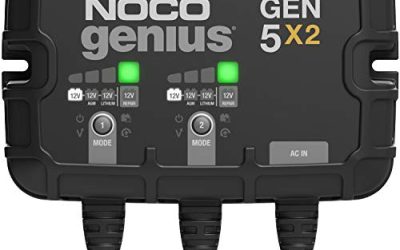
The GENIUS5 covers the same ground as its larger sibling at half the output, which for most passenger cars is entirely sufficient. It charges 6-volt and 12-volt batteries up to 120 amp-hours at 5 amps, with modes for flooded, gel, AGM, and maintenance-free lead-acid batteries and a lithium mode for LiFePO4 batteries. Like the GENIUS10, it has an integrated thermal sensor for temperature-compensated charging, a repair mode using slow pulse reconditioning technology, and the ability to charge batteries as low as 1 volt, with force mode available for batteries at zero volts. NOCO describes it as a fully automatic charger and maintainer that can remain connected continuously with zero overcharge, which makes it a sensible default for a car that is driven regularly but sits between trips. The package includes a 72-inch AC cable, an 80-inch DC cable with clamps and integrated eyelet terminals, a mounting bracket, and a three-year warranty. At roughly the size of a paperback book, it also stores easily in a trunk or toolbox.
View the NOCO GENIUS5 on Amazon
3. CTEK MXS 5.0 — 8-Step Charging with Recondition Mode
The CTEK MXS 5.0, model 40-206, takes a different approach built around a fully automatic 8-step charging program for 12-volt lead-acid batteries. It charges at up to 4.3 amps, is specified for charging batteries up to 110 amp-hours, and can maintain larger batteries up to 160 amp-hours. Its distinctive features include a reconditioning mode aimed at deeply discharged flooded batteries, built-in temperature sensing, and a mode suited to cold-weather and AGM charging. The step-by-step indicator display shows where the battery is in the program, which gives a clearer picture of progress than a single status light. The charger ships with both clamp and eyelet Comfort Connect leads, so it can move between vehicles or stay attached to one stored car, and it carries a five-year limited warranty per the listing details. The MXS 5.0 is aimed squarely at lead-acid batteries, so owners of lithium batteries should look at one of the NOCO models instead, but for conventional and AGM car batteries its methodical program and long warranty make it a strong candidate.
View the CTEK MXS 5.0 on Amazon
4. Battery Tender Plus — 1.25A Classic for Long-Term Storage
The Battery Tender Plus is one of the longest-established names in battery maintenance, and its design brief is narrow on purpose: keep a 12-volt lead-acid battery full and healthy during storage. Its 1.25-amp output runs a four-step program — initialization, bulk charge, absorption, and float — and automatically switches to float mode when the battery is full, maintaining proper voltage without overcharging. It is compatible with flooded, AGM, and gel lead-acid batteries, and the listing highlights spark-proof connections and reverse-polarity detection as standard safety behavior. Both a fused ring-terminal harness and alligator clips are included on a quick-disconnect lead, which is exactly the setup a stored car, motorcycle, or ATV needs. This is not the charger for rescuing a large flat battery quickly, and it does not offer a lithium mode, but as a connect-and-forget maintainer for a vehicle that sits for months, it remains a benchmark option. Deltran backs it with a long manufacturer warranty, listed as ten years for this model line.
View the Battery Tender Plus on Amazon
5. NOCO GENIUS1 — 1A Compact Maintainer for Small Batteries
At the small end of the range, the GENIUS1 is a 1-amp charger and maintainer that plugs directly into a wall outlet, with no separate AC cable. Despite its size, it covers both 6-volt and 12-volt batteries, with modes for standard lead-acid, AGM, and 12-volt lithium batteries, and NOCO rates it for charging batteries up to 30 amp-hours while maintaining batteries of any size once they are full. It includes temperature compensation through an integrated thermal sensor, can start charging at 1 volt, and offers force mode for batteries at zero volts. The package includes a 110-inch DC cable with clamps and integrated eyelet terminals and a three-year warranty. Its low output makes it a poor choice for reviving a big, flat truck battery, but for motorcycles, ATVs, lawn tractors, snowmobiles, and a stored car that starts the season with a healthy battery, it provides the essential smart-charging behavior in the smallest and simplest form in this guide.
View the NOCO GENIUS1 on Amazon
Which One Fits Your Situation
For most households with one or two ordinary cars, the GENIUS5 is the balanced choice: enough current to recover a drained battery overnight, support for both lead-acid and lithium batteries, and maintenance behavior that allows it to stay connected. Owners of trucks, large SUVs, or RV and deep-cycle batteries should step up to the GENIUS10, whose higher output and 230 amp-hour rating suit bigger batteries and shorter turnaround times. The CTEK MXS 5.0 appeals to owners of conventional and AGM batteries who value its 8-step program, recondition mode, and longer warranty. A vehicle going into long-term storage on a healthy battery is the Battery Tender Plus’s home territory, while the GENIUS1 serves small batteries and tight spaces where a compact wall-plug unit is the most practical form.
Whichever model is chosen, a few habits make any smart charger more effective. Connect the charger before storage rather than after the battery has already sat flat, since deep discharge shortens battery life even when the battery is later recovered. Keep terminals clean and connections snug, because a poor connection can confuse the charger’s voltage sensing. Finally, remember that a maintainer manages charge, not battery health miracles: a battery that repeatedly fails to hold a charge after a full charging cycle is telling its owner that replacement, not another accessory, is the next step.






Write Your Review
No reviews yet. Be the first to share your experience!