
As an Amazon Associate, we earn from qualifying purchases made through links on this page.
A church music team asks a lot from one keyboard. It has to sound like a piano at the start of a hymn, become a full backing band for a contemporary worship song, and then settle into quiet pads under prayer, all while a volunteer who may only rehearse once a week is playing it. A 61-key arranger fits that job because the footprint stays manageable on a platform or in a rehearsal room, while styles, registrations and microphone inputs do the heavy lifting that a plain piano cannot.
This guide compares five 61-key arrangers on the things that decide a Sunday morning: worship-friendly voices, accompaniment that follows the player, fast recall of saved songs, microphone support and clean connections to a PA system. Every model below is a current arranger with auto-accompaniment, and the differences between them are mostly about depth: how much arranging power, storage and live control each team actually needs.
What to look for
The shortlist in this guide was built from manufacturer-published specifications and feature lists, matched against the job described in the title. These are the criteria that matter most for this use case:
- Voices for worship: Look for convincing piano, electric piano, organ, strings and pad voices. A church keyboard lives on those sounds, and layering piano with strings or pads should be simple enough to do between songs.
- Styles that follow the player: Auto-accompaniment should respond to left-hand chords without forcing the tempo. Intros, variations, fills and endings matter because worship songs change dynamics often.
- Registrations and set lists: A service runs as a sequence of songs. Registration memory or a playlist function lets the player store tempo, voice and style for each song and move on with one press.
- Microphone and PA connections: A mic input with basic effects helps a singer-keyboardist, and proper line outputs connect cleanly to a church mixer without relying on headphone sockets.
- Playability for volunteers: Touch-sensitive keys, clear controls and a readable screen matter when several volunteers share one instrument and rehearsal time is short.
The picks in detail
Yamaha PSR-SX700 — Most complete workstation for a lead worship player

ASIN: B07W3PTMJQ · View on Amazon: https://www.amazon.com/dp/B07W3PTMJQ
The PSR-SX700 steps up to a touch screen, a Chord Looper and expansion memory. For players who build complete arrangements on the keyboard itself, the larger style library, vocal tools and on-board recording make it the most self-contained option in this group.
Key features and specifications:
- 61 keys with 128-note polyphony and a 7-inch colour touch screen
- More than 1,000 voices and more than 400 accompaniment styles
- Joystick controller, Chord Looper and Multi Pad audio link
- Microphone input with vocal harmony and vocoder options
- USB audio recording, expansion memory for additional content
- Registration memory and playlist functions for organised live sets
Who it fits: Readers whose priority is most complete workstation for a lead worship player will find this the most direct match in the group.
Limitations to note: No model leads on every criterion here, so check the criteria above against this specification set carefully. Other picks in this comparison cover the formats, libraries or recording systems outside this model’s focus.
Yamaha PSR-SX600 — Set lists and playlists for organised services

ASIN: B08F7HX4GK · View on Amazon: https://www.amazon.com/dp/B08F7HX4GK
The PSR-SX600 is the entry point into Yamaha’s SX workstation line. It adds a colour screen, a joystick for pitch and modulation, Multi Pads and a proper playlist system to the familiar PSR formula, so complete songs and set lists can be stored and recalled as single setups.
Key features and specifications:
- 61 touch-sensitive keys with 128-note polyphony
- 415 accompaniment styles with Smart Chord and full-band follow modes
- Colour display, joystick controller and assignable live controls
- Microphone and guitar input with vocal effects
- USB audio recording and playback, plus Multi Pad triggers
- Playlist and registration memory for saving complete setups
Who it fits: Readers whose priority is set lists and playlists for organised services will find this the most direct match in the group.
Limitations to note: No model leads on every criterion here, so check the criteria above against this specification set carefully. Other picks in this comparison cover the formats, libraries or recording systems outside this model’s focus.
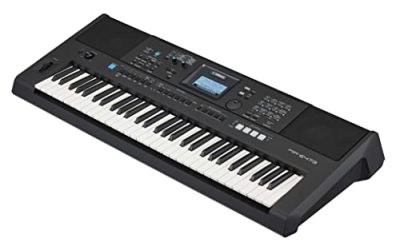
Yamaha PSR-E473 — Practical controls for small teams and rehearsals

ASIN: B09PRSNDGJ · View on Amazon: https://www.amazon.com/dp/B09PRSNDGJ
The PSR-E473 pairs a large Yamaha style library with practical controls that invite experimentation. Two assignable Live Control knobs, a Groove Creator section and sampling pads make it easy to move from a simple chord backing to a fuller arrangement without opening a computer program.
Key features and specifications:
- 61 touch-sensitive keys with 48-note polyphony
- 820 voices and 290 auto-accompaniment styles
- Live Control knobs, pitch bend wheel and Groove Creator for building patterns in real time
- Quick Sampling pads and a microphone input with vocal effects
- USB audio and MIDI connection, plus line outputs for a PA or interface
- Built-in lesson functions and a two-track song recorder
Who it fits: Readers whose priority is practical controls for small teams and rehearsals will find this the most direct match in the group.
Limitations to note: No model leads on every criterion here, so check the criteria above against this specification set carefully. Other picks in this comparison cover the formats, libraries or recording systems outside this model’s focus.
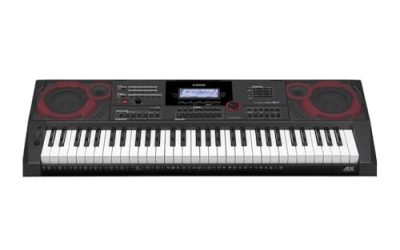
Casio CT-X5000 — Song recorder and strong speakers for choir support

ASIN: B07D7Y92KP · View on Amazon: https://www.amazon.com/dp/B07D7Y92KP
The CT-X5000 is built around Casio’s AiX sound source and a 17-track recorder, which makes it unusually capable as a stand-alone songwriting and arranging tool. Phrase pads, editable DSP effects and proper line outputs help it move between practice room, classroom and small stage.
Key features and specifications:
- 61 touch-response keys driven by the Casio AiX sound source
- 800 tones and 235 rhythm accompaniments
- 17-track MIDI recorder for capturing complete songs on board
- Phrase pads, pitch bend wheel and modulation button
- Microphone input, stereo line outputs and USB MIDI
- Twin speakers rated by Casio at 15 watts per side
Who it fits: Readers whose priority is song recorder and strong speakers for choir support will find this the most direct match in the group.
Limitations to note: No model leads on every criterion here, so check the criteria above against this specification set carefully. Other picks in this comparison cover the formats, libraries or recording systems outside this model’s focus.
Korg EK-50 L — Simplest operation for rotating volunteers

ASIN: B07H8RLGBP · View on Amazon: https://www.amazon.com/dp/B07H8RLGBP
The EK-50 L keeps operation deliberately simple: styles, sounds and Keyboard Sets sit behind clear buttons, and a dedicated grand piano key resets the instrument in one press. The L version adds a more powerful speaker system, which matters when the keyboard has to fill a room on its own.
Key features and specifications:
- 61 touch-sensitive keys with 64-note polyphony
- More than 700 sounds and more than 280 styles
- Keyboard Sets that store a complete sound combination under one button
- Grand piano button for instant return to a piano setup
- USB host and device ports, audio input and pedal input
- Larger speaker system than the standard EK-50, designed for room-filling sound
Who it fits: Readers whose priority is simplest operation for rotating volunteers will find this the most direct match in the group.
Limitations to note: No model leads on every criterion here, so check the criteria above against this specification set carefully. Other picks in this comparison cover the formats, libraries or recording systems outside this model’s focus.
Quick comparison
| Product | Format | Standout strength |
|---|---|---|
| Yamaha PSR-SX700 (ASIN B07W3PTMJQ) | 61 touch-sensitive keys | Most complete workstation for a lead worship player |
| Yamaha PSR-SX600 (ASIN B08F7HX4GK) | 61 touch-sensitive keys | Set lists and playlists for organised services |
| Yamaha PSR-E473 (ASIN B09PRSNDGJ) | 61 touch-sensitive keys | Practical controls for small teams and rehearsals |
| Casio CT-X5000 (ASIN B07D7Y92KP) | 61 touch-response keys | Song recorder and strong speakers for choir support |
| Korg EK-50 L (ASIN B07H8RLGBP) | 61 touch-sensitive keys | Simplest operation for rotating volunteers |
Buying notes for this use case
Think about where the keyboard will live. A fixed platform setup can justify the deeper SX models, because registrations can be built once and reused every week. A keyboard that travels between a hall, a youth room and an outdoor service needs lighter weight, built-in speakers that can work without a PA for small gatherings, and controls a stand-in player can understand in minutes. In both cases, budget a session after purchase to build registrations for the team’s ten most-used songs; that preparation is what turns an arranger from a home keyboard into a worship instrument.
Frequently asked questions
Can one keyboard cover a whole service without a band?
Yes, within limits. A style-based arranger can supply drums, bass and chord backing that follows the left hand, so one player can support congregational singing. It will not replace the feel of a full live band, but it keeps tempo, harmony and dynamics together when volunteers are few.
Is a microphone input worth having for church use?
It helps when the keyboard player also leads singing. A mic input with reverb lets one person sing and play through the same amplifier or PA input, which simplifies small services, rehearsals and prayer meetings.
How should a church team store settings for each service?
Save one registration or playlist entry per song with its tempo, style and voices. Build the list in service order during rehearsal, then step through it on the day instead of searching menus between songs.
Do we need weighted keys for worship playing?
Not necessarily. Most worship keyboard parts are piano, organ, pads and strings played with accompaniment, and touch-sensitive synth-action keys handle that well and keep the instrument light enough to move between rooms.
Conclusion
For most church teams, the Yamaha PSR-SX600 hits the balance of set-list tools, microphone support and manageable size, while the PSR-SX700 is the step up for a lead player who arranges on the keyboard itself. Teams with rotating volunteers should look closely at the Korg EK-50 L for its one-press simplicity, and the PSR-E473 remains a strong rehearsal and youth-room option.
Write Your Review
No reviews yet. Be the first to share your experience!