
As an Amazon Associate we earn from qualifying purchases.
Disclosure: This article contains affiliate links. If you buy through them, we may earn a commission at no extra cost to you.

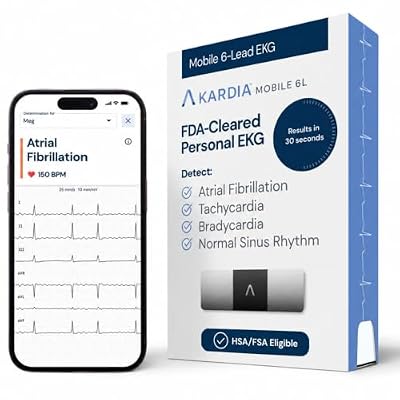
A personal EKG monitor for iPhone use solves a very specific problem: heart symptoms rarely happen on schedule in a doctor’s office. A flutter in the kitchen, a racing pulse on a walk, a skipped-beat feeling at night — a small dedicated recorder lets you capture a real electrocardiogram trace in about thirty seconds, while the sensation is still happening, and keep that trace in an iPhone app where it can be reviewed, exported, and shared with a clinician later.
Every pick in this guide is a dedicated personal ECG/EKG recorder that pairs with a real iPhone app. That scope is deliberate. These are not blood-pressure cuffs, not fingertip pulse oximeters, and not smartwatches with an incidental ECG feature. Each device below exists to record an ECG, and each one sends that recording to an iPhone app — Kardia, EMAY ECG, or ViHealth — for storage and sharing.
The five picks split into two families. The AliveCor models are flat electrode pads with no screen: your iPhone is the display, recorder, and filing cabinet. The EMAY and Wellue models carry their own screens and memory, so they can record alone and sync to the iPhone afterwards.
One caution applies to the whole category. Personal EKG monitors are screening and recording tools, not diagnoses. Several are not recommended for people with pacemakers or implanted defibrillators, and none can rule out a heart attack. With chest pain or severe symptoms, seek emergency care first and record a trace later.
1. AliveCor KardiaMobile 1-Lead EKG Monitor
The original KardiaMobile is the simplest expression of the phone-based EKG idea. It is a slim pad with two metal electrodes on top and nothing else — no screen, no buttons, no charging port. You open the Kardia app on your iPhone, rest two fingers on the electrodes, and the device captures a single-lead (Lead I) ECG in thirty seconds, sending the trace to the phone over its wireless connection.
Specs
- :
- ASIN: B01A4W8AUK
- Brand: AliveCor
- Model: KardiaMobile (AC-009)
- Leads: Single-lead (Lead I)
- Recording time: 30 seconds
- iPhone app: Kardia by AliveCor
- Connection: Wireless link to the phone, no cables or gels
- Power: Replaceable coin-cell battery
Because there is no display, everything happens in the Kardia app. The app stores your recordings, shows an instant rhythm determination for the classifications the device is cleared to detect — including atrial fibrillation, bradycardia, tachycardia, and normal sinus rhythm — and lets you attach notes and symptoms to a trace before exporting it as a file for your doctor. Optional paid membership tiers in the app add extra determinations and review services, but basic recording and storage work without committing to anything extra.
The hardware’s appeal is size and readiness. The pad is thin enough to ride in a wallet-style phone case or a small pocket, it wakes instantly when your fingers touch it, and the coin-cell battery lasts for months of occasional checks, so it is never sitting dead when a symptom appears. There is nothing to charge the night before a trip.
This is the right pick for someone who wants the least possible friction: a first personal EKG, a quick yes-or-no rhythm check when palpitations strike, and a tidy app library of traces to bring to appointments. If you already know you want the extra detail of a six-lead recording, the next pick covers that — but for straightforward spot checks, the single-lead original remains the easiest device in this guide to actually have with you.
2. AliveCor KardiaMobile 6L Personal EKG Monitor
The KardiaMobile 6L keeps the same pad format and the same Kardia app, but adds a third electrode on its underside. Rest your thumbs on the two top electrodes for a single-lead reading as usual — or place the bottom electrode against the skin of your left knee or ankle, and the same thirty-second session produces a six-lead ECG covering leads I, II, III, aVR, aVL, and aVF.
Specs
- :
- ASIN: B07RQW6SD5
- Brand: AliveCor
- Model: KardiaMobile 6L
- Leads: Six-lead (I, II, III, aVR, aVL, aVF) plus single-lead mode
- Recording time: 30 seconds
- iPhone app: Kardia by AliveCor
- Connection: Bluetooth to the phone
- Power: CR2016 coin-cell battery
- Weight: About 24 grams
Six leads give a clinician more viewing angles on the same heartbeat than a single lead can, which is why this model is often the one people graduate to when a cardiologist wants richer traces between visits, or when single-lead results keep coming back inconclusive. The recording routine barely changes — same app, same half-minute, no wires, patches, or gels — and the device still detects atrial fibrillation, bradycardia, tachycardia, and normal sinus rhythm, with additional determinations available through the optional KardiaCare membership in the app.
Physically it is only slightly larger than the single-lead pad and still genuinely pocketable. AliveCor notes the 6L is not tested or recommended for use with pacemakers and ICDs, and, like its sibling, it does not check for heart attack.
Choose the 6L if the person reading your traces wants maximum detail from a home device, or if you are recording frequently enough that the extra leads justify a bigger pad. Choose the original KardiaMobile instead if ultimate slimness matters more than lead count. Either way, your recordings live in the same Kardia library, so switching between them later is painless.
3. EMAY 6L Portable ECG Monitor

The EMAY 6L takes the opposite design bet from AliveCor: instead of outsourcing everything to the phone, it is a self-contained handheld with a 2.4-inch color screen, onboard memory, and a rechargeable battery. Hold it in both hands and it records ECG across six channels; the trace and heart rate appear on its own display immediately, with no phone required at the moment of recording.
Specs
- :
- ASIN: B0C88W44M2
- Brand: EMAY
- Model: EMG-6L
- Leads: Six channels
- Recording time: 30-second recordings, stored on device
- iPhone app: EMAY ECG
- Connection: Bluetooth to smartphone, USB to computer
- Display: 2.4-inch built-in screen
- Power: Rechargeable lithium battery
- Weight: About 85 grams
The iPhone side of the EMAY 6L runs through the EMAY ECG app, which handles case review, measurement, and sharing, while USB connection to a Windows or Mac computer offers a second, larger-screen workflow. EMAY emphasizes that no subscription is required to use the device or its software — what you record is yours to review and export without an ongoing plan, which will appeal to anyone wary of membership-based health gadgets.
The built-in screen changes who this device suits. A family member who is not comfortable running everything through a phone can still take a reading and see the result on the spot, then hand the device to someone else to sync. The trade-off is bulk: at roughly 85 grams with a phone-like footprint, it is a nightstand or travel-bag device rather than something that disappears into a pocket.
Pick the EMAY 6L if you want six-channel recording plus a standalone screen and a no-subscription promise. Pick a KardiaMobile if the device must live on your person. As with the other handhelds here, EMAY does not recommend it for people with implanted pacemakers, and it is a home monitoring aid rather than a substitute for a clinical ECG.
4. EMAY Portable ECG Monitor
EMAY’s original Portable ECG Monitor is the single-lead member of the family: a compact handheld that records Lead I ECG signals and heart rate, shows the reading on its own small display, and syncs everything to your phone or computer when you are ready. It covers the same basic job as the EMAY 6L — a thirty-second trace at the moment symptoms appear — in a lighter, simpler package.
Specs
- :
- ASIN: B07DXHJYBX
- Brand: EMAY
- Model: Portable ECG Monitor (EMG-20)
- Leads: Single-lead (Lead I)
- Recording time: 30 seconds
- iPhone app: EMAY ECG (EMAY Portable ECG Monitor app)
- Connection: Bluetooth to smartphone, USB to computer
- Display: Built-in screen for real-time waveform and heart rate
- Power: Rechargeable lithium battery
Setup follows EMAY’s standard pattern: install the EMAY app from the App Store, switch on Bluetooth, bind the device in the app, and recordings sync over for review, storage, and PDF-style report sharing. The PC software route mirrors the same library on a bigger screen. Because the device stores readings internally, you can take several traces away from your iPhone and let them upload in a batch later — useful on walks, flights, and hospital waiting rooms alike.
Compared with its six-channel sibling, you give up lead coverage and screen size, and in return get a smaller body and a simpler routine. Compared with the KardiaMobile pad, you give up pocket invisibility and gain a screen that works with no phone present at all.
This is the sensible middle pick for home users who want an uncomplicated Lead I recorder with both phone and computer access, no subscription, and a display of its own. If your clinician has asked for multi-lead traces specifically, step up to the EMAY 6L or the KardiaMobile 6L instead.
5. Wellue DUOEK-S Personal EKG Monitor
The Wellue DUOEK-S is a smooth, oval handheld with a small OLED screen in the middle and an electrode at each end. Touch both ends and it records an ECG in as little as thirty seconds; for a closer look, it can also record for up to five minutes. The screen shows the live waveform and heart rate, so, like the EMAY models, it works fully on its own and treats the iPhone as its archive and sharing hub.
Specs
- :
- ASIN: B098XQQVB6
- Brand: Wellue
- Model: DUOEK-S
- Leads: Single-lead handheld recording, with additional wearing options
- Recording time: 30 seconds to 5 minutes
- iPhone app: ViHealth
- Connection: Bluetooth to smartphone
- Display: Built-in OLED screen
- Power: Rechargeable battery, magnetic charging dock
- Weight: About 26.8 grams
In the ViHealth app on iPhone, recordings sync over Bluetooth for unlimited free storage, detailed waveform review, and export as files you can send to a clinician. The device itself holds a limited set of recent sessions onboard — ten sessions at shorter lengths — so regular syncing keeps the full history in the app where it belongs. Wellue rates the battery for hundreds of measurements per charge, and the magnetic dock makes topping it up a drop-and-go habit rather than a cable hunt.
Flexibility is the DUOEK-S’s calling card. Beyond the basic two-hand hold, its measurement methods include hand-to-leg and chest placements, and it can be worn with an optional chest strap for hands-free recording — handy when symptoms tend to appear during activity rather than at rest. At under 30 grams for the main unit, it is also the lightest screen-equipped option in this guide.
Choose the DUOEK-S if you want longer recordings, several ways to take them, and a pocketable body with its own display. It is not intended for people with pacemakers or defibrillators, and Wellue positions it as a personal monitoring device — always route worrying traces through a medical professional rather than interpreting them alone.
How to Choose an EKG Monitor for iPhone
Start with lead count. A single-lead (Lead I) recording is enough for the classic spot-check question — was that flutter an irregular rhythm, and what did it look like? Six-lead devices, the KardiaMobile 6L and EMAY 6L, capture the same event from more angles and produce traces clinicians generally find more informative, at the cost of a slightly larger device or a leg-placement step during recording.
Next, decide how phone-dependent you want to be. The AliveCor pads do nothing without the Kardia app open on your iPhone, which keeps them tiny and always ready. The EMAY and Wellue handhelds record independently and sync afterwards, which suits shared household use, less technical users, and anyone who wants a result on a built-in screen immediately.
Then look at the app itself, because that is where your history will live. Kardia, EMAY ECG, and ViHealth all store recordings and export files for sharing, but they differ in extras: Kardia offers optional membership tiers with added determinations and review services, while EMAY and Wellue emphasize free storage and no subscription for core use. If a cardiologist will be receiving your files, ask which format they prefer before you commit.
Finally, check the exclusions. Most personal EKG monitors advise against use with pacemakers or implanted defibrillators, and none replaces emergency care or a full clinical ECG. Treat every surprising trace as a reason to talk to a professional, not as an answer in itself.
FAQ
Do these EKG monitors need an iPhone nearby to record?
The two AliveCor KardiaMobile models do — the iPhone and the Kardia app are their screen and storage. The EMAY 6L, EMAY Portable, and Wellue DUOEK-S can record on their own screens first and sync to their iPhone apps afterwards.
Which iPhone apps do these monitors use?
AliveCor devices use the Kardia app. EMAY devices use the EMAY ECG app. The Wellue DUOEK-S uses the ViHealth app. All three are available for iPhone and handle storage, review, and sharing of your ECG recordings.
Is a six-lead EKG always better than a single-lead?
Six leads show a clinician more angles on the same heartbeat and can make some traces easier to interpret, but a clean single-lead recording taken during symptoms is far more useful than no recording at all. Many people start with a single-lead device and upgrade only if their clinician asks for more detail.
Can a personal EKG monitor detect a heart attack?
No. These devices record heart rhythm and can flag irregular rhythms such as atrial fibrillation, but they do not diagnose or rule out a heart attack. Chest pain, pressure, or severe shortness of breath always warrants emergency care immediately.
Can I use one of these monitors with a pacemaker?
The manufacturers of the devices in this guide advise against it — AliveCor, EMAY, and Wellue all note their personal EKG products are not tested or recommended for people with pacemakers or implanted defibrillators. Ask your cardiology team what monitoring approach they prefer instead.


Write Your Review
No reviews yet. Be the first to share your experience!