
Our Short List of 3

- Best for: An owner whose garage holds an ATV plus a mower or a second machine with a different battery chemistry.
- Output: 2 amps
- Voltage: 6V and 12V
- Battery types: lead-acid (flooded, gel, AGM, deep-cycle) and lithium-ion (LiFePO4)
- Battery capacity: up to 40Ah

- Best for: A small lead-acid ATV battery in a heated garage that will sit untouched for months.
- Output: 0.8 amps
- Voltage: 12V
- Battery types: 12V lead-acid (wet, MF, Ca/Ca, AGM, gel)
- Battery capacity: charges 1.2Ah to 32Ah, maintenance charging up to 100Ah

- Best for: An ATV stored in a damp shed or an outdoor shelter where the charger itself needs to survive the conditions.
- Output: 800mA
- Voltage: 12V
- Model number: 022-0150-DL-WH
- Charging behavior: fully automatic SuperSmart charging and maintenance
All 4 Picks at a Glance
| Product | Specs | Action |
|---|---|---|
| NOCO GENIUS2 |
| Check price on Amazon |
| CTEK US 0.8 |
| Check price on Amazon |
| Battery Tender 800 |
| Check price on Amazon |
 MOTOPOWER MP00205B |
| Check price on Amazon |
A four-wheeler battery spends most of its life parked. Between rides it loses charge, and every accessory left switched on, every cold morning, and every week in the shed pulls it further down. A battery that sits partly charged for months does not just go flat once, it loses capacity a little at a time, until one morning the starter turns slowly or not at all. The decision that matters is not which charger looks strongest on paper, it is which one matches the size and chemistry of the battery in the machine and how long that machine sits between rides.
This guide is for ATV and four-wheeler owners who store a machine for weeks or months and want it to start on the first try. It covers five 12V chargers and maintainers, each described from the specifications stated on its own Amazon listing, with output, battery chemistry, charging stages, and connection hardware compared side by side so the choice follows the battery rather than the brand name.
Quick Picks
As an Amazon Associate we earn from qualifying purchases.
| Product | Best for | Key spec from title |
|---|---|---|
| NOCO GENIUS2 | A mixed garage with lead-acid and lithium batteries | 2-amp output, 6V and 12V |
| CTEK US 0.8 | Long storage of a small lead-acid ATV battery | 0.8-amp output, 6-step charging |
| Battery Tender 800 | A damp shed or an outdoor storage spot | 800mA output, waterproof housing |
| FOVAL 12V 1000mA Smart Battery Charger | A simple 1-amp maintainer for one ATV | 1-amp output, 4-step charging |
| MOTOPOWER MP00205B | A bolted-on lead that stays on the battery | 1000mA output, timer protection |
How to Choose
Match the output to the battery size
An ATV battery is small, between 8Ah and 30Ah, so a charger built for a full-size car battery is the wrong tool. A high-output unit finishes faster, but it pushes more current into a small battery than the battery needs, while a low-output maintainer does the work better over a long winter. The chargers range from 0.8 amps to 2 amps, which fits the batteries found in most four-wheelers. Check the amp-hour figure on the battery label, then pick a charger whose capacity range covers it. A charger that lists a range, such as up to 40Ah or a 1.2Ah to 32Ah window, gives an answer, while one that states no range leaves the match to guesswork.
Check the battery chemistry before you buy
Most four-wheelers still run a sealed lead-acid battery, including AGM and gel types, and a charger built for those chemistries works fine. Newer machines sometimes carry a lithium battery instead, usually a LiFePO4 pack, and that changes the choice completely, because a charging profile written for lead-acid is not automatically right for lithium. Two of the chargers below state lithium support on their listings, and the other three are lead-acid only. Read the battery label first, look for the words AGM, gel, or LiFePO4, and then confirm the charger lists that exact chemistry. Getting this wrong does not just waste money, it can shorten the life of the battery the charger is meant to protect.
Look for a maintenance mode that stays connected
A charger and a maintainer are not the same job. A charger refills a flat battery, while a maintainer holds a full battery at a safe storage voltage for weeks or months without pushing current into it. Every charger in this guide switches to a float or maintenance stage once the battery reaches full charge, and that stage is what makes it safe to leave connected through the off-season. The float voltage matters here: the listings in this guide state maintenance voltages around 13.6V, the level that keeps a 12V lead-acid battery topped up without gassing. A fixed-output trickle charger without that automatic switch is a different product, and it should not stay connected unattended.
Choose connection hardware for where the ATV sits
Clamps are the simplest connection, and they suit a battery that is easy to reach. A ring-terminal lead that bolts to the battery posts and stays there is better for a machine connected and disconnected all winter, because the charger plugs into the lead instead of needing the clamps positioned each time. Four of the five chargers below include both styles of lead in the box, and the fifth uses a quick-connect system where the ring lead is sold separately, so check the box contents before ordering. Cable length matters too, especially when the wall outlet sits across the garage, and the listings here range from a short bench lead to a combined run of more than eight feet.
The 5 Best Options
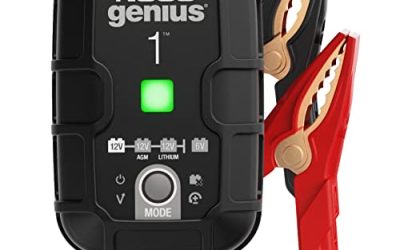
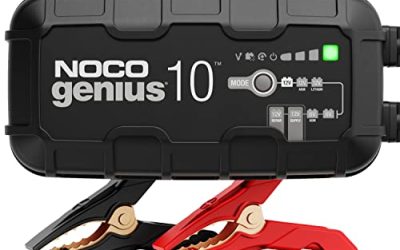
NOCO GENIUS2
- Best for: An owner whose garage holds an ATV plus a mower or a second machine with a different battery chemistry.
- Output: 2 amps
- Voltage: 6V and 12V
- Battery types: lead-acid (flooded, gel, AGM, deep-cycle) and lithium-ion (LiFePO4)
- Battery capacity: up to 40Ah
An owner whose garage holds an ATV plus a mower or a second machine with a different battery chemistry.
The 2-amp output is still slow on a large car battery, so treat this as a powersports and small-vehicle charger rather than a workshop unit.
The GENIUS2 is the most flexible charger in this group, and it earns that place by covering the widest combination of voltages and chemistries. It handles 6V and 12V batteries, lead-acid types including flooded, gel, AGM, and deep-cycle, plus lithium-ion packs, so it stays useful when the garage holds more than one kind of machine. Its 2-amp output is the strongest here, which shortens the wait on a battery that has gone flat, and the built-in desulfator works against the sulfation that builds up while a battery sits. A mounting bracket in the box lets it live bolted to a garage wall.
Watch out for: The 2-amp output is still slow on a large car battery, so treat this as a powersports and small-vehicle charger rather than a workshop unit.
CTEK US 0.8
- Best for: A small lead-acid ATV battery in a heated garage that will sit untouched for months.
- Output: 0.8 amps
- Voltage: 12V
- Battery types: 12V lead-acid (wet, MF, Ca/Ca, AGM, gel)
- Battery capacity: charges 1.2Ah to 32Ah, maintenance charging up to 100Ah
A small lead-acid ATV battery in a heated garage that will sit untouched for months.
Lead-acid only, so it does not suit a lithium battery, and its operating range starts at 41°F, which rules out an unheated shed in a cold winter.
The US 0.8 is the smallest and gentlest charger here, and that is exactly its point. Its 0.8-amp output is sized for the small batteries found in ATVs, motorcycles, jet skis, and lawn tractors, and its six-step automatic program includes a patented desulfation stage that can recover a battery left sitting too long. The housing is splash and dustproof, the unit is non-sparking with reverse polarity protection, and it comes with both clamps and eyelets plus a storage bag. CTEK states it can stay connected for months at a time, which is the main job for a machine in seasonal storage.
Watch out for: Lead-acid only, so it does not suit a lithium battery, and its operating range starts at 41°F, which rules out an unheated shed in a cold winter.
Battery Tender 800
- Best for: An ATV stored in a damp shed or an outdoor shelter where the charger itself needs to survive the conditions.
- Output: 800mA
- Voltage: 12V
- Model number: 022-0150-DL-WH
- Charging behavior: fully automatic SuperSmart charging and maintenance
An ATV stored in a damp shed or an outdoor shelter where the charger itself needs to survive the conditions.
At 800mA it is purely a maintainer, so a deeply discharged battery takes a long time to come back, and it will not revive one that has been left flat for a season.
The Battery Tender 800 is built for storage spots that are less than ideal. Its interior is fully encapsulated in epoxy resin, which seals it against shock, vibration, and moisture, and the listing describes it as fully waterproof, so damp air in a shed or a garage that sweats in spring does not bother it. It delivers a steady 800mA at 12 volts, monitors the battery, and switches between charging and maintenance on its own, with the same smart charging behavior as its better-known Junior sibling in a tougher package. The universal input accepts 100 to 240 volts, and the unit is mountable.
Watch out for: At 800mA it is purely a maintainer, so a deeply discharged battery takes a long time to come back, and it will not revive one that has been left flat for a season.
FOVAL 12V 1000mA Smart Battery Charger
The FOVAL is the simplest 1-amp maintainer in this group, and its appeal is that it does the basic job without extra modes to learn. Its four-step program runs through initialization, bulk charge, absorption, and float, then holds the battery at a maintenance voltage once full, and it covers the common lead-acid types including SLA, VRLA, gel, AGM, and wet cells. The stated capacity range of 2Ah to 100Ah covers anything from a small ATV battery to a much larger one, and the box includes both an alligator clip cable and a ring terminal cable. LED indicators show the charging state at a glance.
Specs
- Output: 1 amp (1000mA)
- Voltage: 12V
- Battery types: SLA, VRLA, GEL CELL, AGM, WET lead-acid
- Battery capacity: 2Ah to 100Ah
- Charging program: 4-step (Initialization, Bulk Charge, Absorption Mode, Float Mode)
- Input: 100-240V
- Cables: 102 inches total, with alligator clip cable and ring terminal cable
- Certification: ETL listed
- Dimensions: 3.9 x 2.4 x 1.25 inches
- Weight: 10.5 oz
- Warranty: 18 months
Best for: A single ATV that needs a straightforward maintainer with no extra settings to manage.
Watch out for: Lead-acid only, so it does not cover a lithium battery, and the 1-amp output is slow on a large battery, so keep it on powersports-size packs.
MOTOPOWER MP00205B
- Best for: An ATV that gets connected and disconnected through the winter, where a bolted-on ring lead saves time every visit to the garage.
- Output: 1000mA
- Voltage: 12V
- Battery types: 12V lead-acid (flooded, sealed maintenance-free, AGM, gel)
- Charge voltage: 14.2V +/- 0.2V
An ATV that gets connected and disconnected through the winter, where a bolted-on ring lead saves time every visit to the garage.
The charger states an activation voltage of 4 volts and does not suggest charging a fully dead battery, so a battery below that floor needs a different approach first.
The MP00205B is the charger to pick when the lead stays bolted to the battery all season. It ships with an SAE alligator clamp cable and a fused 7.5A eyelet terminal cable, and the SAE quick-release connector lets the charger unplug from the lead without tools, so connecting it becomes a ten-second job. Its 1000mA output charges a 12V lead-acid battery to 14.2V, then holds it with pulse current at 13.6V indefinitely, and the timer protection adds a cutoff that the simpler maintainers in this group do not state. Pulse current recovery works on sulfated batteries, and the charger activates batteries down to 4 volts.
Watch out for: The charger states an activation voltage of 4 volts and does not suggest charging a fully dead battery, so a battery below that floor needs a different approach first.
Which One Fits Your Situation
An ATV that sits all winter
The CTEK US 0.8 fits this situation best. Its 0.8-amp output is gentle enough for a small battery left for months, its six-step program includes desulfation for a battery that has started to sulfate, and CTEK states it can stay connected for months at a time. Keep it in a heated garage, since its operating range starts at 41°F, and pair it with the ring-terminal lead so the connection is already in place when the machine goes into storage.
A lithium battery in a newer four-wheeler
The NOCO GENIUS2 is the pick here, because it is one of only two chargers in this guide that state lithium support on their listings. It covers 12V LiFePO4 packs alongside lead-acid, so the same unit works whether the machine runs lithium now or switches back to lead-acid later. Its 2-amp output also refills a flat lithium pack faster than the sub-1-amp maintainers, and the temperature compensation adjusts the charge for cold mornings in the garage.
A damp shed or an outdoor storage spot
The Battery Tender 800 fits this situation best. Its encapsulated, waterproof housing is built for moisture, vibration, and rough handling, which is exactly what a charger faces in a shed that is damp in spring and freezing in winter. The 800mA output is modest, but for a healthy battery that only needs holding at full charge through the off-season, that is enough, and the ring terminals let the lead stay bolted on through the wet months.
Several small batteries across the garage
The FOVAL 12V 1000mA charger fits this situation best. Its stated 2Ah to 100Ah capacity range covers an ATV battery, a mower battery, and a larger spare without changing units, and its four-step program handles the common lead-acid types found across those machines. At 10.5 ounces it moves easily from one battery to the next, and the included clip and ring cables mean no extra hardware is needed for the second machine.
Common Mistakes
- Using a high-output car charger on a small ATV battery, which pushes more current into the pack than it needs and shortens its life.
- Leaving a fixed-output trickle charger connected for months, instead of a smart charger that switches to a float stage once the battery is full.
- Buying a charger for the wrong voltage, such as a 6V-only or 24V unit, for a 12V four-wheeler battery.
- Clamping onto corroded battery terminals without cleaning them first, which gives a weak connection and a misleading charge reading.
- Ignoring battery chemistry and connecting a lead-acid-only charger to a lithium pack, or the other way around.
Frequently Asked Questions
Can I leave a battery charger connected to my ATV all winter?
Yes, if the charger is a smart maintainer that switches to a float or maintenance stage once the battery is full. Every charger in this guide states that behavior on its listing, with maintenance voltages around 13.6V. A fixed-output trickle charger without an automatic switch should not stay connected unattended, because it keeps pushing current into a full battery.
What size charger does an ATV battery need?
Most ATV batteries fall between 8Ah and 30Ah, and a charger between 0.8 amps and 2 amps fits that range well. Check the amp-hour figure printed on the battery label, then match it against the capacity range stated on the charger listing. A maintainer under 1 amp suits long storage, while 2 amps refills a flat battery noticeably faster.
Will these chargers work on a lithium ATV battery?
Only two of the five will. The NOCO GENIUS2 states support for lithium-ion and LiFePO4 batteries, while the CTEK US 0.8, Battery Tender 800, FOVAL, and MOTOPOWER MP00205B are lead-acid only. Read the battery label for AGM, gel, or LiFePO4 before buying, and choose a charger that lists that exact chemistry.
Do I need to remove the battery from the four-wheeler to charge it?
No, in most cases the battery can stay in the machine. Connect the charger leads to the terminals, or bolt a ring-terminal lead to the posts and plug the charger into it, and leave the battery where it sits. Make sure the area is ventilated, the terminals are clean, and the charger sits where it will stay dry, or choose a waterproof model if the storage spot gets damp.



Write Your Review
No reviews yet. Be the first to share your experience!