
Our Short List of 3

- Best for: Households with several vehicles that want the fastest automatic charge here.
- Brand: NOCO
- Model: GENIUS10
- Charging current: 10 amps
- Battery voltage: 6V and 12V

- Best for: Trucks, RVs and boats stored in cold garages.
- Brand: Ampeak
- Output voltage: 6V and 12V
- Output current: 2A, 8A, 15A or automatic
- Charging program: 8 stages, including desulfation and recondition

- Best for: One daily-driven car or SUV, charged and maintained by a single unit.
- Brand: NOCO
- Model: GENIUS5
- Charging current: 5 amps
- Battery voltage: 6V and 12V
All 4 Picks at a Glance
| Product | Specs | Action |
|---|---|---|
| NOCO GENIUS10 |
| Check price on Amazon |
| Ampeak 15A Smart Battery Charger |
| Check price on Amazon |
| NOCO GENIUS5 |
| Check price on Amazon |
 NOCO GENIUS2 |
| Check price on Amazon |
A charger you have to babysit is a charger you will eventually leave connected too long, and that is exactly how a healthy battery gets cooked. Fully automatic chargers remove the guesswork: they read the battery, run a staged program, and drop to a float or maintenance hold when charging is done. The real decision is not whether to go automatic, but how much current your battery actually needs and whether the charger speaks your battery’s chemistry.
This guide is for drivers who want to connect a charger and walk away: commuters keeping a daily car topped up, owners storing a motorcycle or classic over winter, and households juggling cars, trucks and boats. The picks below run from the 10-amp NOCO GENIUS10 and the rate-switching Ampeak 15A to the compact 2-amp NOCO GENIUS2, and every one is sold as a fully automatic smart charger on its Amazon listing.
Quick Picks
As an Amazon Associate we earn from qualifying purchases
| Product | Best for | Key spec from title |
|---|---|---|
| NOCO GENIUS10 | Most cars and trucks | 10A for 6V/12V batteries up to 230Ah |
| Ampeak 15A Smart Battery Charger | Large batteries and cold garages | Selectable 2A, 8A or 15A output |
| NEXPEAK NC201 | Homes with 12V and 24V vehicles | 10A at 12V and 5A at 24V |
| NOCO GENIUS5 | One everyday car | 5A for 6V/12V batteries up to 120Ah |
| NOCO GENIUS2 | Motorcycles and stored cars | 2A for 6V/12V batteries up to 40Ah |
How to Choose
Match the Amp Rating to Your Battery
Charge current decides how long a drained battery takes to recover, and the useful yardstick is the battery’s amp-hour capacity printed on its label. A common rule of thumb is a charger rated around one tenth of that capacity, so a typical 60 amp-hour car battery pairs well with a 5-amp or 6-amp charger. Small motorcycle and lawn batteries are happier at 2 amps, where a big charger can push current too aggressively. At the other end, dual-battery diesel trucks and large deep-cycle batteries justify 10 amps or more, because a small maintainer may need days to refill them.
Check What Fully Automatic Really Covers
Fully automatic should mean the charger runs the whole program without you: it detects the battery, moves through its charging stages, and switches to a float or maintenance hold at full charge instead of cooking the battery. Read the listing for the exact wording, because brands implement this differently. NOCO describes its GENIUS chargers as fully automatic with zero overcharge, while the NEXPEAK and Ampeak listings describe multi-stage programs that end in a maintenance stage. Also check whether the charger restarts on its own after a power cut, since a garage outlet on a tripped breaker can leave a stored car uncharged for weeks.
Confirm Your Battery Chemistry Is Supported
An automatic program is tuned for specific chemistries, and the wrong match matters. Flooded, AGM and gel lead-acid batteries are covered by almost every charger here, but lithium iron phosphate batteries need a dedicated lithium mode with a different charge profile. The NOCO GENIUS models and the Ampeak list LiFePO4 support, while the NEXPEAK NC201 is lead-acid only, so lithium owners should cross it off. Voltage matters too: most picks handle 6-volt and 12-volt systems, which covers classic cars, but only the NEXPEAK here adds 24-volt charging for larger trucks and equipment.
Weigh Temperature Handling and Hardware
A battery charges differently at freezing temperatures than in summer heat, and better chargers adjust for that. Temperature compensation, built into the NOCO and NEXPEAK listings, senses ambient temperature and trims the charging voltage automatically. Ampeak takes a different route with a selectable Winter Mode you switch on yourself. Hardware decides daily convenience just as much: longer cables reach a battery without moving the car, eyelet terminals allow a semi-permanent hookup on a stored vehicle, and a mounting bracket keeps the charger off the floor. Repair or desulfation modes are a bonus for reviving tired batteries, not a reason to buy.
The 5 Best Options
NOCO GENIUS10
- Best for: Households with several vehicles that want the fastest automatic charge here.
- Brand: NOCO
- Model: GENIUS10
- Charging current: 10 amps
- Battery voltage: 6V and 12V
Households with several vehicles that want the fastest automatic charge here.
The 10-amp output is more than a small motorcycle battery needs, and the extra modes add cost if you only ever charge one car.
The GENIUS10 is the pick for drivers who want one automatic charger to cover almost everything in the garage. Its listing rates it for 6-volt and 12-volt batteries up to 230 amp-hours, so it handles a compact car, a full-size truck and most deep-cycle batteries without breaking a sweat. NOCO builds in temperature compensation, a repair mode for sulfated batteries and a supply mode that can hold vehicle voltage during battery swaps. If your household runs several vehicles and you refuse to think about charging after plugging in, this is the default choice.
Ampeak 15A Smart Battery Charger
- Best for: Trucks, RVs and boats stored in cold garages.
- Brand: Ampeak
- Output voltage: 6V and 12V
- Output current: 2A, 8A, 15A or automatic
- Charging program: 8 stages, including desulfation and recondition
Trucks, RVs and boats stored in cold garages.
Winter Mode is a setting you select rather than automatic sensing, and the 15-amp rate is too strong for small powersports batteries, so use the 2-amp setting there.
The Ampeak 15A suits owners whose batteries are big, cold or both. You can select 2, 8 or 15 amps, or let the charger’s automatic rate pick for you, and a dedicated Winter Mode adjusts charging for freezing temperatures. Its listing describes an eight-stage program with desulfation and recondition stages, plus a pulse maintenance stage that holds a stored battery at full charge. It covers 6-volt and 12-volt lead-acid and LiFePO4 batteries, which makes it a flexible bench charger for trucks, RVs and boats that sit between trips.
NEXPEAK NC201
The NC201 is the budget route into fully automatic charging for homes that run both 12-volt and 24-volt vehicles. It charges at 10 amps on 12-volt systems and 5 amps on 24-volt systems, runs a seven-stage program with temperature compensation, and shows voltage and mode on a backlit LCD instead of a row of LEDs. That screen makes it easy to confirm what the charger is doing at a glance. The trade-off is chemistry: the listing limits it to lead-acid batteries, with no lithium mode for LiFePO4 packs.
Specs
- Brand: NEXPEAK
- Model: NC201
- Output voltage: 12V and 24V
- Charging current: 10A at 12V, 5A at 24V
- Charging program: 7 stages
- Battery types: AGM, GEL, SLA and flooded lead-acid
- Temperature compensation: yes
- Display: LCD
- Input voltage: 110V AC
Best for: Mixed 12-volt and 24-volt fleets on a budget.
Watch out for: Lead-acid only, with no lithium mode, and 24-volt charging runs at 5 amps, so big 24-volt banks take a while to refill.
ASIN: B094VQ88X2
NOCO GENIUS5
- Best for: One daily-driven car or SUV, charged and maintained by a single unit.
- Brand: NOCO
- Model: GENIUS5
- Charging current: 5 amps
- Battery voltage: 6V and 12V
One daily-driven car or SUV, charged and maintained by a single unit.
It refills a large, deeply drained truck battery more slowly than the GENIUS10, and there is no supply mode for battery swaps.
The GENIUS5 hits the middle ground for a single everyday car or SUV. Five amps is enough to recover a drained car battery overnight rather than over several days, and the listing rates it for batteries up to 120 amp-hours across 6-volt and 12-volt systems. It shares the GENIUS line’s temperature compensation and adds a repair mode that the smaller GENIUS2 lacks. The box includes clamps with integrated eyelet terminals and a mounting bracket, so it can live on a garage wall between uses or travel in the trunk on longer trips.
NOCO GENIUS2
- Best for: Motorcycles, lawn equipment and cars in long-term storage.
- Brand: NOCO
- Model: GENIUS2
- Charging current: 2 amps
- Battery voltage: 6V and 12V
Motorcycles, lawn equipment and cars in long-term storage.
Two amps is a maintainer’s pace, so a flat full-size car battery can take well over a day, and it lacks the repair mode of the larger GENIUS models.
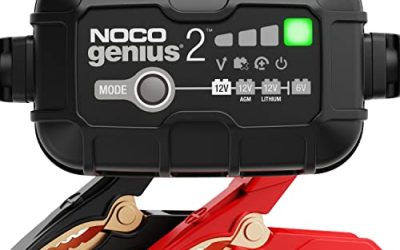
The GENIUS2 is built for batteries that sit: motorcycles, lawn tractors, classics and any car that spends weeks parked. Two amps is slow on a big battery, but for maintaining batteries up to 40 amp-hours it delivers exactly the gentle, fully automatic top-up the listing promises, with temperature compensation and overcharge protection. The sealed housing shrugs off garage dust and damp, and the included mounting bracket and eyelet terminals make a semi-permanent hookup easy to live with. Pick it when the job is storage, not rescue.
Which One Fits Your Situation
Your Only Car Sits Outside Through Winter
Cold weather is where automatic control earns its keep, because a charger that adjusts for temperature can be left connected without supervision. The GENIUS10 does this on its own with built-in temperature compensation and enough output to recover a cold, drained battery. If your garage drops below freezing for months, the Ampeak’s selectable Winter Mode makes the same adjustment manually, with higher rates on tap for bigger batteries.
A Motorcycle or Classic Sleeps for Months
Storage duty rewards gentleness over speed. The GENIUS2 delivers a 2-amp fully automatic charge and then holds the battery at full without overcharging, which suits motorcycle, lawn tractor and classic car batteries up to 40 amp-hours. Its eyelet terminals let you leave a tidy pigtail on the battery, so connecting the charger takes seconds each time you park the machine for another stretch.
Your Household Runs 12V and 24V Vehicles
Most automatic chargers stop at 12 volts, so a home with a 24-volt truck, tractor or boat system usually ends up buying twice. The NC201 covers both voltages in one unit, charging 12-volt batteries at 10 amps and 24-volt batteries at 5 amps, with an LCD that shows which mode is running. Just remember it is lead-acid only before pointing it at anything lithium.
You Want One Charger for the Family Car
For a single daily driver, the GENIUS5 is the balanced buy: fast enough to recover a drained battery overnight, automatic enough to stay connected between drives, and rated for batteries up to 120 amp-hours, which covers most cars and SUVs. Its repair mode adds a second chance for an aging battery, and the mounting bracket keeps it parked on the garage wall instead of lost in a drawer.
Common Mistakes
- Judging a charger by a boost or engine-start headline number instead of its continuous charge current in amps.
- Leaving an old manual charger connected overnight because the battery looked nearly full.
- Running a lithium battery on a lead-acid-only automatic charger such as the NC201.
- Buying a 2-amp maintainer to revive a drained truck battery, then blaming the charger for the long wait.
- Clamping onto corroded terminals and expecting the automatic program to read the battery correctly.
Frequently Asked Questions
Can I leave a fully automatic charger connected all winter?
Yes, that is the use case these chargers are sold for. Once the battery reaches full charge, the listings describe the charger switching to a float or maintenance hold that tops up small losses without overcharging. NOCO rates its GENIUS models for continuous connection, and the Ampeak describes a pulse maintenance stage for stored batteries. You still need a working outlet and clean terminals.
How many amps do I need for a standard car battery?
Most car batteries sit between 40 and 100 amp-hours, and a 5-amp automatic charger like the GENIUS5 refills a half-drained one overnight. Drivers who drain batteries deeply or run large truck batteries should step up to 10 amps or more. Small motorcycle batteries are the opposite case: 2 amps is plenty, and a high-rate charger is wasted on them.
Will an automatic charger charge a completely dead battery?
It depends on how flat the battery is. Automatic chargers need to detect some voltage before they start, so a battery at true zero may be refused. NOCO lists a force mode on its GENIUS chargers that can begin charging batteries reading as low as zero volts, which covers most parked-too-long cases. A battery that still refuses charge after that is usually damaged rather than discharged.
Can one automatic charger look after two vehicles?
A single-bank charger like every pick here connects to one battery at a time, so two stored vehicles means rotating the charger between them or fitting eyelet leads to both for quick swaps. Each battery still gets the full automatic program while connected. Households with two cars stored side by side for months are better served by two small maintainers than by sharing one large charger.





Write Your Review
No reviews yet. Be the first to share your experience!