
Choosing the right screen protector is less about measuring the glass on your phone and more about matching the exact iPhone model. Two phones with similarly sized displays can have different body widths, curved edges, camera cutouts, speaker locations, or Dynamic Island dimensions. A protector that is only a few millimeters off may lift at the corners, block a case, or leave the top speaker partially covered.
This iPhone screen protector size guide explains the measurements that matter, how to identify your phone, and how to choose between full-coverage glass, case-friendly designs, and camera-protector bundles. Use the model name and model number—not only the advertised screen size—before buying.
As an Amazon Associate we earn from qualifying purchases at no extra cost to you. Product prices and availability are accurate as of the date shown and are subject to change.


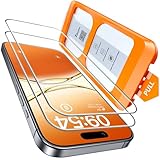
The Short Answer
Buy a screen protector labeled for your exact iPhone model and generation. “6.1-inch iPhone” is not specific enough because the iPhone 15, iPhone 15 Pro, iPhone 16, and iPhone 16 Pro do not have identical body dimensions or screen layouts.
For most current iPhones, a screen protector is approximately 5.1 to 6.3 inches diagonally, depending on the model. The protector itself is slightly smaller than the phone’s front surface so it can avoid the frame and remain compatible with cases. Do not cut a protector to fit: tempered glass can crack, and trimming can expose the screen or interfere with the speaker and front cameras.
Before ordering, confirm:
- The exact model, such as iPhone 15, iPhone 15 Pro, or iPhone 16 Pro Max.
- The display size and phone dimensions.
- Whether the protector supports a Dynamic Island or another top-screen layout.
- Whether it is labeled case-friendly if you use a protective case.
- Whether the package includes one, two, or three protectors.
Standard Sizes
The table below lists Apple’s published phone-body dimensions for common iPhone models. These are not the exact cut dimensions of the glass protector. A screen protector normally leaves a narrow border around the edge, so its length and width will be smaller than the phone body.
| iPhone model | Display size | Phone dimensions (inches) | Phone dimensions (cm) | Approx. body weight |
|---|---|---|---|---|
| iPhone 15 | 6.1 in | 5.81 × 2.82 × 0.31 | 14.76 × 7.16 × 0.79 | 6.02 oz / 171 g |
| iPhone 15 Pro | 6.1 in | 5.77 × 2.78 × 0.32 | 14.66 × 7.06 × 0.81 | 6.60 oz / 187 g |
| iPhone 15 Plus | 6.7 in | 6.33 × 3.06 × 0.31 | 16.09 × 7.76 × 0.79 | 7.09 oz / 201 g |
| iPhone 15 Pro Max | 6.7 in | 6.29 × 3.02 × 0.32 | 15.99 × 7.67 × 0.81 | 7.81 oz / 221 g |
| iPhone 16 | 6.1 in | 5.81 × 2.82 × 0.31 | 14.76 × 7.16 × 0.78 | 6.00 oz / 170 g |
| iPhone 16 Plus | 6.7 in | 6.33 × 3.06 × 0.31 | 16.09 × 7.76 × 0.78 | 7.03 oz / 199 g |
| iPhone 16 Pro | 6.3 in | 5.89 × 2.78 × 0.32 | 14.96 × 7.06 × 0.83 | 7.03 oz / 199 g |
| iPhone 16 Pro Max | 6.9 in | 6.42 × 3.06 × 0.32 | 16.31 × 7.76 × 0.83 | 7.99 oz / 227 g |
Screen protectors are usually listed by compatibility rather than exact glass measurements. A protector for the iPhone 15 may not fit the iPhone 16 even though both have a 6.1-inch display. The iPhone 16 Pro uses a 6.3-inch display, while the iPhone 15 Pro uses a 6.1-inch display, so those products should not be treated as interchangeable.
How to Measure Your Space
- Identify the model in Settings. Open Settings, tap General, and select About. Read the Model Name. If the name is unclear, tap Model Number and compare it with the phone’s packaging or the manufacturer’s model list.
- Remove the case. A case can overlap the screen and make the usable glass appear narrower than it is. Clean fingerprints from the phone before checking the edges.
- Measure the visible screen. Use a ruler to measure from the inside edge of the black border at the top to the inside edge at the bottom, then measure left to right. Do not include the aluminum or titanium frame.
- Check the top cutout. Note whether the phone has a Dynamic Island, a notch, or a different camera and speaker arrangement. A protector with the wrong opening can cover sensors or leave an unattractive gap.
- Allow for case clearance. If your case rises above the display, choose a case-friendly protector. Edge-to-edge glass may touch the case lip and lift after installation.
- Compare the product listing. Match the exact model name and generation. A listing that says “6.1-inch” without naming the compatible iPhone is too vague to trust.
For the most accurate result, rely on the phone model rather than a homemade measurement. A ruler can confirm that a listing looks plausible, but it cannot verify the camera, speaker, sensor, or edge geometry.
By Room or Use Case
Everyday commuting and general use
Choose tempered glass between about 0.25 and 0.33 millimeters thick for a balance of touch sensitivity and impact protection. A case-friendly design is usually the safest choice for pockets, bags, and daily handling. Products in this category commonly cost about $6 to $20, depending on glass quality, installation hardware, and the number of protectors included.
Work, travel, and shared spaces
A two- or three-pack is useful when the phone is frequently handled, packed in luggage, or used around desks and equipment. Look for an alignment tray, cleaning wipes, dust-removal stickers, and clear installation instructions. A low-cost three-pack may be more practical than a single premium protector if you expect to replace it periodically.
Outdoor use and active jobs
Select a protector with a strong edge seal and a compatible rugged case. Avoid assuming that the thickest glass is automatically the best option. A protector that conflicts with a raised case lip can peel at the corners, especially in dust, heat, or cold. A smooth oleophobic coating also helps when the phone is used with damp or dirty hands.
Privacy and bright environments
Privacy protectors restrict viewing from side angles, but they can make the screen appear dimmer and may reduce the apparent viewing area. Confirm that the privacy protector is made for the exact model, since its black border and top opening must align precisely. For outdoor visibility, a clear protector is usually the better choice.
Camera protection
Camera lens protectors are separate from the front screen protector. Bundles may include three screen protectors and three lens covers, but the lens pieces must match the camera bump and flash layout. Check whether your phone case already surrounds the lenses; some cases can press against lens covers and cause lifting or glare.
Common Sizing Mistakes
- Matching only the diagonal measurement: Several iPhones use a 6.1-inch display but have different frames and cutouts.
- Confusing Pro and standard models: The cameras, body width, and screen dimensions can differ even within the same generation.
- Using a Plus protector on a Pro Max: Both may have a large display, but the bodies and screen layouts are not automatically identical.
- Ignoring the case: Edge-to-edge protectors can conflict with tight-fitting cases.
- Measuring the case opening: The opening is not the same as the actual display or protector size.
- Buying a camera lens cover without checking the flash: Incorrect openings can obstruct the flash or create reflections in photos.
- Assuming a three-pack means three identical fits: Verify that every included protector is labeled for your specific model.
FAQ
Are iPhone screen protectors the same size?
No. Even models with the same advertised screen size can differ in body width, corner shape, camera placement, and top-screen cutout. Match the exact iPhone model and generation.
Can an iPhone 15 screen protector fit an iPhone 16?
Do not assume it will. Although the standard iPhone 15 and iPhone 16 are both commonly described as 6.1-inch phones, their front layouts and accessory compatibility may differ. Buy a protector specifically labeled for your model.
Should a screen protector be smaller than the iPhone screen?
Yes. Most protectors leave a narrow perimeter so they do not touch the frame or interfere with a case. A small, even gap is normal. Large gaps, exposed display areas, or lifted corners indicate a poor fit.
How much should I spend on an iPhone screen protector?
Expect roughly $6 to $20 for a multipack or premium single protector. Price depends on the number of pieces, installation tray, edge coverage, privacy features, and included camera protectors. Correct model compatibility matters more than price alone.
Ready to decide? Our #1 pick for 2026 is the iPhone 15.
Live price & availability on Amazon.




Write Your Review
No reviews yet. Be the first to share your experience!