
![Apple Watch SE 3 [GPS 40mm] Smartwatch with Starlight Aluminum Case with Starlight Sport Band - S/M. Fitness and Sleep Trackers, Heart Rate Monitor, Always-On Display, Water Resistant](https://m.media-amazon.com/images/I/61xkvg-RStL._AC_SL400_.jpg)
![Apple Watch Ultra 3 [GPS + Cellular 49mm] Running & Multisport Smartwatch w/Rugged Titanium Case w/Black Ocean Band. Satellite Communications, Advanced Health & Fitness Tracking](https://m.media-amazon.com/images/I/71pdSpwZJiL._AC_SL400_.jpg)
Prime
Editor's Pick
Apple Watch Ultra 3 [GPS + Cellular 49mm] Running & Multisport Smartwatch w/Rugged Titanium Case w/Black Ocean Band. Satellite Communications, Advanced Health & Fitness Tracking
![Apple Watch Series 11 [GPS 46mm] Smartwatch with Jet Black Aluminum Case with Black Sport Band - M/L. Sleep Score, Fitness Tracker, Health Monitoring, Always-On Display, Water Resistant](https://m.media-amazon.com/images/I/6129OfG4gfL._AC_SL400_.jpg)
Apple Watch Vs Garmin is the ultimate smartwatch debate for fitness enthusiasts, athletes, and daily tech users looking for the perfect wrist companion. Choosing between these two industry giants requires understanding how their distinct design philosophies fit your lifestyle. In this honest review, we dive deep into the ecosystem strengths, athletic performance tracking, and battery differences to help you decide which brand deserves a spot on your wrist.
Quick Overview: Choosing Between Smart Power and Athletic Endurance
When looking for a high-end wearable, users are inevitably faced with a stark choice between the seamless ecosystem integration of Apple and the uncompromising fitness focus of Garmin. Both brands offer world-class hardware, but they target fundamentally different personas, making your daily routines the ultimate deciding factor.
As an Amazon Associate we earn from qualifying purchases at no extra cost to you.


The Core Philosophy: Apple Watch vs Garmin
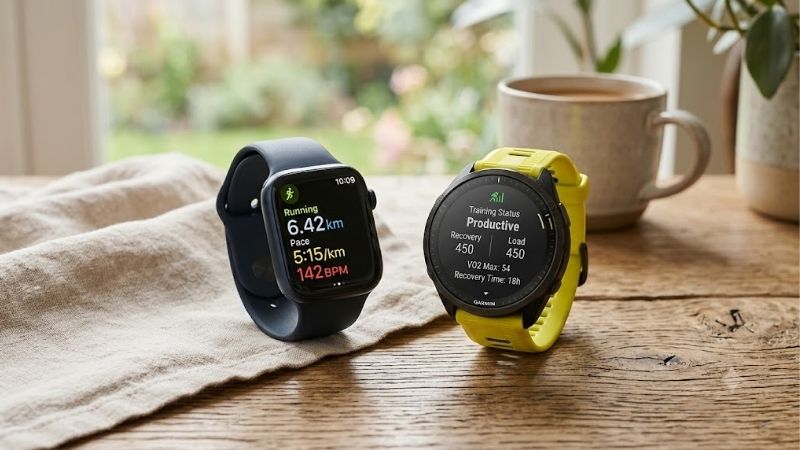
Apple treats its wearable as a natural extension of your mobile device, serving as a highly interactive, communicative hub that keeps you connected without needing to pull out your phone. The interface is highly responsive, visual, and deeply integrated into iOS, providing an unmatched lifestyle companion that handles calls, texts, and payments effortlessly. If you want a device that excels at daily multitasking, Apple is the default choice.
Garmin, conversely, approaches the wrist as a dedicated data instrument designed to withstand extreme environments and deliver hyper-detailed athletic metrics. While it offers basic notifications, Garmin devices prioritize performance metrics, maps, recovery analysis, and long-term training load over lifestyle apps. Their screens are optimized for outdoor visibility rather than flashy animations, focusing entirely on helping you achieve your physical peaks.
This fundamental difference in design means you are choosing between a device that helps you manage your day and one that helps you manage your physical performance. For casual exercisers who value convenience, Apple is incredible, while endurance athletes, marathon runners, and outdoor adventurers will find Garmin’s detailed telemetry indispensable. Deciding which core philosophy aligns with your lifestyle is the first and most critical step.
Design Aesthetics: Elegant Curves vs Rugged Utility
The physical design of these wearables highlights their distinct purposes, with Apple favoring a sleek, rounded aesthetic and Garmin opting for a more traditional, rugged watch look. The Apple Watch Series and Ultra lines feature bright, beautiful OLED displays that look spectacular in office settings or formal events, pairing perfectly with any outfit. However, their glass screens and polished cases can feel delicate, requiring protective cases if you frequently hike or work in demanding environments.
Garmin watches, such as the Fenix or Epix series, feature robust bezels, physical buttons for navigation during sweaty workouts, and durable fiber-reinforced polymer cases. Many models utilize transflective memory-in-pixel displays that actually become clearer in direct sunlight, though they lack the vibrant colors of Apple’s screens. This makes Garmin watches highly practical for outdoor use where physical button inputs are far more reliable than a wet touchscreen.
If you are styling your watch for everyday wear, Apple’s slim profile and massive library of stylish bands make it highly customizable. Garmin offers a commanding, industrial presence on the wrist that appeals to those who love traditional watches or need a rugged tool that can survive heavy impacts. Both design choices are excellent, but they serve vastly different aesthetic preferences and practical use cases.
Battery Life: Daily Charging vs Weeks of Power
Battery performance remains the single most decisive factor when comparing Apple Watch Vs Garmin models. The Apple Watch generally requires daily charging, with standard models lasting around 18 to 36 hours depending on usage, while the Ultra pushes that to 2 to 3 days. This means you will need to establish a charging routine, often placing the device on its charger while you shower or sleep, which can disrupt consistent sleep tracking.
Garmin devices completely eliminate daily battery anxiety, with entry-level and premium models lasting anywhere from a week to a full month on a single charge. Some outdoor models even feature solar charging lenses, extending their endurance indefinitely under the right sunny conditions. This incredible longevity makes Garmin the undisputed champion for multi-day backpacking trips, ultramarathons, or simply for users who hate packing chargers.
Having a watch that stays powered for weeks changes how you interact with your health data, allowing for seamless, uninterrupted sleep tracking and continuous heart rate monitoring. While Apple has made strides with fast charging, it still cannot compete with Garmin’s power efficiency. If you despise the chore of charging another daily device, Garmin is the runaway winner in this category.
See today’s deal on Amazon →
Key Features Face-Off: Tracking, Connectivity, and Health
Beyond external design and battery life, the real value of these smartwatches lies in the software algorithms and sensors packed beneath their displays. Both brands offer highly accurate biometric tracking, but they present this information in very different ways, appealing to different levels of health and fitness enthusiasts.
Health Monitoring and Sleep Analysis Capabilities
For comprehensive health monitoring, Apple provides a highly certified medical-grade experience, featuring FDA-cleared ECG readings, blood oxygen tracking, and irregular heart rhythm notifications. The watch is incredibly proactive, warning users of potential cardiovascular anomalies and offering robust fall detection and crash detection features that have saved lives. It is a fantastic health companion for users of all ages who want a reliable, quiet guardian on their wrist.
Garmin approaches health from an athletic recovery standpoint, compiling metrics like HRV status, Sleep Score, and its signature Body Battery tool. This metric acts as an energy gauge, showing you how sleep, stress, and activity levels drain or restore your body’s resources throughout the day. It helps you decide whether you should push hard in training or take a rest day, providing actionable training guidance.
While Apple tells you if you are healthy, Garmin tells you if you are rested and ready to perform. Apple’s medical certifications give it an edge for general health oversight, especially for older adults or those with specific medical concerns. Garmin is the superior choice for active individuals who want to optimize their daily energy, recovery cycles, and athletic preparation.
GPS Accuracy, Fitness Tracking, and Athletic Metrics
When it comes to tracking workouts, the choice in the Apple Watch Vs Garmin debate depends on how deeply you want to analyze your data. Garmin is legendary for its dual-frequency GPS accuracy and pre-loaded color topo maps, allowing you to navigate remote trails without cellular service. The watch tracks everything from running dynamics and trail climbs to ski maps and golf courses, providing a mountain of data that can be exported or analyzed directly.
Apple offers highly accurate workout tracking as well, and its GPS performance on recent models is incredibly precise, matching Garmin in urban canyons and deep forests. However, Apple’s native Workout app is simpler, focusing on active calories, duration, and heart rate zones without offering native, in-depth recovery advice. To get Garmin-level training metrics on an Apple Watch, you often have to rely on third-party App Store subscriptions.
For casual gym-goers, runners, and swimmers, Apple provides more than enough information in a beautiful, easy-to-read format. For serious athletes who need precise split paces, VO2 max trends, training load balance, and offline trail maps, Garmin remains the golden standard. If your primary goal is athletic improvement, Garmin’s built-in ecosystem is unmatched.
Smart Features, Cellular Connectivity, and Ecosystem Synergy
Smart features are where Apple utterly dominates, offering a mini-smartphone experience on your wrist that Garmin simply cannot match. If you pair your watch with an iPhone, you can dictate texts, take phone calls over cellular, use Apple Pay at checkout, and access thousands of standalone App Store apps. The device is highly responsive, allowing you to control smart home accessories or check weather alerts instantly.
Garmin offers extremely basic smart features, largely limited to mirroring phone notifications, showing calendar events, and supporting Garmin Pay (which has far fewer compatible banks). You can load music directly onto many Garmin models for offline listening with Bluetooth headphones, but you cannot reply to text messages if you are using iOS. It functions as a passive notifier rather than an active communications tool.
The level of ecosystem synergy depends heavily on your phone, as the Apple Watch is strictly compatible with iPhones and will not work with Android. Garmin is fully cross-platform, working beautifully with both iOS and Android devices, though Android users get slightly better messaging capabilities. If you want a seamless smart experience where you can leave your phone at home, Apple is the only logical choice.
Check the latest price on Amazon →
Real User Experience, Pros & Cons, and Buying Decisions
Understanding how these watches perform in the real world, beyond spec sheets, is essential to making an informed buying decision. By looking at long-term user reviews and analyzing current economic shifts, we can determine the true value of each platform in today’s market.
Synthesized Amazon Reviews and Real-World Wearability
To provide an honest review of these devices, we synthesized feedback from thousands of real-world users who transitioned between these platforms. Amazon reviews for the Apple Watch overwhelmingly praise its vibrant screen, intuitive interface, and how easily it handles daily tasks like replying to family group chats. However, common 2-star and 3-star complaints focus on the frustration of daily charging and the fragility of the glass screens during minor drops.
Garmin users on Amazon frequently leave 5-star praise for the incredible battery life and the reliability of physical buttons when wearing gloves or swimming. On the flip side, critical 2-star reviews often mention a steep learning curve, a dated-looking user interface, and the lack of interactive smart features. Many users noted that Garmin Connect can feel overwhelming with too many complex charts, requiring hours of adjustment to fully master.
Ultimately, real-world wearability comes down to comfort and daily habits. Apple Watch users love the lightweight, comfortable feel of the standard models, but must accept the charging chore. Garmin users accept a bulkier, more utilitarian design in exchange for absolute reliability and zero battery anxiety during outdoor excursions.
Brand Evaluation: Apple Watch vs Garmin
Weighing the advantages and drawbacks of both ecosystems is crucial when contemplating Apple Watch Vs Garmin models. Each brand excels in its respective arena while presenting distinct trade-offs that can make or break your daily experience. Below, we break down the most prominent pros and cons of both options to simplify your choice.
For the Apple Watch, the ✅ Pros include a gorgeous, ultra-responsive LTPO OLED display, seamless cellular calling and messaging capabilities, and deep integration with iOS devices. The Apple Watch is highly compatible with iPhone 17 and other modern Apple hardware. On the other hand, the ❌ Cons center around its abysmal 18-hour battery life on standard models, its complete lack of Android compatibility, and the high subscription fees associated with third-party fitness apps.
For Garmin wearables, the ✅ Pros are highlighted by staggering multi-week battery life, robust physical durability, and a massive suite of built-in fitness metrics with no subscription fees. These watches are ideal for serious athletes. Conversely, the ❌ Cons include extremely limited smart capabilities, a lack of deep communication features on iOS, and high upfront costs for premium titanium or sapphire crystal models.
Who Should Buy and Market Price Trends in 2026
Deciding which watch to buy also requires looking at market trends, as global laptop and component prices are trending upward. This macroeconomic shift has trickled down to wearable tech, driving up manufacturing costs for OLED screens, GPS sensors, and premium casing materials. Because of this, premium models like the Garmin Fenix and Apple Watch Ultra may see price increases later this year, making it highly worth buying in 2026 to lock in current pricing.
If you want a daily helper that works flawlessly with your iPhone 17 Pro Max, manages notifications, and tracks casual workouts, you should buy the Apple Watch. It is highly convenient, works with MagSafe charging pucks or standard Qi chargers, and fits perfectly into a busy modern lifestyle. You can also explore premium charging options vs Anker or Belkin to make the daily charging routine much more manageable and efficient.
If your life revolves around training plans, trail exploration, or outdoor sports, you should buy a Garmin. Its rugged build, advanced training metrics, and incredible battery make it a reliable tool that never lets you down in the wild. While Garmin is a significant upfront investment, the lack of ongoing fitness app subscriptions makes it an incredibly cost-effective option over several years.
Conclusion
Ultimately, deciding on Apple Watch Vs Garmin depends on whether you prioritize everyday smart convenience or deep, uninterrupted athletic tracking. For seamless iPhone integration and unmatched communicative power, Apple is the clear winner, while Garmin remains the undisputed champion for endurance athletes who value battery life above all else. No matter which path you choose, both brands represent the pinnacle of modern wearable technology.
See today’s deal on Amazon →
Frequently Asked Questions
Which has better battery life, Apple Watch or Garmin?
Garmin wins decisively. Most Garmin sports watches run for one to three weeks on a charge, and solar models extend that further, because they use low-power transflective displays and a lighter operating system. Apple Watch typically needs charging every day or two, with the Ultra line stretching further but still measured in days rather than weeks.
Does Garmin work fully with an iPhone?
Yes. Garmin Connect on iOS handles syncing, notifications, workout uploads and settings, and Garmin watches show iPhone notifications reliably. What you cannot do is reply to iMessages with full functionality, use Apple Pay, run iPhone apps on the wrist, or unlock a Mac. Those integrations are exclusive to Apple Watch by design.
Which is better for health monitoring?
Apple Watch leads on medical-grade features, offering an ECG app, irregular rhythm notifications, fall and crash detection, and tight integration with the Health app and clinical records. Garmin leads on training analytics such as training load, recovery time, VO2 max trends and detailed sleep and stress scoring aimed at endurance athletes rather than general health.
Which is more accurate for GPS running?
Garmin generally holds an edge on GPS track accuracy, especially models with multi-band GNSS in cities and under tree cover, because navigation is their core competency and the antennas are tuned for it. Apple Watch has narrowed the gap substantially with dual-frequency GPS on newer models, and for casual running the difference is small.
Can you switch between them without losing data?
Partially. Both write to Apple Health, so daily steps, heart rate and workouts can be shared, and third-party services such as Strava sit in the middle as a common history. Detailed proprietary metrics do not transfer: Garmin training status and body battery scores have no Apple equivalent, and vice versa, so some history is effectively left behind.




Write Your Review
No reviews yet. Be the first to share your experience!