
As an Amazon Associate we earn from qualifying purchases.
- 1. Shure MV88+ Video Kit — Best Stereo Kit for Music and Events
- 2. Rode VideoMic Me-C+ — Best Plug-In Directional Mic for USB-C iPhones
- 3. Hollyland Lark A1 — Best Simple Wireless Kit for Two-Person Recording
- 4. DJI Mic 3 (2 TX + 1 RX + Charging Case) — Best for Unrepeatable Takes
- 5. Sennheiser MKE 200 Mobile Kit — Best Battery-Free Directional Kit
- How to Choose an iPhone Microphone
- FAQ
The microphone built into an iPhone is designed for phone calls and quick voice notes, not for the way most people actually record today. Stand a few steps back for a vlog, film an interview in a busy room, or record a lesson outdoors, and the built-in mic picks up distance, echo and wind along with your voice. A dedicated iPhone microphone fixes that problem in one of three ways: it moves the capsule closer to the speaker with a wireless transmitter, it points a directional capsule at the subject from the phone itself, or it adds stereo width and app control for music and events.
This guide covers five purpose-built iPhone microphones that take genuinely different approaches. There is a stereo video kit for musicians and event filming, a tiny plug-in directional mic for USB-C iPhones, a simple two-person wireless kit for everyday creators, a feature-heavy wireless system with internal backup recording for work you cannot repeat, and a battery-free directional kit that suits older iPhones through an adapter. Each pick connects to an iPhone directly — over USB-C, Lightning, or a TRRS cable with the appropriate adapter — and each solves a different recording problem, so the right choice depends on how far you stand from the phone and how much control you want over the sound.
Disclosure: This article contains affiliate links. If you buy through them, we may earn a commission at no extra cost to you.
1. Shure MV88+ Video Kit — Best Stereo Kit for Music and Events

Most phone microphones record in mono and aim at a single voice. The Shure MV88+ Video Kit is built for the opposite job: capturing a scene in stereo. Its digital stereo condenser capsule sits on an adjustable mount above the phone, and the kit adds a Manfrotto PIXI tripod, a phone clamp and both Lightning and USB-C cables, so it works across older and current iPhones without extra parts. That makes it a natural fit for live music, school performances, worship services, conferences and travel footage where the sense of space matters as much as the words.
Inside the free ShurePlus MOTIV app, you can adjust stereo width from narrow to wide, choose between polar pattern configurations, and apply DSP presets for speech, singing, flat, acoustic and loud environments. A monitor output lets you check the recording while you film, and the app also handles gain and compression, which helps when a performance swings between quiet passages and loud peaks. Because the microphone records the room as well as the subject, it is less suited to noisy street interviews than the directional and wireless picks below — but for a seated performance filmed from one position, nothing else in this guide captures as much atmosphere.
Specs
- :
- ASIN: B07M8JLFLK
- Brand: Shure
- Type: Digital stereo condenser microphone, video kit
- Connector: Lightning and USB-C cables included
- Polar patterns: Adjustable stereo, cardioid, bidirectional and raw mid-side configurations via app
- App: ShurePlus MOTIV, with DSP presets and gain control
- Included: Manfrotto PIXI tripod, phone clamp, shoe-mount mic clip, cables and carry case
- Monitoring: Headphone output for real-time monitoring
2. Rode VideoMic Me-C+ — Best Plug-In Directional Mic for USB-C iPhones

The Rode VideoMic Me-C+ takes the simplest possible form: a short directional microphone that plugs straight into the USB-C port of an iPhone 15 or later and points where the camera points. There is no battery to charge, no receiver to pair and no cable to manage. Its cardioid capsule focuses on sound in front of the phone and rejects much of what comes from the sides and behind, which is exactly what you want for pieces to camera, product demonstrations, classroom recording and walk-and-talk vlogging.
Despite the tiny body — it weighs about 27 grams — the Me-C+ records at 24-bit depth with 44.1 or 48 kHz sample rates, and it includes a feature many plug-in mics skip: a 3.5 mm headphone output for monitoring and playback, so you can confirm the audio is clean before you finish a take. A mounting clip keeps it steady on the phone, the capsule can face forward or backward depending on which camera you use, and the included furry windshield helps outdoors. It is MFi certified and works with Rode Capture and Rode Reporter as well as the standard camera app. Owners of Lightning iPhones should look elsewhere in this guide, because this model is USB-C only.
Specs
- :
- ASIN: B0DCBM3VN5
- Brand: Rode
- Type: Directional plug-in condenser microphone
- Connector: USB-C, bus-powered, MFi certified
- Polar pattern: Cardioid
- Frequency response: 20 Hz to 20 kHz
- Audio: 24-bit, 44.1/48 kHz sample rates
- Max SPL: 115 dB
- Monitoring: 3.5 mm headphone output
- Weight: About 27 g
- Included: Mounting clip and furry windshield
3. Hollyland Lark A1 — Best Simple Wireless Kit for Two-Person Recording
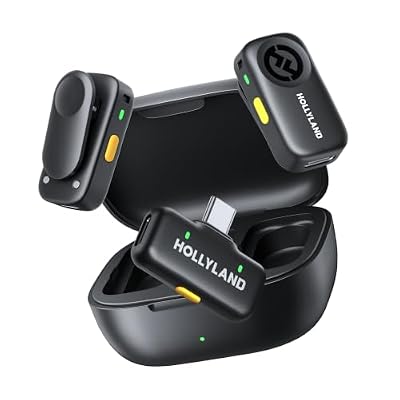
When the speaker needs to move — a fitness instructor, a market trader showing products, two people in an interview — a wireless kit is the practical answer, and the Hollyland Lark A1 is the straightforward option in this guide. The configuration covered here includes two clip-on transmitters, a USB-C receiver that plugs into the phone, and a charging case. Both transmitters can record at once, so a conversation is captured with each voice on its own microphone rather than shared across a room.
The Lark A1 records 48 kHz, 24-bit audio and offers three levels of intelligent noise cancellation, which you can step up in a loud venue or turn down in a quiet room where processing can sound unnatural. Gain, equalisation and reverb adjustments are handled through the companion app, and the stated line-of-sight range of up to 200 metres is far beyond what indoor filming ever needs — the real benefit is a stable link when the speaker turns, walks or briefly steps behind obstacles. The transmitters attach with clips and magnets, keeping them visible but tidy on a collar. If you need a Lightning receiver for an older iPhone, choose the combo configuration of this same system rather than a different model, and check the port before ordering.
Specs
- :
- ASIN: B0F3D55D5R
- Brand: Hollyland
- Type: Wireless lavalier microphone system
- Configuration: 2 transmitters, USB-C receiver, charging case
- Audio: 48 kHz, 24-bit
- Noise cancellation: 3-level intelligent noise cancellation
- Range: Up to 200 m line of sight
- Controls: App-based gain, EQ and reverb adjustment
- Attachment: Clip and magnetic mounting
4. DJI Mic 3 (2 TX + 1 RX + Charging Case) — Best for Unrepeatable Takes

The DJI Mic 3 is the pick for recordings that cannot be done twice: wedding vows, client interviews, ceremonies and field reports. Its defining feature sits inside each transmitter — internal recording at up to 32-bit float, including a dual-file mode that saves a safety copy alongside the main track. Loud peaks that would clip a normal recording can be pulled down in editing, and quiet speech can be raised, which removes much of the pressure from setting perfect levels on location. The transmitters also embed timecode, which speeds up syncing when an iPhone is one of several cameras on a shoot.
Around that safety net, DJI adds adaptive gain control with automatic and dynamic modes, two levels of noise cancelling, three voice-tone presets, and dual-band transmission that hops between 2.4 GHz and 5 GHz for a more stable link in busy radio environments. The stated maximum range is 400 metres in open, unobstructed conditions. Each transmitter weighs 16 grams with its magnet, runs for about 8 hours, and the receiver runs for about 10 hours, with the charging case extending total use to around 28 hours. The receiver connects to an iPhone over USB-C, with a Lightning adapter available for older models. It is the most complex kit here, and casual vloggers will not use half of it — but for paid or one-chance work, the backup recording alone justifies it.
Specs
- :
- ASIN: B0FPG2MQSR
- Brand: DJI
- Type: Wireless microphone system with internal recording
- Configuration: 2 transmitters, 1 receiver, charging case
- Internal recording: 24-bit or 32-bit float, dual-file option, timecode support
- Transmitter weight: 16 g with magnet
- Battery: About 8 hours per transmitter, 10 hours receiver, up to 28 hours with case
- Range: Up to 400 m in open, unobstructed conditions
- Transmission: Dual-band 2.4 GHz and 5 GHz with adaptive gain control
- Connection to phone: USB-C receiver, Lightning adapter available
5. Sennheiser MKE 200 Mobile Kit — Best Battery-Free Directional Kit

The Sennheiser MKE 200 Mobile Kit suits creators who want better sound without charging anything or learning an app. The MKE 200 is a compact directional microphone with a super-cardioid pickup pattern, an internal shock mount and integrated wind protection, so handling noise and light breeze are dealt with by the hardware itself. The Mobile Kit adds a Sennheiser smartphone clamp and a Manfrotto PIXI mini tripod, turning a phone into a stable tabletop or handheld rig for tutorials, unboxings, lessons and seated interviews.
Connection is by cable: locking 3.5 mm TRS and TRRS coiled cables are included for cameras and mobile devices. On an iPhone with a headphone jack it plugs straight in; on later iPhones you will need the standard Lightning or USB-C to 3.5 mm adapter, which keeps this kit relevant to owners of older phones who are not ready to move to a USB-C-only mic. The microphone runs on plug-in power from the device, so there is no battery to go flat mid-shoot, and at 48 grams it adds little weight to a small rig. A furry windshield and storage pouch are included for outdoor use. Because the mic stays on the phone, it works best when the subject stays within a few metres of the camera.
Specs
- :
- ASIN: B08YS2JKMG
- Brand: Sennheiser
- Type: Directional on-camera microphone, mobile kit
- Polar pattern: Super-cardioid
- Frequency response: 40 Hz to 20 kHz
- Max SPL: 120 dB
- Connector: 3.5 mm locking jack, TRS and TRRS cables included
- Power: Plug-in power, battery-free operation
- Weight: 48 g (microphone)
- Included: Smartphone clamp, Manfrotto PIXI mini tripod, furry windshield, pouch
How to Choose an iPhone Microphone
Start with distance. If you always record within arm’s length of the phone — tutorials, video calls, desk lessons — a plug-in directional mic such as the VideoMic Me-C+ or the MKE 200 Mobile Kit gives a clear improvement with no pairing or charging. If you walk around, teach a class, present products or interview people, a wireless kit such as the Lark A1 or DJI Mic 3 puts the microphone on the speaker, and distance stops mattering.
Next, check your iPhone’s port. iPhone 15 models and later use USB-C, which suits the Me-C+ and the USB-C receivers in this guide directly. Earlier iPhones use Lightning: the Shure MV88+ Video Kit includes a Lightning cable in the box, the DJI Mic 3 supports a Lightning adapter, and the MKE 200 works through a Lightning to 3.5 mm adapter. Confirming the port before you buy avoids the most common compatibility mistake with iphone microphones.
Then think about voices and scenes. One speaker needs one transmitter; interviews and conversations need two, which both wireless kits here provide. Filming music or events is different again — a stereo microphone like the MV88+ captures width and atmosphere that mono lavalier mics flatten. Finally, consider failure. For casual clips, a simple kit is enough. For a wedding, a paid interview or anything you cannot reshoot, internal backup recording and monitoring move from luxuries to insurance, which is where the DJI Mic 3 and the monitor outputs on the Shure and Rode picks earn their place.
A few habits improve results with any of these microphones. Keep the capsule close to the mouth and consistent in position, use the furry windshield outdoors even in light wind, monitor with headphones whenever the microphone offers an output, and record a few seconds of test audio in the actual location before the real take. Room echo is the one problem no microphone fully solves, so soft furnishings, curtains and a smaller room will improve a recording more than any setting in an app.
FAQ
Do these microphones work with the standard iPhone camera app?
Yes. USB-C and Lightning microphones that present themselves as standard audio devices are recognised by the built-in camera app, and the wired TRRS connection on the MKE 200 works the same way through an adapter. Companion apps from Shure, Rode, Hollyland and DJI add gain control, presets and monitoring options, but they are optional for basic recording.
Which microphone is best for interviews?
A two-transmitter wireless kit is the most reliable choice, because each person gets a microphone at the same distance from their mouth. The Hollyland Lark A1 covers everyday interviews simply, while the DJI Mic 3 adds internal backup recording for interviews that cannot be repeated.
Can I use one of these microphones for live music?
The Shure MV88+ Video Kit is the strongest fit here, because its stereo capsule and loud-environment preset are designed for performances, and its adjustable stereo width lets you match the recording to the size of the room. Keep some distance from amplifiers and monitor the levels on a test recording first.
Why does my iPhone still sound echoey with an external microphone?
Echo usually comes from the room, not the microphone. A directional or close-placed microphone reduces it, but hard walls, bare floors and high ceilings will still reflect sound. Move closer to the microphone, record in a furnished room, and hang soft material behind the camera position when you can.
Do wireless iPhone microphones need an app to work?
No. The receivers in this guide connect and record as soon as they are plugged in and paired with their transmitters. The apps are for adjusting gain, noise cancellation, equalisation and firmware, and for managing internally recorded files on systems such as the DJI Mic 3.
Write Your Review
No reviews yet. Be the first to share your experience!