
- Top Pick: Trailgo Pro Portable Water Filter for Camping – Water Purifier Survival
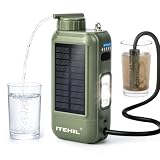
- Best Value: ITEHIL Portable Electric Water Filter, 0.01 Micron Camping Water Purifier with Solar, Outdoor Water Purification System for Camping, Hiking, Emergency & Survival
- Premium Choice: Swonder Portable Electric Water Filter – 0.01 Micron Camping Water Purifier with Solar & 5200mAh Battery, 4-Stage Filtration System for Hiking, Emergency, Survival
The best portable water purifiers for travel and outdoors depend on whether you need protection from bacteria and protozoa only, or also viruses: choose a lightweight hollow-fiber filter for hiking in treated backcountry streams, a chemical or UV purifier for uncertain viral risk, and a pump or press purifier for emergency water sources.
As an Amazon Associate we earn from qualifying purchases at no extra cost to you.


Quick picks by situation
- Best lightweight hiking filter: Sawyer Squeeze, when low weight, field repairability, and a very large rated capacity matter more than fast filling.
- Best fast squeeze-bottle system: Katadyn BeFree 1.0L, for solo day hikes and travelers who want a high initial flow rate with minimal setup.
- Best compact bottle purifier for travel: Grayl GeoPress, when you need a physical barrier against viruses as well as bacteria and protozoa.
- Best high-confidence emergency pump: MSR Guardian, for frequent use with difficult water and a self-cleaning design, provided its weight and price fit your kit.
- Best clear-water virus treatment: SteriPEN UltraLight, when batteries can be kept charged and the water has already been strained or filtered.
“Purifier” is not a universal technical label. Many popular outdoor products are filters: they physically remove bacteria, protozoa, sediment, and often microplastics, but their pore size does not reliably remove viruses. A purifier is designed to address a broader range of microorganisms, usually through a sufficiently small filter, UV light, chemical treatment, or a combination of methods.
Head-to-head comparison
| Product or type | Primary pathogen coverage | Rated capacity or battery | Flow or treatment time | Approx. weight | Care and limitations |
|---|---|---|---|---|---|
| Sawyer Squeeze | Bacteria, protozoa, and particles; not viruses | Up to 3,785 L, depending on model and maintenance | About 1.7 L/min when new and clean | About 63 g for the filter alone | Backflush regularly; protect the hollow fibers from freezing |
| Katadyn BeFree 1.0L | Bacteria, protozoa, and particles; not viruses | Up to 1,000 L under manufacturer conditions | Up to about 2 L/min when new | About 63 g including filter, before optional accessories | Shake or swish to clean; the soft flask is a wear item |
| LifeStraw Peak Series bottle or squeeze filter | Bacteria, protozoa, and particles; standard versions do not remove viruses | Common models are rated around 2,000 L | Typically about 1–3 L/min, model dependent | Roughly 100–245 g, model dependent | Clean the membrane; avoid freezing and heavily muddy water |
| Grayl GeoPress | Bacteria, protozoa, viruses, and many chemicals, depending on contaminant | About 250 L per cartridge | About 5 L/min; a 710 mL press takes roughly 8 seconds | About 450 g | Replace cartridges; do not treat seawater or rely on it for every chemical |
| MSR Guardian pump | Bacteria, protozoa, and viruses | About 10,000 L | About 2.5 L/min | About 490 g | Self-cleaning, but bulky; replace parts as seals and cartridges wear |
| SteriPEN UltraLight | Viruses, bacteria, and protozoa in clear water | Up to about 50 one-liter treatments per charge | One liter in about 90 seconds | About 76 g | Needs charged batteries and reasonably clear water; carry a prefilter |
Specifications vary by generation, accessory, and test conditions. Treat the table as a buying comparison rather than a guarantee of field performance. A blocked filter can be much slower than its advertised flow rate, and real cartridge life depends heavily on sediment and maintenance.
Filters versus true purifiers
Hollow-fiber filters: the efficient hiking choice
Hollow-fiber filters use bundles of tiny membrane tubes. Water passes through the membrane while larger organisms and particles remain outside. They are usually the best balance of weight, price, and operating simplicity for established backcountry routes where viral contamination is unlikely.
The trade-off is important: a filter such as the Sawyer Squeeze or Katadyn BeFree should not be treated as a complete solution for water that may contain human sewage, nor does it remove dissolved salts and most chemicals. A filter also needs careful handling in freezing weather. Water trapped inside the fibers can expand into microscopic cracks, creating damage that may not be visible.
Press purifiers: broad coverage without batteries
The Grayl GeoPress combines a bottle and replaceable purifier cartridge. It is attractive for international travel, uncertain municipal supplies, and short emergency use because pressing the cartridge requires no pumping or charging. Its disadvantages are weight, cartridge cost, and a relatively small cartridge capacity compared with a hiking filter.
A press purifier is also not a universal chemical remover. Follow the manufacturer’s contaminant guidance, and do not assume that a treated bottle makes industrial runoff, fuel-contaminated water, or seawater safe.
UV purifiers: lightest broad treatment for clear water
A UV device such as SteriPEN UltraLight can treat viruses, bacteria, and protozoa quickly while adding little weight. UV works best in clear water because suspended sediment can shield microorganisms from the light. Pre-filter cloudy water through a cloth, coffee filter, or compatible mechanical filter, then treat the stated volume with a fully charged device.
UV does not remove dirt, taste, heavy metals, or chemical pollutants. It also introduces an electronic failure point, so carry a backup method on remote trips.
Decision matrix: match the purifier to your trip
| Your situation | Best fit | Why | What to accept |
|---|---|---|---|
| Lowest pack weight and frequent wilderness use | Sawyer Squeeze or similar hollow-fiber filter | Low mass and high rated capacity | Backflushing, slower collection from shallow sources, no virus protection |
| Beginner who wants a simple bottle system | Katadyn BeFree or LifeStraw bottle filter | Fill, squeeze or drink, and clean with fewer loose parts | Limited cartridge life and a soft container that can puncture |
| International travel or uncertain viral risk | Grayl GeoPress or MSR Guardian | Designed to include virus treatment | More weight and substantially higher consumable cost |
| Solo emergency kit used occasionally | Grayl GeoPress plus a backup chemical method | Simple storage and no charging requirement | Cartridges expire or become less convenient after repeated use |
| Group or family water collection | MSR Guardian or a larger pump system | Better sustained throughput than a small bottle | Bulk, pump maintenance, and higher purchase cost |
| Clear water and strict weight savings | SteriPEN UltraLight with a prefilter | Broad pathogen treatment at low weight | Charging, clear-water requirement, and electronic failure risk |
Capacity is not the same as value
Consider a 10-day trip where one person treats 3 L per day: that is 30 L. A Grayl cartridge rated for about 250 L has ample volume capacity, but its replacement cost is incurred after the cartridge reaches its life limit, whether the trip uses 5 L or 200 L. A high-capacity hollow-fiber filter may cost less per liter over repeated trips, but only if you clean it correctly and replace the soft bags or seals when they fail.
For occasional travel, convenience can matter more than the lowest theoretical cost per liter. For frequent hiking, consumable cost and maintenance usually favor a replaceable or backflushable filter.
Maintenance that prevents most failures
- Collect from the clearest moving water available. Avoid surface scum, muddy edges, and stagnant pools. Less sediment means higher flow and longer membrane life.
- Protect clean and dirty sides. Keep the dirty-water bag, bottle mouth, and untreated hose away from the treated outlet. Cross-contamination can defeat an otherwise effective filter.
- Clean according to the design. Backflush a Sawyer-style filter with clean water; shake or swish a BeFree-style membrane; follow the pump’s cleaning procedure rather than forcing it.
- Dry before storage. Long-term damp storage can create odors and biological growth. Follow the manufacturer’s instructions for disinfecting and storage solutions.
- Prevent freezing damage. Keep hollow-fiber filters inside clothing or a sleeping bag overnight. If one may have frozen while wet, replace it rather than trusting an invisible membrane.
- Carry a backup. A few chlorine-dioxide tablets or another independent method weigh little and protect against a broken bag, dead battery, or blocked filter. Use products exactly as labeled.
Common buying mistakes
- Choosing a “0.2-micron filter” while assuming that number means virus removal. Most viruses are smaller than the pores used in common hiking filters.
- Comparing advertised flow rates without considering muddy source water, elevation, bag height, or a partially clogged membrane.
- Buying a purifier with a narrow mouth that cannot be filled efficiently from shallow streams or hotel sinks.
- Ignoring replacement bags, cartridges, O-rings, batteries, and caps. These often wear out before the main filter element.
- Using UV on cloudy water without prefiltering, or using any portable device as though it removes all chemical contamination.
Bottom line
For most lightweight hiking, the Sawyer Squeeze, Katadyn BeFree, or comparable hollow-fiber filter is the sensible choice when the water source has low viral risk. For travel where virus protection matters, the Grayl GeoPress is the more compact all-in-one option, while the MSR Guardian suits heavier, repeated emergency use. Choose SteriPEN UltraLight when clear water, charging, and a backup plan are all practical. Whatever you buy, confirm the pathogen claims, treat the source water conservatively, and follow the specific cleaning and replacement instructions supplied with the device.
Ready to decide? Our #1 pick for 2026 is the Sawyer Squeeze.
Live price & availability on Amazon.



Write Your Review
No reviews yet. Be the first to share your experience!