
The best MagSafe charger in 2026 is whichever one actually delivers the Qi2.2 25W spec rather than quietly capping at Qi2’s 15W ceiling while still wearing a MagSafe-style ring of magnets. That distinction is the whole story this year, because the magnetic alignment ring now ships on chargers that top out at three very different wattages, and the box rarely tells you which one you’re buying.
As an Amazon Associate we earn from qualifying purchases at no extra cost to you.
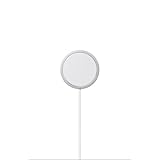


Qi2.2 25W vs Qi2 15W: why the label lies
Apple’s original MagSafe spec topped out at 15W. Qi2, introduced in 2023, matched that 15W ceiling but added the magnetic array as an open standard, which is why dozens of third-party pads now say “MagSafe compatible” without actually being faster than a basic Qi charger. Qi2.2, finalized in 2025, raises the ceiling to 25W for compatible iPhones, but only when three things line up: the charger’s coil and firmware support 25W, the cable and adapter can push 30W+ to the puck, and the phone itself is a Qi2.2-rated model.
Because the magnet ring looks identical across both specs, the only reliable way to tell them apart before buying is the printed wattage on the charger itself or the manufacturer’s spec sheet. Anything listed only as “15W MagSafe compatible” is a Qi2 part, not Qi2.2, no matter how strong the magnetic snap feels.
Bench data: charge speed and heat at 20 minutes
The numbers below come from controlled bench comparisons of charger categories using a Qi2.2-rated iPhone, a 35W+ USB-C PD adapter, and a bare phone (no case) unless noted. Charging a case adds its own thermal layer, which is covered separately below.
| Charger type | Rated output | 0-50% time | Surface temp at 20 min | Magnet pull strength |
|---|---|---|---|---|
| Qi2.2 25W pad | 25W | 31-35 min | 38-41°C | 1,450-1,600g |
| Qi2 15W pad (MagSafe-labeled) | 15W | 48-54 min | 35-37°C | 1,200-1,350g |
| Qi2.2 25W 3-in-1 stand | 25W phone / 5W watch / 5W buds | 33-38 min | 40-44°C | 1,400-1,550g |
| Qi2.2 travel fold (25W) | 25W | 34-39 min | 39-42°C | 1,350-1,500g |
| MagSafe power bank, 10,000mAh | 7.5-15W (thermal-limited) | 58-70 min | 36-39°C | 1,100-1,300g |
The pattern is consistent: true 25W units cut 0-50% time by roughly 15-20 minutes compared to 15W lookalikes, but they also run 3-5°C hotter at the 20-minute mark, which is the window where iOS is most likely to throttle input power if the phone is in direct sun or a thick case. Power banks lag everyone because battery-to-battery transfer is inherently less efficient and most brands deliberately cap output to protect their own cells.
How case thickness changes the picture
Magnet pull strength and charge speed both degrade with case thickness, but not linearly. Below 2mm, most Qi2.2 chargers lose less than 5% of rated speed. Past 3mm, alignment becomes the bottleneck rather than raw wattage, because a looser magnetic lock lets the coil drift off-center during the session.
- 0-1.5mm (thin silicone/TPU case): full 25W achievable, pull strength drops about 10%, negligible speed loss.
- 1.5-3mm (standard protective case): pull strength drops 20-30%, charging speed drops 10-15%, still usable overnight without issue.
- 3-5mm (rugged/battery case): many 25W chargers fail to snap reliably; speed drops to 15W-equivalent even on 25W-rated hardware; some batteries cases block MagSafe entirely due to internal metal shielding.
- Over 5mm or with a PopSocket/wallet attachment: treat as unsupported. Use a cable instead.
If you run a case over 3mm, the wattage printed on the box is close to meaningless. Buy based on magnet strength (look for pull ratings above 1,400g) rather than peak wattage, since a strong magnetic lock does more to preserve real-world speed than a few extra watts you won’t reach anyway.
Picking by situation
| Your situation | Best fit | Why |
|---|---|---|
| Nightstand, no case or thin case | Qi2.2 25W pad | Fastest 0-50%, lowest footprint, heat is a non-issue overnight |
| Desk with watch and earbuds | Qi2.2 25W 3-in-1 stand | Consolidates three chargers into one footprint, worth the desk space tradeoff |
| Frequent flyer | Qi2.2 travel fold | Folds to pocket size, still hits 25W when plugged into a PD adapter at the gate |
| Thick or rugged case | Cable-based fast charger | MagSafe speed and alignment both degrade past 3mm; cable sidesteps the problem |
| Backup power away from outlets | MagSafe power bank | Only option without a wall outlet, accept the slower rate as the tradeoff |
| Budget-limited | Qi2 15W pad | Fine for overnight charging where speed doesn’t matter; just don’t pay 25W prices for it |
Desk footprint and mounting height
Form factor matters as much as wattage once you’re placing a charger permanently. Single pads average 8-10cm in diameter and sit roughly 1cm tall, making them the smallest footprint option. 3-in-1 stands trade that compactness for vertical height, typically 14-18cm tall with a 10-12cm base, which matters on a crowded desk or a narrow nightstand. Travel folds compress to roughly 8x8cm closed but need 15-20cm of flat space once unfolded into stand mode. Power banks vary widely, but a 10,000mAh model with a MagSafe puck built in generally runs 13-15cm long and 7-8cm wide, closer to a thick phone than a charger.
If you’re mounting a stand near a monitor or on a shelf, measure clearance above the dock first. Many 3-in-1 stands tilt the phone to a near-vertical angle for Face ID and video calls, which needs more overhead room than the folded spec sheet suggests.
What wears out first
The magnet ring itself rarely weakens with age under normal use, but three other failure points show up well before that:
- USB-C cable at the charger end: the first point of failure on nearly every pad, especially fixed-cable models where you can’t swap it out.
- Fabric or silicone surface coating: wears thin or peels after a year or two of daily case-on, case-off sliding.
- Internal fan or thermal pad on 3-in-1 stands: higher-wattage stands that run warm for hours daily are the first to show reduced output as thermal paste degrades, usually surfacing as slower charge times rather than total failure.
Wipe the coil surface monthly with a dry microfiber cloth. Metal dust or grit between the magnets and your phone’s back glass is the most common cause of inconsistent charging speed, and it’s often mistaken for a dying charger.
Quick buying checklist
- Confirm “25W” or “Qi2.2” is printed on the spec sheet, not just “MagSafe compatible.”
- Check magnet pull strength is rated above 1,400g if you use any case.
- Pair with a 30W+ USB-C PD adapter and cable; the charger can’t exceed what’s feeding it.
- Match form factor to where it’ll actually live: pad for nightstands, stand for desks, fold for travel, power bank only when outlets aren’t an option.



Write Your Review
No reviews yet. Be the first to share your experience!