
- Top Pick: EVEO Screen Cleaner Spray – Large Screen Cleaner Bottle – TV Screen Cleaner, Computer Screen Cleaner, for Laptop, Phone, Ipad – Computer Cleaning kit Electronic Cleaner (1 Pack)
- Best Value: iO CLEAN 16oz Screen Cleaner Spray – Best Large Cleaning Kit
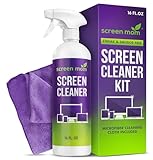
- Premium Choice: Screen Mom Screen Cleaner Spray 16oz Bottle for TV, Car, Laptop & Computer
The best cleaner for TV screen surfaces without streaks is a small amount of distilled water applied to a clean, tightly woven microfiber cloth—not a household glass cleaner sprayed directly onto the panel.
For most modern OLED, QLED, LED-LCD, and mini-LED televisions, the safest purchase is a screen-specific, alcohol-free, ammonia-free formula paired with two or three high-quality microfiber cloths. However, a dry microfiber cloth is often the better choice for ordinary dust, fingerprints, and light smudges because every liquid adds a small risk of streaking, seepage, or residue.
As an Amazon Associate we earn from qualifying purchases at no extra cost to you.


Best cleaner for TV screen: the short answer
- For dust: use a clean, dry microfiber cloth with a tight weave and no abrasive edging.
- For fingerprints: lightly dampen the cloth with distilled water.
- For greasy marks: use a screen-safe, alcohol-free, ammonia-free cleaner, applied to the cloth rather than the TV.
- For expensive OLED or anti-glare displays: start with distilled water and use a commercial formula only when water is insufficient.
- For the frame and stand: a separate slightly damp cloth is acceptable, but do not assume a product safe for plastic or glass is safe for the screen coating.
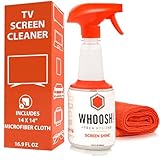
Screen-specific products such as WHOOSH! Screen Shine and Screen Mom are examples of purpose-made display cleaners. Their main advantage is not that they clean better than water in every situation; it is that they are formulated to avoid common ingredients that can harm or leave residue on display surfaces. Follow the label and the television manufacturer’s instructions, since coatings differ between models.
Screen-safe formulas compared
| Cleaner type | Best use | Streak risk | Coating risk | Typical cost |
|---|---|---|---|---|
| Dry microfiber cloth | Dust and light marks | Very low | Low when clean | $5–$15 for a two- to six-pack |
| Distilled water | Fingerprints and fresh smudges | Low when used sparingly | Very low | $1–$3 per 1-gallon container |
| Alcohol-free screen cleaner | Oily fingerprints and persistent film | Low to moderate | Low if labeled for displays | $8–$20 for 4–16 fl oz |
| Glass cleaner | Windows and mirrors, not televisions | Moderate to high | High | $3–$8 per bottle |
| Isopropyl alcohol solution | Some electronics and hard plastics only | Moderate | Potentially high on TV coatings | $3–$10 per bottle |
The least expensive option is usually distilled water, but the cloth matters. Tap water can contain minerals that dry into spots, especially in areas with hard water. A screen cleaner can be worthwhile if a household television is frequently touched, if cooking grease reaches the display, or if repeated water cleaning leaves a film.
Which microfiber tools are worth buying?
A useful screen-cleaning kit has more to do with cloth construction than with branding. Look for a lint-free microfiber cloth marketed for lenses, displays, or delicate surfaces. A tight, smooth weave is preferable to a thick automotive drying towel, which can trap grit and apply more pressure than necessary.
| Tool | Useful specification | Role | Ownership note |
|---|---|---|---|
| Primary screen cloth | 30 × 30 cm or larger; smooth microfiber; edgeless or soft-seamed | Removes dust and cleaner | Reserve it for displays and wash separately |
| Detail cloth | 20 × 20 cm to 30 × 30 cm; short pile | Cleans corners and bezels | Replace when it develops a rough edge |
| Drying cloth | 30 × 30 cm or larger; clean and dry | Removes remaining moisture | Use a second cloth to reduce streaks |
| Soft air blower | Hand-powered, no liquid propellant | Moves dust from seams | Useful before wiping; never use compressed air at close range |
Cloths marketed by brands such as MagicFiber and e-cloth are common examples of reusable microfiber options, but the fabric condition is more important than the logo. Wash them without fabric softener, bleach, or strong fragrance products. Fabric softener coats the fibers and can redistribute oily residue across the panel. Do not use a cloth that has previously cleaned a kitchen surface, car wheels, or a dusty shelf.
What can damage a modern TV screen?
Ammonia and standard glass cleaner
Many glass cleaners are designed to cut grease on windows, not to protect anti-reflective or low-glare coatings. Ammonia and related solvents can dull, haze, discolor, or unevenly affect a delicate surface. Even if no damage is visible after one use, repeated exposure is an unnecessary risk.
Alcohol and strong solvents
Isopropyl alcohol is useful for certain electronics and hard surfaces, but television panels are not interchangeable with keyboards, phones, or remote controls. Alcohol can interact poorly with screen coatings, printed markings, adhesives, or plastic layers. Unless the TV manufacturer specifically permits it, do not use alcohol on the display.
Direct spraying
Spraying the panel can force liquid into the lower bezel, speakers, buttons, ventilation openings, or internal edges. A spray bottle also delivers more liquid than a screen normally needs. Apply a small amount to the cloth instead. The cloth should be damp, not wet enough to leave a visible trail or drip when held vertically.
Paper towels and abrasive materials
Paper towels can contain rough fibers that create fine scratches or shed lint. Facial tissues, kitchen roll, melamine foam, scouring pads, and textured cleaning wipes are unsuitable. A new microfiber cloth can also scratch if it has picked up grit, so shake or rinse it before use.
Choose by your situation
| Your situation | Best choice | Why |
|---|---|---|
| Weekly dusting, no fingerprints | One dry display microfiber cloth | It avoids unnecessary moisture and costs the least |
| Children touch the screen often | Two cloths plus an alcohol-free screen cleaner | One cloth removes residue; the second buffs dry |
| Large OLED with an anti-glare finish | Distilled water and a very soft cloth | Minimizes exposure to chemicals and excess liquid |
| Kitchen or open-plan room | Screen-safe cleaner and a separate frame cloth | Grease requires more than dry dusting, while the frame may collect heavier soil |
| Infrequent cleaning on a budget | Distilled water and two washable cloths | Low ongoing cost and enough separation for wiping and drying |
How to clean a TV without streaks
- Turn the television off and let it cool. A warm panel can dry liquid too quickly and make streaks more visible. A dark screen also makes fingerprints easier to see.
- Remove loose dust first. Use a dry microfiber cloth with almost no pressure, moving from the top toward the bottom. If dust is dragged across the surface, it can act like fine grit.
- Inspect the cloth. Use a clean section with no trapped particles, tags, hard seams, or debris.
- Dampen the cloth, not the TV. Use distilled water or a small amount of a screen-specific cleaner. For a 55-inch television, a few light sprays onto the cloth are normally more than enough; do not saturate it.
- Wipe in straight, overlapping passes. Work in sections rather than scrubbing one fingerprint in circles. Gentle pressure is sufficient.
- Buff with a second dry cloth. This removes residual moisture before it evaporates into streaks. If the screen still looks smeared, the problem is usually too much product or a contaminated cloth, not a need for stronger chemicals.
- Clean the bezel separately. The frame may tolerate a slightly different cleaner, but keep liquid away from panel edges, controls, ports, speakers, and ventilation slots.
Cost per use and replacement reality
Suppose a $12 bottle contains 8 fl oz and supplies roughly 80 light applications. That works out to about $0.15 per use. A two-pack of $10 microfiber cloths used once a week costs about $0.10 per cleaning over the first year, before washing. In practice, cloths wear out sooner than the bottle: embedded grit, roughened edges, lint, and residue are the usual failure points.
Replace a screen cloth when it no longer feels smooth, leaves lint, develops a hard seam, or continues streaking after careful washing. Keep the bottle capped, store it away from heat, and do not pour cleaner into a different container. A dedicated cloth and modest cleaning frequency usually matter more than buying the most expensive formula.
Final recommendation
For most households, buy two smooth microfiber cloths and keep a bottle of distilled water available. Add an alcohol-free, ammonia-free display cleaner—such as a purpose-made product from WHOOSH! or Screen Mom—only if fingerprints, grease, or repeated smearing justify it. Avoid glass cleaner, direct spraying, paper towels, abrasive wipes, and aggressive solvents. The best cleaner for TV screen care is the one that uses the least liquid, the lightest pressure, and a clean tool matched to the panel’s coating.
Ready to decide? Our #1 pick for 2026 is the Dry microfiber cloth.
Live price & availability on Amazon.




Write Your Review
No reviews yet. Be the first to share your experience!