
The best patio furniture covers are made from solution-dyed polyester or polyester with a waterproof backing, sized 2–5 inches larger than the furniture, and secured with adjustable straps, buckles, or drawcords rather than relying on elastic alone.
- Best patio furniture covers by situation
- How to measure patio furniture for a dependable fit
- Fabric and weather resistance: what the specifications mean
- Ventilation prevents a different kind of damage
- Fastening systems compared
- Cover shapes: match the furniture, not just the category
- Durability and ownership costs
- Common buying mistakes
As an Amazon Associate we earn from qualifying purchases at no extra cost to you.


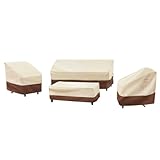

Best patio furniture covers by situation
| Situation | Cover type to choose | Why it fits the job | Useful target specifications |
|---|---|---|---|
| Lowest-cost seasonal protection | PU-coated polyester cover | Blocks rain and dirt without the weight of premium canvas | 300–420 denier fabric, taped or bound seams, two tie-down points |
| Windy balcony or exposed deck | Heavy-duty cover with buckles and drawcord | Multiple restraints prevent lifting and ballooning | 600-denier polyester, four or more straps, vent panels |
| Frequent use | Lightweight cover with handles and storage bag | Easy removal encourages regular use instead of leaving furniture exposed | 300–600 denier fabric, two handles, compact folded size |
| Large sectional or unusual shape | Modular covers or custom-fit cover | Reduces loose fabric, water pockets, and uncovered corners | Separate pieces or precise dimensions within 2–3 inches |
| Snow, ice, and long-term storage | Heavy-duty waterproof cover with reinforced seams | Handles repeated moisture, freezing, and heavier accumulation better | 600–900 denier polyester, waterproof backing, reinforced handles |
How to measure patio furniture for a dependable fit
Measure the furniture in the position where it will remain covered. Do not measure only the cushion area: include armrests, table edges, chair backs, wheels, and any attached extensions.
- Length: Measure from the farthest left point to the farthest right point.
- Width: Measure the deepest front-to-back dimension, including protruding arms or table legs.
- Height: Measure from the ground to the highest fixed point. For chairs, include the top of the backrest.
- Irregular features: Record the location and size of shelves, fire-pit openings, umbrella poles, or raised bases.
- Furniture that moves: Measure it pushed together only if the cover is specifically intended for that arrangement.
Add roughly 2 inches to each horizontal measurement for a close, usable fit. Add 2–4 inches to height so the cover reaches below the furniture frame without dragging on the ground. A cover that is substantially oversized can be less protective: loose fabric catches wind, sags between cushions, and creates places for rainwater to collect.
Worked sizing example
Suppose a rectangular dining table measures 72 inches long, 38 inches wide, and 30 inches high. A practical target is approximately 74–76 inches long, 40–42 inches wide, and 32–34 inches high. A cover listed as 80 by 50 by 30 inches is not automatically better: its length and width may be too loose, while its height may leave the legs exposed.
For chairs pushed under that table, check the combined height. If the chair backs rise to 36 inches, shop for a table-and-chair cover with at least 38–40 inches of usable height, not a table-only cover.
Fabric and weather resistance: what the specifications mean
Polyester
Polyester is the most practical general-purpose material because it is relatively light, dries quickly, and resists stretching better than many basic woven fabrics. A polyurethane, or PU, coating on the underside adds water resistance. Solution-dyed polyester is preferable in bright sun because the color is incorporated into the fibers before weaving, improving fade resistance.
Olefin
Olefin fabric has good resistance to moisture and sunlight and is often used in higher-end outdoor textiles. It can be comfortable and colorfast, but cover construction matters more than the fiber name alone. A thin olefin cover with weak seams will not outperform a well-made coated polyester cover.
Vinyl and PVC-coated fabric
Vinyl can provide a strongly waterproof surface and is useful for severe exposure. It is usually heavier, less breathable, and more prone to stiffness or cracking after repeated cold-weather folding. It should have vents or breathable side panels when used over furniture for long periods.
Denier and coating
Denier describes yarn thickness, not complete quality. A 600-denier cover is generally more abrasion-resistant than a 300-denier cover, but seam construction, stitching, and the waterproof backing are equally important. Look for bound or double-stitched seams, reinforced corners, and a coating designed for outdoor use.
Ventilation prevents a different kind of damage
A fully sealed cover can keep rain out while trapping condensation underneath. That moisture may encourage mildew on cushions, leave metal frames damp, and stain wood surfaces. Vent panels placed on the sides allow humid air to escape while limiting wind-driven rain.
Ventilation is especially important for furniture stored under a cover for weeks at a time. It is less critical for a cover removed every day, although air circulation still helps after rain. Avoid covering wet cushions whenever possible; a breathable cover cannot dry saturated fabric quickly if there is no airflow underneath.
Fastening systems compared
- Elastic hem: Gives a neat edge and works in sheltered locations, but can loosen or lose elasticity in sunlight.
- Drawcord: Lets you tighten the lower edge around different furniture shapes. It is useful but may not be enough by itself in strong wind.
- Click-close buckles: The most dependable choice for exposed decks. Straps should be adjustable and positioned so they do not rub against sharp frame edges.
- Hook-and-loop tabs: Convenient for small covers, though dirt and repeated moisture can reduce their grip.
- Leg ties: Helpful on chairs and tables with accessible legs. They are less useful when the legs are close together or hidden by a solid base.
For windy conditions, choose at least two independent restraints for a small chair cover and four or more for a sofa, sectional, or dining set. Keep straps snug rather than dangerously tight. Excess tension can pull stitching away from the hem.
Cover shapes: match the furniture, not just the category
Rectangular covers are efficient for dining tables, benches, and box-shaped sofas. Round covers suit pedestal tables and circular fire pits, but a circular cover placed over a rectangular table usually leaves corners exposed. L-shaped sectional covers should follow the sectional’s angle; using one oversized rectangle often creates a deep pocket where water and leaves accumulate.
Separate covers are usually better for a table and chairs than one large set cover when the chairs are used frequently. Individual pieces can be removed without exposing everything else, and each cover is less likely to catch wind. One set cover is faster to install and can be appropriate for long-term storage in a sheltered area.
Durability and ownership costs
The first parts to wear are commonly the hem, buckle stitching, drawcord eyelets, and folded creases exposed to sunlight. Covers also fail early when they rub against rough masonry, sharp chair corners, or protruding screws. Before covering furniture, remove sharp accessories, close umbrellas, and pad unavoidable edges with smooth foam or fabric.
Cleaning is usually simple: shake off debris, rinse with a hose, and use mild soap with a soft brush for grime. Avoid bleach, harsh solvents, pressure-washing, and machine drying unless the care label specifically permits them. Dry the cover completely before folding it. Store it loosely in a dry, ventilated place rather than compressed while damp.
A useful ownership calculation is cost per season. A $35 cover used for two seasons costs about $17.50 per season. A $90 cover that lasts five seasons costs $18 per season, before considering the cost of replacing damaged cushions or refinishing furniture. For exposed furniture, stronger fabric and better fasteners can therefore be economical even when the purchase price is higher.
Common buying mistakes
- Choosing the largest available cover instead of measuring the furniture.
- Confusing “water-resistant” fabric with waterproof seams and backing.
- Ignoring the wind rating of the location and buying an elastic-only cover.
- Covering wet cushions and assuming the cover will dry them.
- Leaving a cover resting in puddles because the furniture is too low or the fabric has no sloped surface.
- Using a table cover for a table with chairs whose backs are higher than the listed cover height.
For most patios, the best balance is a close-fitting solution-dyed polyester cover with a waterproof backing, breathable vents, reinforced seams, and adjustable buckles plus a drawcord. Measure first, allow only a small amount of extra room, and choose a shape that follows the furniture’s actual outline. Those details matter more than a premium-sounding fabric label or an unusually high denier number.


Write Your Review
No reviews yet. Be the first to share your experience!