
- Top Pick: 8Bitdo Arcade Stick for Switch & Windows, Arcade Fight Stick Support Wireless Bluetooth, 2.4G Receiver and Wired Connection
- Best Value: 8Bitdo Arcade Stick for Xbox Series X|S, Xbox One and Windows 10, Arcade Fight Stick with 3.5mm Audio Jack – Officially Licensed (Black)
- Premium Choice: 8BitDo Arcade Stick for Switch 2, Switch and Windows PC, Purple
The best arcade fight sticks for competitive play are the Victrix Pro FS-12 for a premium leverless setup, the HORI Fighting Stick Alpha for a traditional PlayStation/PC lever stick, and the 8BitDo Arcade Stick for affordable Switch and PC use.
The right choice depends less on appearance than on four practical questions: do you want a joystick lever or buttons, how much input delay can you tolerate, which consoles must work without adapters, and are you likely to replace switches, buttons, or the lever later?
As an Amazon Associate we earn from qualifying purchases at no extra cost to you.


Quick picks by situation
- Best premium leverless controller: Victrix Pro FS-12. It has 12 low-profile buttons, a rigid metal chassis, and a layout designed for fast directional inputs.
- Best traditional PlayStation stick: HORI Fighting Stick Alpha. Its Sanwa Denshi parts, tournament-style layout, and accessible case make it a strong long-term platform for PS5, PS4, and PC.
- Best value Switch stick: 8BitDo Arcade Stick. It is wireless, affordable, and compatible with Nintendo Switch and PC, although its stock parts are less competition-focused than Sanwa hardware.
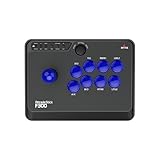
- Best inexpensive modding base: Mayflash F500 or F700. These cases are easy to open and accept widely available replacement parts, with compatibility varying by model and connected platform.
- Best compact competitive option: Razer Kitsune. Its leverless layout is thin and portable, with optical switches and a PlayStation/PC focus, but it is less universally compatible than a multi-platform adapter-based stick.
Lever versus leverless: which hardware is faster for you?
A traditional arcade stick uses a four-direction joystick lever plus eight attack buttons. Sanwa JLF-style levers remain popular because their square restrictor, spring tension, actuator, and gate can be replaced independently. They provide tactile diagonal and circular motion, which many players prefer for charge characters, grapplers, and arcade-style movement.
Leverless controllers replace the joystick with four directional buttons. This can reduce the physical travel required for left, right, up, and down, and simultaneous-opposite-direction rules are handled by the controller’s firmware. That makes techniques such as rapid charge inputs and certain motion shortcuts easier for some players. It does not automatically make a player better: unfamiliarity, accidental inputs, and game-specific rules can outweigh the theoretical speed advantage.
For competition, check tournament rules before buying. Some events restrict how simultaneous opposite directions are resolved, particularly when a controller sends left and right together. A compliant controller may need a firmware setting that neutralizes one direction.
Head-to-head comparison
| Model | Layout and parts | Primary compatibility | Approx. size and weight | Typical 2026 market range |
|---|---|---|---|---|
| Victrix Pro FS-12 | 12-button leverless layout; low-profile mechanical switches | PS5, PS4, PC | Approx. 15.8 × 8.8 × 2.1 in; about 4 lb | $300–$400 |
| HORI Fighting Stick Alpha | Sanwa JLF lever and Sanwa buttons; replaceable panel design | PS5/PS4/PC version; Xbox version is separate | Approx. 15.7 × 8.8 × 4.8 in; about 5.7 lb | $160–$230 |
| Razer Kitsune | Four-direction leverless layout; optical switches | PS5, PS4, PC | Approx. 15.4 × 8.0 × 1.4 in; about 1.9 lb | $250–$300 |
| 8BitDo Arcade Stick | Traditional lever; swappable buttons and restrictor gate | Nintendo Switch, PC; wireless and wired modes | Approx. 14.2 × 9.6 × 4.2 in; about 4.8 lb | $80–$120 |
| Mayflash F500/F700 | Traditional lever; user-replaceable arcade parts | PC and multiple consoles through USB or supported adapters | Approx. 14 × 9 × 3.5 in; roughly 4–5 lb | $90–$170 |
Dimensions and weights are approximate manufacturer figures and can vary by revision. Wireless functions, console support, and authentication requirements also change by firmware and platform, so verify the exact model rather than assuming that a similarly named version works everywhere.
Sanwa parts versus proprietary hardware
Sanwa Denshi parts are the safest choice when you value a familiar tournament feel and easy replacement. Sanwa buttons are commonly available in multiple colors and sizes, while JLF-compatible levers have a large ecosystem of gates, shafts, springs, and actuators. The trade-off is that stock Sanwa buttons are relatively light and clicky compared with some silent or low-profile alternatives.
Proprietary hardware can be better optimized for a particular case. Razer’s Kitsune uses optical switches rather than a conventional joystick, reducing moving parts and allowing a slim enclosure. Victrix’s low-profile buttons and metal frame prioritize portability and a firm playing surface. These designs can feel excellent, but replacement parts may be less interchangeable and more expensive.
On inexpensive sticks, the first upgrade is often the buttons, followed by the lever’s spring or restrictor gate. A full Sanwa conversion can cost roughly $40–$90 in parts, plus time and tools. That means a $100 stick can become a $150–$190 project before artwork or a larger storage case is added.
Input latency and connection choices
Input latency is the delay between pressing a control and the console or computer registering it. Differences between modern wired fight sticks are usually small enough that connection stability, firmware, display latency, and player timing matter more. For serious competition, wired USB is the safest default.
- Wired USB: the preferred connection for tournaments and lowest uncertainty.
- 2.4 GHz wireless: convenient when supported, but keep the receiver close and maintain its battery charge.
- Bluetooth: useful for casual play, but generally less desirable for latency-sensitive competition.
- Console adapters: may introduce compatibility or authentication issues, especially after console firmware updates.
PC compatibility is usually broad because the controller can appear as XInput, DirectInput, or a platform-specific USB device. PlayStation 5 compatibility is more restrictive: a stick must explicitly support PS5 games, not merely work with PS4 titles on the console. Switch compatibility is also model-specific; a PlayStation-focused stick should not be assumed to work on Nintendo’s console.
Decision matrix: match the stick to your situation
| Your situation | Best direction | Why |
|---|---|---|
| New to arcade controllers and under $120 | 8BitDo Arcade Stick | Low entry cost, Switch/PC support, and enough access for later button or lever upgrades. |
| Already use a lever and play PS5 regularly | HORI Fighting Stick Alpha | Sanwa parts, full-size layout, and a case designed for maintenance and customization. |
| Want the shortest directional inputs | Razer Kitsune or Victrix Pro FS-12 | Leverless buttons eliminate joystick travel, though the learning curve is different. |
| Travel frequently or have little desk depth | Razer Kitsune | Its slim body is easier to carry and store than a traditional stick with a tall lever. |
| Play several consoles and expect to modify parts | Mayflash F500/F700 | The open case and broad replacement-part support are more useful than premium materials. |
Modding and ownership costs
Before opening a stick, check whether the case uses quick-disconnect terminals and standard 30 mm action buttons. Standard parts make upgrades simple; soldered switches and proprietary connectors make them less convenient. Also confirm that the replacement lever matches the mounting plate and shaft height. A part can fit the button hole while still colliding with the case or producing the wrong travel.
For a basic maintenance routine, unplug the controller, remove dust with a dry compressed-air burst, and wipe the exterior with a lightly damp microfiber cloth. Do not spray cleaner into switches. Buttons commonly show wear first through inconsistent actuation or a weaker return, while a lever may develop looseness from a worn spring, actuator, or pivot. If inputs begin repeating, test the controller in a button-input display before replacing parts; the issue may be firmware or a cable rather than mechanical wear.
A useful ownership calculation is cost per use. A $200 stick used twice a week for three years sees about 312 sessions, or roughly $0.64 per session before replacement parts. A $100 model used only ten times costs $10 per session. Frequent players should prioritize a comfortable layout, repairable parts, and the correct platform connection over decorative features.
Bottom line
Choose the HORI Fighting Stick Alpha if you want the safest traditional lever-and-Sanwa combination for PlayStation and PC. Choose the Victrix Pro FS-12 or Razer Kitsune if you specifically want leverless directional buttons and compete mainly on PS5 or PC. Choose the 8BitDo Arcade Stick for the most approachable Switch/PC option, and a Mayflash model when broad modding potential matters more than premium stock parts.
Ready to decide? Our #1 pick for 2026 is the Victrix Pro FS-12.
Live price & availability on Amazon.




Write Your Review
No reviews yet. Be the first to share your experience!