
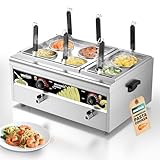
- Top Pick: WantJoin Commercial Pasta Cooker – Electric Pasta Cooker with 6 Noodle Strainers, Precision Temp Control 86°F to 230°F, Cooking Machine w/Drain Valve for Spaghetti Ramen, Noodles and Vegetables
- Best Value: WantJoin Commercial Pasta Cooker – Electric Pasta Cooker with 2 Noodle Strainers, Precision Temp Control 86°F to 230°F, Cooking Machine w/Drain Valve for Spaghetti Ramen, Noodles and Vegetables
- Premium Choice: Commercial Gas Pasta Cooker with 6 baskets Natural Gas Noodle Cooking Boiler with Precise Temperature Control(86°F-257°F)Auto Gas Shut-off for Restaurant Buffet, Food Truck- 122000 BTU
The best commercial pasta cookers for busy kitchens are gas-fired countertop or range-mounted units with at least 12 gallons of water, independent baskets, strong recovery, and a drain or filtration system that staff can operate without shutting down service.
As an Amazon Associate we earn from qualifying purchases at no extra cost to you.


Quick picks by kitchen situation
| Kitchen situation | Best cooker format | Useful target specification | Why it fits |
|---|---|---|---|
| Small café, limited menu | Single-well countertop cooker | 8–12 gal capacity, 30–50 lb/hr output | Lowest footprint and simpler cleaning |
| Busy restaurant with several pasta dishes | Two-well gas cooker | 16–24 gal total, 90,000–150,000 BTU/hr | Separates products and preserves recovery during rushes |
| High-volume Italian kitchen | Range-mounted or modular multi-well unit | 24–40 gal total, 150,000+ BTU/hr | Supports continuous basket loading and larger production |
| Ventilation-constrained site | Electric countertop cooker | 12–18 kW, 8–16 gal capacity | No gas connection, although electrical demand is substantial |
| Occasional pasta service | Compact countertop unit with one or two baskets | 6–10 gal, 30–60 lb/hr output | Avoids paying for unused wells and burner capacity |
What matters most when comparing commercial pasta cookers
Capacity is not the same as usable capacity
A cooker advertised as a 12-gallon unit does not necessarily provide 12 gallons of practical cooking water. The vessel needs headspace to prevent boil-over, and displacement from baskets and pasta reduces the working volume. For busy service, a 12-gallon well commonly provides around 8–10 gallons of useful water.
As a working estimate, allow roughly 1 gallon of water for every 1–2 pounds of dry pasta cooked in a batch. This is not a rigid cooking rule, but it helps compare equipment. A kitchen cooking 6 pounds at once should look beyond a small 6-gallon well, particularly if it needs to reload immediately.
Recovery time determines whether the cooker survives a rush
Recovery is the time required for the water to return to a vigorous boil after cold or room-temperature pasta enters the basket. A large tank with weak heating can perform worse than a smaller tank with a powerful burner.
Gas models are commonly specified by input in BTU/hr. A single-well unit may use approximately 60,000–100,000 BTU/hr, while a high-output two-well cooker may use 120,000–200,000 BTU/hr across both wells. Electric models often fall around 9–18 kW. Higher input generally improves recovery, but it also increases gas consumption, electrical requirements, heat output, and installation cost.
Ask the manufacturer for recovery data under a defined load rather than relying only on the input rating. A useful specification should state how many pounds of pasta were added, the starting water temperature, and the time to return to a boil.
Basket configuration affects speed and cross-contact
Independent baskets are more useful than one oversized basket in most restaurants. They let cooks remove one portion without disturbing another and make it easier to separate spaghetti, filled pasta, gluten-free pasta, and vegetables.
- Four to six small baskets: best for varied à la carte orders and precise portion control.
- Two medium baskets: a practical compromise for moderate volume and mixed menu items.
- One large basket: efficient for batch production but less flexible during simultaneous orders.
- Split wells: useful when different products require different cook times or water-change schedules.
Check basket dimensions, handle clearance, and whether replacement baskets are stocked separately. A basket that is technically compatible but difficult to lift when full becomes a service bottleneck.
Gas versus electric pasta cookers
| Factor | Gas | Electric |
|---|---|---|
| Recovery | Usually very strong at high input ratings | Can be strong, but depends on available circuit capacity |
| Installation | Requires gas, flue, and suitable ventilation | Requires correctly sized dedicated electrical service |
| Heat around cooking line | Higher, especially with open burners | Often lower at the front of the unit |
| Temperature control | Fast response, often manual | Some models provide more precise thermostatic control |
| Cleaning access | Burner and flue areas add service points | Fewer combustion parts, but controls and heating elements need protection |
| Best use | High-volume kitchens with strong ventilation | Sites without gas or with a preference for electric cooking lines |
Manufacturers such as Vulcan, Garland, Imperial, Pitco, and Montague offer commercial cooking equipment in formats that can include pasta-cooking configurations. Exact capacity, burner input, electrical service, and basket options vary by model and jurisdiction, so confirm the current specification sheet before ordering.
Water management: the overlooked buying criterion
Water management often matters more than an extra basket. Look for a full-size drain valve that can be operated safely, a drain connection compatible with the site, an overflow or skimming arrangement, and a way to refill the tank without carrying pots of water across the kitchen.
Some kitchens change water several times per shift; others top up and filter it depending on menu volume and starch release. A drain that is too small slows emptying and encourages staff to postpone cleaning. A poor drain location can also create spills beneath the appliance.
If the cooker will be used for gluten-free pasta, seafood, or allergen-sensitive dishes, specify a dedicated well or a documented water-change procedure. Separate baskets alone do not prevent all cross-contact.
Footprint, ergonomics, and installation
Measure the complete operating footprint, not just the stainless-steel body. Include basket handles, drain handles, rear connections, clearance for cleaning, and room to place a landing pan. A cooker that fits the counter but blocks an adjacent refrigerator or aisle is not a space-saving purchase.
A typical single-well countertop cooker may occupy roughly 15–24 inches of frontage and 30–36 inches of depth. Two-well and modular units can require approximately 24–36 inches of frontage, with substantially greater gas or electrical demand. Confirm countertop load capacity when the tank is full: water alone weighs about 8.3 pounds per US gallon, before adding the equipment and baskets.
For a 16-gallon working tank, water weighs approximately 133 pounds. Add a 150–250-pound appliance and the counter may be supporting more than 280 pounds. This is especially important on mobile stands, pass-through counters, and older worktops.
Cleaning and service requirements
The parts most likely to wear first are drain-valve seals, basket handles, basket welds, burner ports, thermostats, heating elements, and high-limit safety controls. Choose a brand with readily available replacement baskets, valves, thermostats, and service documentation in your region.
- Drain and rinse the well at the interval specified by the manufacturer, using the equipment’s heat and drain procedure.
- Remove starch residue from the tank, baskets, ledges, and drain screen before it hardens.
- Do not pour cold water into a severely overheated empty tank; thermal shock can damage components or finishes.
- Keep burner ports and air openings free of grease and debris on gas units.
- Inspect electrical cords, plugs, heating elements, and control housings for moisture damage on electric units.
- Have gas connections, combustion performance, and safety controls checked by qualified personnel according to local requirements.
Ask service providers about expected response time, stocked parts, warranty exclusions for scale or blocked drains, and whether preventive maintenance is required. A lower purchase price can disappear quickly if the cooker needs a specialist from another city.
A practical buying decision
For fewer than about 30 pounds of pasta per hour, a compact single-well countertop cooker is usually the sensible starting point. Between roughly 30 and 80 pounds per hour, prioritize a two-well unit with independent baskets and strong recovery. Above that level, consider a modular or range-mounted installation, because refilling, draining, and staging become as important as tank capacity.
Before choosing, calculate the busiest 15-minute period rather than the daily average. If the kitchen must cook 12 pounds during that interval and each basket holds 2 pounds, the cooker needs at least six basket loads without an unacceptable recovery delay. That points toward multiple baskets and adequate burner or element input—not simply the largest tank.
FAQ
Is a larger water tank always better?
No. More water provides thermal stability but takes longer to heat and increases weight, energy use, and cleaning time. Match tank size to peak demand and recovery capability.
How many baskets should a busy kitchen buy?
Buy enough baskets to keep orders moving while other baskets are draining or being portioned. Four to six small baskets per active well is a flexible configuration for à la carte service; batch-production kitchens may prefer fewer large baskets.
Should the cooker have a built-in filtration system?
Filtration can reduce starch buildup and extend water life, but it adds pumps, screens, and maintenance. It is most valuable in high-volume kitchens that otherwise change water repeatedly during service.
What is the safest final check before ordering?
Have the installer verify gas pressure or electrical service, ventilation, floor or counter loading, drain compatibility, water supply, clearances, and local sanitation requirements against the exact model specification.
Ready to decide? Our #1 pick for 2026 is the Small café, limited menu.
Live price & availability on Amazon.



Write Your Review
No reviews yet. Be the first to share your experience!