
- Top Pick: Eavnbaek 32 Keys Melodica Instrument, Soprano Melodica Air Piano Keyboard Pianica with 2 Soft Long Tubes, 2 Short Mouthpieces and Carrying Bag (Black)
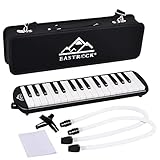
- Best Value: EastRock 32 Key Black Melodica Keyboard Soprano Piano Instrument with Case
- Premium Choice: Eavnbaek 32 Keys Melodica Instrument Soprano Air Piano Keyboard Pianica
For most beginners, the best melodica is a 32-key instrument such as the Yamaha Pianica P-32D — it covers F3 to C6, weighs roughly 0.7 kg, and matches the range that nearly every method book and school program assumes. If you already read treble clef fluently and want the five semitones a 32-key model cannot reach, step up to a 37-key instrument like the Suzuki Pro-37 v3. On a classroom budget the Hohner Student 32 does the same job for less, and players who need the widest range should look at the 44-key Hammond 44 Pro.
- Quick Comparison: The Best Melodicas by Situation
- 32 Keys vs 37 Keys: The Difference Is Five Notes and 7 cm
- Reed Material: Brass, Phosphor Bronze and Stainless Steel
- Mouthpiece Options and What They Change
- The Picks in Detail
- Decision Matrix: Match the Model to Your Situation
- What Wears Out First — and How to Make One Last
- Frequently Asked Questions
As an Amazon Associate we earn from qualifying purchases at no extra cost to you.



Quick Comparison: The Best Melodicas by Situation
| Pick | Best for | Keys & range | Approx. weight | Typical price range |
|---|---|---|---|---|
| Yamaha Pianica P-32D | Most beginners | 32 keys, F3–C6 | ~0.7 kg | $90–$140 |
| Suzuki Pro-37 v3 | Advancing players who need the top of the staff | 37 keys, F3–F6 | ~1.1 kg | $250–$350 |
| Hohner Student 32 | Budget buyers and classrooms | 32 keys, F3–C6 | ~0.8 kg | $50–$90 |
| Suzuki Andes 25F / Yamaha P-25F | Travel and small hands | 25 keys, ~F3–F5 | ~0.5 kg | $40–$90 |
| Hammond 44 Pro | Pros and wide-range playing | 44 keys, ~3.5 octaves | ~1.6 kg | $550–$800 |
Prices are general market ranges for new instruments. Bundles, cases and extra mouthpieces shift them by $20–$40 in either direction, so compare what is actually in the box before comparing price tags.
32 Keys vs 37 Keys: The Difference Is Five Notes and 7 cm
The choice between a 32-key and a 37-key melodica is not about quality — it is about which notes exist. Both formats start on the same low F below middle C. A 32-key instrument stops at C6; a 37-key instrument continues to F6. That means a 32-key model is missing exactly five notes: C#6, D6, D#6, E6 and F6.
For a first-year player, those five notes almost never appear. For anyone playing flute, oboe or violin transcriptions, or melody lines written high in the treble staff, they appear constantly — and the workaround (playing the passage an octave lower) changes the character of the line. That single fact decides the purchase for most people.
| Format | Typical range | Body length | Weight | Notes missing vs. a 37-key | Typical price band |
|---|---|---|---|---|---|
| 25-key (mini) | ~F3–F5 | 33–36 cm | 0.4–0.6 kg | Top octave and a half | $40–$90 |
| 32-key | F3–C6 | 40–43 cm | 0.6–0.9 kg | C#6, D6, D#6, E6, F6 | $50–$150 |
| 37-key | F3–F6 | 47–50 cm | 0.9–1.3 kg | None in the treble staff | $150–$350 |
| 44-key | ~3.5 octaves | 55–60 cm | 1.4–1.8 kg | None | $450–$800 |
Two practical notes on those numbers. First, weight climbs faster than length because longer models carry a longer reed block plus a heavier case. Second, a 37-key instrument is around 17% longer than a 32-key one, which is the point at which a child under about eight starts struggling to reach both ends comfortably — a 25-key or a light 32-key is usually the better fit at that age.
Reed Material: Brass, Phosphor Bronze and Stainless Steel
Reed alloy is the most over-marketed spec on a melodica, so it helps to know what each material actually does.
- Brass reeds are the traditional choice and appear in most mid-priced instruments, including the Hohner Student line and, per the manufacturers’ spec sheets, the Yamaha Pianica series. The tone is generally described as warm and slightly rounded. Brass is the most corrosion-prone of the three, which is why draining moisture matters.
- Phosphor bronze reeds are what Suzuki lists on higher-end Melodion models such as the Pro-37 v3 and M-37C. Players typically describe the response as quicker and the tone as brighter and more defined, especially in the upper register where brass can thin out. It resists corrosion better than plain brass.
- Stainless steel reeds show up mostly in low-cost instruments. They tolerate moisture and humid climates best, but are often described as brighter and less full in the low register.
The honest trade-off: reed alloy matters less than reed-block sealing and gasket quality. A well-sealed brass instrument sounds better than a poorly sealed phosphor bronze one. If you are choosing between two models in the same price band, weight the key action, case and mouthpiece bundle higher than the reed metal.
Mouthpiece Options and What They Change
Almost every melodica ships with one mouthpiece, and the type you get shapes both tone and how long you can comfortably practise.
- Short straight mouthpiece. Direct airflow gives the fastest response and the most control over articulation. The trade-off is that the instrument sits close to your face, your arm supports its full weight, and more saliva reaches the reed block.
- Angled or bent mouthpiece. Same direct response, but the instrument hangs at a more natural angle. This reduces wrist and neck strain on longer sessions, which is why it is the common choice for adult players practising for an hour at a time.
- Flexible tube (whip). The instrument rests flat on a desk or music stand while you play through a tube. This is the classroom standard: students can play without holding a 1 kg instrument up, and hand strain disappears. Expect slightly softer response and a little more condensation inside the tube, which needs blowing out after each session.
If you buy one model and want the other option later, tubes and mouthpieces are sold separately — but check the connector diameter first, since they are not universal across brands.
The Picks in Detail
Best overall for beginners: Yamaha Pianica P-32D
The P-32D is the instrument most teachers reach for because it does nothing badly. Key action is consistent, the body is light enough for a nine- or ten-year-old, and it ships with a case and mouthpiece. Its main trade-off is the ceiling: C6 is the highest note, so anything written above the treble staff is off the table. For a first instrument that is the right compromise — you are trading five rare notes for a lower price and a lighter body.
Best 37-key step-up: Suzuki Pro-37 v3
This is the natural second instrument for someone who has outgrown a 32-key model. It adds the full range to F6, and Suzuki’s spec sheet lists phosphor bronze reeds, which is a real difference in the upper register rather than a marketing line. The trade-off is weight and cost: at roughly 1.1 kg it is noticeably heavier to hold with a short mouthpiece, and it costs about three times a budget 32-key. The Yamaha P-37D is the lower-cost alternative in this class if you want 37 keys with the same familiar action as the P-32D.
Best budget and classroom pick: Hohner Student 32
For a school buying fifteen or twenty instruments, the Student 32 is the sensible default: same 32-key range, durable key mechanism, and a price low enough that replacing one is not a crisis. Its trade-off is tone refinement — the sound is functional rather than rich, and the included case is basic. If a classroom is choosing, buy one mouthpiece per student and a set of flexible tubes so instruments can stay on desks.
Best ultra-portable: Suzuki Andes 25F or Yamaha P-25F
At roughly 0.5 kg and around 35 cm, a 25-key model fits in a daypack and is the only realistic option for playing while travelling. The trade-off is severe: the top octave and a half is gone, so most written melodies need transposing. Treat this as a second instrument or a young child’s first one, not as your only melodica.
Best for pros: Hammond 44 Pro
The 44-key format gives the widest range in this group and the strongest low-register response, which is why it turns up in studio and jazz contexts. It is also heavy and expensive enough that it makes no sense as a learning instrument — at 1.5 kg or more, holding it with a short mouthpiece for an hour is real work. Buy it when range is the limiting factor in your playing, not before.
Decision Matrix: Match the Model to Your Situation
| Your situation | What to choose | Why |
|---|---|---|
| Adult beginner, plays a few times a week | 32-key, e.g. Yamaha P-32D | Full beginner repertoire fits in F3–C6; lowest cost per session |
| Child aged 7–10 | 25-key or a light 32-key | Key spacing and 0.5–0.7 kg weight matter more than range |
| School class of 20+ students | Hohner Student 32 + one mouthpiece each + tubes | Cheap to replace, plays from a desk, no shared mouthpieces |
| Reads flute, oboe or violin music | 37-key, e.g. Suzuki Pro-37 v3 | Needs C#6–F6, which 32-key models do not have |
| Travels or busks | 25-key with a soft case | Under 0.9 kg and packable |
| Recording or playing jazz lines | 44-key, e.g. Hammond 44 Pro | Widest range and strongest low-register response |
What Wears Out First — and How to Make One Last
Melodicas fail in a predictable order. The moisture valve or drain button is usually first, because it is a small spring-loaded part sitting in the wettest place in the instrument. Gaskets around the reed block go next, which shows up as a loss of power or air leaking when you press keys. Reed corrosion follows, hitting the lowest reeds hardest because moisture pools at that end. Key springs and the case zipper are the last common failures.
- Drain after every session. Press the water-release valve and blow gently through the instrument until no more moisture comes out. Reason: trapped saliva is what corrodes brass reeds and feeds mould inside the tube.
- Blow the tube and mouthpiece through, then air-dry both before closing the case. Reason: a sealed case traps humidity against the reed block for hours.
- Wipe keys and body with a dry or barely damp cloth. Reason: sugar and oils from hands cause sticking keys; solvents and soaking damage the key mechanism and gaskets.
- Never submerge the instrument or run water through it. Reason: felt, gaskets and the reed block are not designed for immersion, and water that does not drain fully becomes a corrosion problem.
- Store flat in the case, out of hot cars and direct sun. Reason: heat warps the reed block and can shift the key mechanism out of alignment.
- Do not share mouthpieces. Reason: it is the one part that contacts the mouth directly. In a classroom, issue one per student, and if you have an existing respiratory condition, talk to a healthcare professional before regular playing rather than assuming it is harmless.
Cost per session puts the 32-key vs 37-key decision in perspective. A $110 32-key played three times a week for two years is 312 sessions, or about $0.35 per session. A $300 37-key over the same period works out to roughly $0.96 — nearly three times the cost per session. If you genuinely need the top five notes, that is money well spent. If you are guessing, it is not.
Frequently Asked Questions
Is a 32-key or 37-key melodica better for beginners?
For a first instrument, 32 keys is the better buy. It covers F3 to C6, which is the full range of almost all beginner repertoire, and it is lighter and cheaper than a 37-key model. The only reason to start at 37 keys is if you already read treble clef well and intend to play flute or violin transcriptions that use notes above C6.
Can you learn piano on a melodica?
You can learn to read music, find notes by touch and understand keyboard geography on a melodica, and the key layout is the same as a piano’s. What you cannot develop is piano technique — touch, dynamics through key weight and pedalling — because a melodica produces sound with air rather than hammers. Many teachers use one as a cheap, portable note-reading tool alongside a real keyboard.
Do melodicas go out of tune?
Reeds are set at the factory and hold their pitch well, but they drift flat over time as reeds corrode, and they can shift if the reed block warps from heat or moisture. Consistent draining and cool storage are the two habits that keep tuning stable. If an instrument goes noticeably out of tune, it needs a repair technician rather than an owner adjustment.
How do you clean a melodica?
Drain the moisture valve, blow the tube through and let everything air-dry after each session, then wipe the keys and body with a dry or barely damp cloth. Never submerge it or run water through the body, and do not use solvents on the keys. Deep cleaning of the reed block is a technician’s job, not a household one.
What is the difference between a melodica and a pianica?
They are the same family of instrument — a keyboard played by blowing air across free reeds. “Pianica” is Yamaha’s product name for its melodicas, the same way “Melodion” is Suzuki’s and “Melodica” is Hohner’s general term. Range, key count and mouthpiece options differ between models, but the playing technique transfers directly.
Is a melodica hard to play?
The keyboard part is easy to start on, since pressing a key and blowing produces a note immediately. The hard parts are breath control — you must exhale continuously and breathe in through your nose — and holding an instrument that weighs up to 1.6 kg while playing. A flexible tube solves the second problem, and the first improves with a few weeks of regular short sessions.
Ready to decide? Our #1 pick for 2026 is the Yamaha Pianica P-32D.
Live price & availability on Amazon.




Write Your Review
No reviews yet. Be the first to share your experience!