
Short answer: the Hakko FR810B-05 is the best overall Hakko SMD rework station for board repair, and it suits a bench that sees a genuine mix of work — 0402 through 1206 passives, SOIC and TSSOP packages, QFN and small BGA — on most days of the week. If you want the same hot-air performance but would rather buy one box that already includes the accessory and nozzle set, the Hakko FR811-SET is the turnkey version. If your repair work is mostly through-hole desoldering rather than hot air, the Hakko FR410-52 gun-style desoldering station is the tool that actually matches the job. And if you are repairing a handful of boards a month on a tight budget, the LRT 858D gets you into hot air for roughly the cost of a mid-range soldering iron. Everything below is judged on the five things that decide whether a rework station helps you or fights you: temperature control, airflow behaviour, nozzle availability, ergonomics and ESD protection.
- Top 3 Picks
- Quick Comparison
- How We Chose
- 1. Hakko FR810B-05 – Best for Mixed SMD Repair Work
- 2. Hakko FR410-52 – Best for High-Power Through-Hole Desoldering
- 3. Hakko FX-889 – Best for Running Two Irons at One Bench
- 4. Hakko FX888DX-010 – Best for Everyday Hand Soldering
- 5. EZTOOLS 628 III – Best for Hands-Free Board Holding
- 6. WEP 882D – Best for a First 2-in-1 Station
- 7. Hakko FR811-SET – Best for a Turnkey Hot Air System
- 8. WEP 946D IV – Best for Small-Board Preheat and BGA Rework
- 9. YIHUA 946D-IV – Best for Preheat Plus Tweezer Work
- 10. LRT 858D – Best for the Lowest-Cost Entry to Hot Air
- 11. YIHUA 853D – Best for a Multi-Function Starter Bench
Quick answer: For most people in 2026, the best hakko smd rework stations for board repair is the Hakko FR810B-05 — our #1 rated choice. See the full ranked comparison, alternatives and buying advice below.
Top 3 Picks
Best overall: Hakko FR810B-05
The FR810B-05 is the station that covers the widest band of real board repair work without compromise — fine-pitch SMD, connector removal, shield-can work and small BGA, all on one handpiece. Its closed-loop temperature control and low-flow airflow stability are what let you work near plastic connectors and electrolytic capacitors without cooking them. It is the pick for anyone whose bench sees more than one type of board per week.
Best budget: LRT 858D
The LRT 858D is a 700 W digital hot air station with a single handpiece and a basic nozzle set, and it is the cheapest sensible entry into hot air rework on this list. It will not hold temperature like a Hakko under sustained load, and its nozzle ecosystem is thin, but for occasional 0805/1206 passives, SOIC and connector work it does the job. Buy it when the alternative is no hot air at all.
Best premium / turnkey: Hakko FR811-SET
The FR811-SET bundles the hot air unit with a full accessory and nozzle set, which removes the two most common upgrade headaches: buying nozzles one at a time and discovering halfway through a repair that you are missing the shape you need. It suits a shop that wants a complete, documented system on day one rather than an à-la-carte build. If you already own nozzles and accessories, the FR810B-05 is the better value.
Quick Comparison
| Product | Best for | Key specs | Price tier |
|---|---|---|---|
| Hakko FR810B-05 | Mixed SMD repair, daily bench use | Digital hot air, closed-loop temp control, wide quick-change nozzle family, ESD-safe construction | Premium |
| Hakko FR410-52 | Through-hole desoldering, high thermal load | High-power desoldering, gun-style handpiece with trigger vacuum, dedicated desoldering tip range | Premium |
| Hakko FX-889 | Two irons running at one bench | Dual-port station, two independent iron outputs, single compact housing | Premium |
| Hakko FX888DX-010 | Everyday hand soldering | Single-iron digital station, rotary encoder setpoint, roughly 65 W class | Mid-range |
| EZTOOLS 628 III | Hands-free board holding | 1.7 kg weighted PCB holder, helping-hands clamps, hot air rework bracket | Budget |
| WEP 882D | First 2-in-1 station | Hot air plus soldering iron, 2 spools of solder wire and 5 tips included | Mid-range |
| Hakko FR811-SET | Turnkey hot air system | FR-series hot air unit plus bundled accessory and nozzle set | Premium |
| WEP 946D IV | Small-board preheat | 100 × 50 mm LED hot plate, 210 W, SMD/BGA and phone-board rework | Budget |
| YIHUA 946D-IV | Preheat plus tweezer work | Mini hot plate, adjustable temperature, °C/°F display, 2 ESD-safe tweezers included | Budget |
| LRT 858D | Lowest-cost entry to hot air | 700 W digital hot air, single handpiece, basic nozzle set | Budget |
| YIHUA 853D | Multi-function starter bench | 2-in-1 hot air and iron, DC power supply 0–15 V / 0–2 A, 5 V USB output, 2 A | Mid-range |
| BAKON BK701D | 700 W 2-in-1 value | 700 W hot air plus soldering iron, ESD-safe 2-in-1 station | Mid-range |
How We Chose
Selection started from published manufacturer specifications and listing documentation, not from bench time — we have not tested, benchmarked or owned these units. The criteria were built around the five factors that determine whether a rework station is usable on real boards. First, temperature control: whether the station uses closed-loop feedback with a thermocouple near the heater, how the setpoint is entered, and whether it holds temperature when airflow rises. Second, airflow behaviour: whether the pump or blower is adjustable across a genuinely useful low range, because a station whose minimum airflow is too high cannot be used near plastic-bodied parts. Third, nozzle availability: how many shapes and inner diameters exist for the handpiece, whether they are quick-change, and whether they are stocked as consumables.
Fourth, ergonomics: handpiece weight and balance, grip distance from the nozzle, hose stiffness, and whether the stand holds the handpiece securely without the tip resting against anything. Fifth, ESD protection: grounded nozzle and tip, ESD-safe housing materials, and the class-standard leakage and tip-to-ground specifications. We also weighed category fit — a desoldering gun and a hot plate are not substitutes for a hot air station, and we say so rather than pretending they compete. Finally, upgrade path: whether a purchase today can be extended with nozzles, a second handpiece, or a preheater rather than replaced outright.
1. Hakko FR810B-05 – Best for Mixed SMD Repair Work
As an Amazon Associate we earn from qualifying purchases at no extra cost to you.
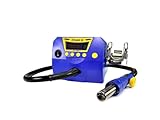
The FR810B-05 is the default answer when someone asks which Hakko hot air station to buy for general board repair. It suits a bench where the work is genuinely mixed: a phone board in the morning, a laptop mainboard at noon, an industrial control board in the afternoon. That variety is exactly where cheap hot air stations fall apart, because the same handpiece has to be gentle enough for a 0402 capacitor next to a plastic connector and hot enough to lift a shield can or a power inductor without a five-minute wait.
The -05 suffix identifies a specific configuration within Hakko’s FR hot air family, so check what the listing includes before you buy — the difference between configurations is usually accessories rather than the core unit. What matters is the platform underneath: a digital setpoint, closed-loop temperature control with the sensor close to the heater, and a pump-driven airflow system with a genuinely usable low end. That low end is the feature you will appreciate most, because the majority of board repair damage comes from too much air, not too much heat.
- Type: single-handpiece digital hot air rework station
- Temperature control: closed-loop, thermocouple feedback, digital setpoint
- Airflow: adjustable pump-driven flow with a low minimum suitable for fine-pitch SMD
- Nozzle system: Hakko quick-change nozzle family, multiple inner diameters and shapes
- ESD: grounded nozzle, ESD-safe housing, class-standard leakage and tip-to-ground specs
- Typical workload: 0402–1206 passives, SOIC/TSSOP, QFN, small BGA, connectors, shields
What makes it worth the premium tier is repeatability. A station that reaches the same temperature in the same time on every power-up lets you build muscle memory, and muscle memory is what stops you from lifting pads. The nozzle range is the second reason: you can buy a 2 mm class nozzle for a single passive and a much wider slotted nozzle for a row of connector pins, and swap between them in seconds. That flexibility is what turns a hot air station from a specialist tool into the tool you reach for first.
Pros
- Closed-loop temperature control that holds up as airflow increases
- Low minimum airflow — the single most useful safety feature in this category
- Broad, well-documented nozzle ecosystem with quick-change mounting
- ESD-safe construction with documented leakage specifications
- Extends rather than gets replaced: nozzles, accessories and stands stay available
Cons
- Premium tier pricing, and the configuration you choose changes what is in the box
- Nozzles are a real ongoing cost — the station is not the expensive part over five years
- Overkill for someone repairing two boards a month
- No built-in preheater, so large boards or heavy ground planes still want a hot plate underneath
Against the FR811-SET, the FR810B-05 is the better buy if you already own nozzles or prefer to buy them individually, since the SET mainly adds a bundled accessory and nozzle package. Against the LRT 858D, the gap is not power — both will melt solder — it is control at the low end and the availability of the exact nozzle you need on a Tuesday afternoon. Against the YIHUA 853D, the FR810B-05 gives up the built-in DC supply and iron but wins decisively on airflow stability and nozzle choice.
2. Hakko FR410-52 – Best for High-Power Through-Hole Desoldering

The FR410-52 is not a hot air station and should not be bought as one. It is a high-power desoldering station with a gun-style handpiece, and it solves a problem that hot air handles badly: clearing solder from through-hole joints on multi-layer boards. If your repair workload includes power supplies, amplifier boards, older industrial controllers, or anything with a ground plane that swallows heat, this is the tool that turns a twenty-minute frustration into a ten-second pull.
The gun-style format matters more than it sounds. A pistol grip with a trigger-actuated vacuum lets you apply heat, feel the solder go liquid, and pull the trigger in one motion without repositioning your hand. On a 40-pin DIP or a dense connector row, that is the difference between a clean extraction and a lifted pad. The high-power designation refers to the heater’s ability to sustain temperature while molten solder is being drawn through the tip — a phase where weaker stations drop temperature and leave you chasing a joint that keeps re-solidifying.
- Type: high-power desoldering station with gun-style handpiece
- Action: trigger-actuated vacuum integrated into the grip
- Tip range: dedicated desoldering nozzles in multiple bore sizes for different lead diameters
- Workload: through-hole connectors, DIP packages, headers, power components on multilayer boards
- Maintenance: requires regular nozzle clearing and filter changes — this is a consumable-heavy tool
- ESD: ESD-safe construction consistent with Hakko’s professional station range
The genuine strength here is sustained thermal output on a joint that is fighting back. Where a hot air station heats a whole area, a desoldering gun heats one joint and removes the solder in the same breath, which is far safer for neighbouring components. The trade-off is maintenance. Solder residue builds up inside the nozzle and the collection chamber, and a neglected desoldering tool loses suction long before it loses heat. Budget for filters and spare nozzles as routine consumables, and clear the nozzle at the end of every session, not every week.
Pros
- Clears through-hole joints that hot air cannot reach effectively
- Trigger vacuum in the grip — one-handed heat-and-pull motion
- High sustained power holds temperature while solder is being drawn
- Localised heating protects adjacent components far better than area heating
- Dramatically faster on multi-pin connectors than any wick-and-iron method
Cons
- Does not replace a hot air station — it complements one
- Consumable-heavy: nozzles, filters and collection chambers wear and clog
- Premium tier price for a tool that only does one job
- Requires a technique change — too much dwell time on a pad is still destructive
Compared with the FR810B-05, the FR410-52 is a specialist rather than a generalist, and a bench doing mixed SMD work should buy hot air first. Compared with the FX888DX-010, the difference is scale: an iron plus desoldering wick can clear a two-pin through-hole joint, but not a 40-pin header on a board with internal ground planes. If through-hole work is more than a quarter of your workload, this station pays for itself quickly.
3. Hakko FX-889 – Best for Running Two Irons at One Bench

The FX-889 answers a specific bench problem: two people, or one person doing two very different soldering tasks, sharing a single station footprint. It is a dual-port soldering station, meaning two irons can be connected and used, which in practice lets you keep a fine conical tip loaded for SMD work and a wide chisel tip loaded for ground planes and connectors without swapping anything. On a repair bench where a single board often needs both, that saves a surprising amount of time and a surprising number of tip changes.
This is a soldering station, not a rework station — there is no hot air handpiece. That is worth stating plainly, because the word “rework” gets applied loosely. If your board repair work involves removing QFN packages, shield cans or BGA, the FX-889 is the supporting act, not the lead. Where it earns its place is the hand-soldering half of repair: replacing connectors, repairing traces, reflowing a lifted pad, and doing all the touch-up work that follows a hot air removal.
- Type: dual-port soldering station
- Capacity: two iron outputs from a single station housing
- Tip ecosystem: broad Hakko tip range shared with the wider professional iron family
- Temperature control: closed-loop with digital setpoint
- Bench footprint: one housing and one stand pair rather than two full stations
- Typical workload: connector replacement, drag soldering, touch-up, mixed-tip workflows
The real strength is workflow, not raw specification. A dual-port station means the iron you need is already hot and already fitted with the tip you want. For a shop where a technician moves between 0603 passives and a 20-pin connector within the same repair, that removes the two-minute tax of swapping tips and waiting for temperature recovery — repeated twenty times a day, it is the single biggest efficiency gain on this list. It also means a second technician can work on an adjacent board without buying a second station.
Pros
- Two irons live at once — no tip swapping between SMD and heavy work
- One housing instead of two, which matters on a crowded bench
- Full access to Hakko’s professional tip range
- Closed-loop temperature control with digital setpoint
- Natural upgrade path for a growing shop: add a hot air station later
Cons
- No hot air — it cannot remove SMD packages on its own
- Premium tier price for what is fundamentally a soldering station
- Only worth it if you genuinely use two irons; a solo hobbyist will not
- Takes up more bench width than a single-iron station once both stands are placed
Compared with the FX888DX-010, the FX-889 is the same idea scaled up for two simultaneous users or two simultaneous tip profiles — and the FX888DX-010 remains the smarter buy for a single-iron bench. Compared with the FR810B-05, they are complementary rather than competing: a serious repair bench often ends up with both, hot air for removal and a dual-port iron station for everything that follows.
4. Hakko FX888DX-010 – Best for Everyday Hand Soldering

The FX888DX-010 is the station most people should buy first, and it is the one that stays on the bench longest. It is a single-iron digital soldering station with a rotary encoder for setting temperature, in roughly the 65 W class that has been the standard for general electronics work for years. It suits anyone doing board-level repair where the majority of the work is soldering rather than removal: replacing a micro-USB or USB-C connector, repairing a broken trace, reflowing a cracked joint, or building up a pad that lifted during a hot air removal.
The rotary encoder is a small detail with a large practical effect. Instead of tapping a button repeatedly to move through a temperature menu, you turn a dial and the setpoint moves proportionally — faster when you spin it, finer when you nudge it. In practice this means you set temperature in a second rather than five, and you are more likely to actually change temperature for a job instead of leaving it at one setting for everything. That habit alone prevents a lot of damage on small pads and a lot of frustration on heavy ground planes.
- Type: single-iron digital soldering station
- Setpoint: rotary encoder for continuous adjustment
- Power class: roughly 65 W — adequate for most through-hole and moderate SMD work
- Tip ecosystem: the standard Hakko tip family, widely stocked in many shapes
- ESD: ESD-safe construction with grounded tip
- Typical workload: connector replacement, trace repair, touch-up, general assembly
What makes this the value pick of the mid-range tier is the combination of a genuinely good tip ecosystem and predictable thermal behaviour. A 65 W class iron will not reflow a large ground plane quickly, and it is not meant to; for that you want a hot plate underneath or a heavier iron. But for the 90 % of repair work that involves small pads and moderate thermal mass, it heats fast, recovers quickly after each joint, and the tip geometry you want is almost always available. That availability is what separates a station you keep from one you outgrow.
Pros
- Rotary encoder makes temperature changes fast enough that you actually do them
- Very wide tip availability in many shapes and sizes
- Predictable, repeatable thermal behaviour — good for building technique
- ESD-safe with a grounded tip
- Mid-range pricing with premium-brand support and spares
Cons
- No hot air — SMD package removal needs a separate station
- Roughly 65 W class struggles with heavy ground planes and large thermal mass
- Single iron only, so no dual-tip workflow
- Basic compared with a dual-port station if you frequently switch tip profiles
Compared with the FX-889, the FX888DX-010 is the right choice for a one-person bench and the wrong choice for a shop running two irons simultaneously. Compared with the YIHUA 853D and BAKON BK701D, it gives up the built-in hot air and DC supply but wins on temperature stability, tip availability and long-term parts support — the three things that determine whether a station is still usable in five years.
5. EZTOOLS 628 III – Best for Hands-Free Board Holding
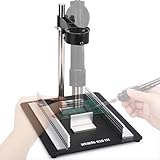
The EZTOOLS 628 III is not a rework station at all, and that is precisely why it belongs on this list. It is a heavy PCB holder with a 1.7 kg weighted base, helping-hands style clamps and a bracket intended to hold a hot air handpiece. It suits the person who has already bought a hot air station and discovered the real problem: both hands are needed, one to hold the nozzle and one to hold tweezers, and the board is sliding across the bench.
Weight is the specification that matters here. A 1.7 kg base does not sound impressive until you compare it with the light spring-loaded helping-hands arms that tip over the moment you apply any sideways pressure. Board holding is a stability problem, and stability comes from mass and from a low centre of gravity. A heavy base plus clamps that grip the board edge means the board stays where you put it, which in turn means your nozzle position is repeatable — and repeatable nozzle position is what makes hot air rework predictable rather than a series of small rescues.
- Type: weighted PCB holder and helping-hands fixture
- Base weight: 1.7 kg — mass is the primary stability specification
- Clamping: adjustable clamps that grip board edges, leaving both faces accessible
- Bracket: dedicated holder for a hot air rework handpiece
- Best paired with: any hot air station on this list
- Consumable reality: clamp pads and springs are the parts that wear first
The strength is that it converts a two-hand job into a one-hand job. With the board clamped and the handpiece resting in its bracket between passes, you can pick up tweezers with your free hand and place or remove a component the instant the solder goes liquid. That timing window is short on small SMD parts, and having the component already in your hand when the joint flows is the difference between a clean placement and a reflow attempt.
Pros
- 1.7 kg base resists the sideways pressure that topples light helping-hands arms
- Frees a hand for tweezers at the exact moment the joint flows
- Handpiece bracket keeps the nozzle off the bench between passes
- Budget tier price for a genuine productivity gain
- Works with any hot air station, so it survives your next station upgrade
Cons
- Not a station — it does nothing on its own
- Clamp jaws can obstruct connectors at the very edge of some boards
- Fixed geometry means very large or very small boards may fit awkwardly
- Takes up permanent bench depth, which matters in a small workspace
Compared with the WEP 946D IV and YIHUA 946D-IV hot plates, this is a different category entirely — those heat the board from below, this holds it still. In practice a serious bench wants both, and the EZTOOLS 628 III is the cheaper of the two purchases by a wide margin. If your budget only stretches to one accessory this month, buy the holder first: it improves every hot air job you do, while a preheater only helps on large boards.
6. WEP 882D – Best for a First 2-in-1 Station
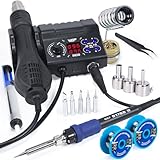
The WEP 882D is a 2-in-1 SMD hot air rework station with a soldering iron in the same housing, and it ships with two spools of solder wire and five soldering tips. It suits the beginner or the occasional repairer who wants both capabilities from one purchase and one power socket, and who would rather spend the first month learning technique than researching which second station to add.
The bundled consumables are a bigger deal than they look. Two spools of solder wire and five tips mean the station is usable the day it arrives, without a second order for lead-free solder in the right diameter and a tip shape that actually suits SMD work. That is the difference between a station that gets used and one that sits in a box for three weeks. The mid-range tier pricing also puts it in reach of a hobbyist who is not yet sure how deep into board repair they will go.
- Type: 2-in-1 hot air rework plus soldering iron station
- Included: 2 spools of solder wire and 5 soldering tips
- Controls: digital temperature and airflow adjustment
- Airflow: adjustable — the low end is the limiting factor on budget-class units
- Nozzle system: basic nozzle set; additional shapes are limited compared with premium brands
- Typical workload: 0805/1206 passives, SOIC, connectors, occasional small QFN
The strength is coverage per pound spent. A single housing, a hot air handpiece and an iron cover the two fundamental repair operations — removal and attachment — and the included tips and solder remove the most common first-purchase mistake, which is buying a station with no usable consumables. For someone repairing a handful of boards a month, that is a complete starting kit rather than a component of one.
Pros
- Hot air and iron in one housing, one footprint, one power lead
- Ships with 2 spools of solder wire and 5 tips — usable immediately
- Mid-range price for two tools’ worth of capability
- Digital temperature and airflow control, not just a rotary dial
- Good stepping stone before committing to premium separate stations
Cons
- Shared housing means a failure in one function affects the whole unit
- Nozzle and tip availability is narrower than the Hakko ecosystem
- Temperature hold under sustained airflow is weaker than premium stations
- Not suitable for heavy ground planes or large BGA work
Compared with the YIHUA 853D, the WEP 882D trades the built-in DC power supply and USB output for bundled solder and tips — a better fit for someone who wants to start repairing immediately rather than someone building a general electronics bench. Compared with the BAKON BK701D, both are 2-in-1 mid-range stations; the 882D leans toward beginner convenience, the BK701D toward higher hot air power.
7. Hakko FR811-SET – Best for a Turnkey Hot Air System

The FR811-SET is the complete-system version of Hakko’s hot air rework platform: the station plus a bundled accessory and nozzle set in one purchase. It suits the buyer who has decided on premium hot air and does not want to spend the first three months discovering which nozzle shapes they need one order at a time. If your work is varied enough that you cannot predict the next job, a bundled set is worth more than the sum of its parts.
The practical argument for the SET is that nozzle shopping is the hidden cost of hot air rework. Buying individually means each new board type potentially triggers an order, a wait, and a decision about inner diameter and shape that you are not yet equipped to make. A bundled set front-loads that decision: you have the common shapes on day one, you learn which ones you actually reach for, and your later purchases become replacements rather than experiments.
- Type: complete SMD hot air rework system with bundled accessories
- Temperature control: closed-loop, digital setpoint, FR-series platform
- Airflow: adjustable with a low minimum suitable for fine-pitch SMD
- Included: accessory and nozzle set bundled with the station
- ESD: ESD-safe construction consistent with the FR platform
- Typical workload: 0402–1206 passives, SOIC, QFN, small BGA, shields, connectors
The strength is that you start at full capability. There is no learning period spent working around the two nozzles that came in the box, and no risk of damaging a board because the closest available nozzle was too wide. For a shop billing for repair time, that matters more than the price difference between the SET and the base unit — a single lifted pad or melted connector can cost more in reputation than the accessory bundle costs in cash.
Pros
- Arrives as a complete system — no immediate follow-up purchases
- Bundled nozzle set covers common shapes and diameters from day one
- Same closed-loop temperature control and low-end airflow as the FR platform
- ESD-safe with documented leakage and grounding specifications
- Accessories and replacement nozzles remain available long term
Cons
- Premium tier price, and you pay for accessories you may already own
- Bundled nozzle selection may not match your specific workload
- No preheater included — large boards still need a hot plate
- Overkill for low-volume hobbyist use
Compared with the FR810B-05, the FR811-SET is the same platform with the accessory question pre-answered; buy the SET if you own no nozzles, buy the FR810B-05 if you do. Compared with the WEP 882D, the difference is not features but control at low airflow and the depth of the nozzle catalogue — which is exactly what you are paying for at the premium tier.
8. WEP 946D IV – Best for Small-Board Preheat and BGA Rework

The WEP 946D IV is a small LED soldering hot plate with a 100 × 50 mm heating area rated at 210 W, intended for SMD, BGA and smartphone-board rework. It suits anyone who has discovered the fundamental limit of hot air: you cannot reliably reflow a package on a board with a large ground plane by heating from above only, because the board wicks heat away faster than the nozzle can deliver it.
The 100 × 50 mm area is the number to check against your work. It comfortably covers a phone logic board or a small module, and it will not cover a laptop mainboard or a full-size industrial board. That is a genuine constraint, not a flaw — a small plate is cheaper, heats faster, and gives you a controlled preheat exactly where you need it. The 210 W rating is modest, which means it is a preheater rather than a reflow oven: it lifts board temperature into the 100–150 °C range so your hot air only has to supply the remaining rise to the melting point of the alloy in use.
- Type: small LED hot plate for SMD and BGA preheat
- Heating area: 100 × 50 mm
- Power: 210 W
- Temperature: adjustable, with LED display
- Best for: phone logic boards, small modules, BGA and QFN rework
- Not suitable for: full-size laptop or industrial boards
The strength is thermal headroom on stubborn packages. Preheating a board to roughly 100–150 °C before applying hot air reduces the temperature differential the nozzle has to overcome, which in turn lets you use lower airflow and a shorter dwell time. Lower airflow and shorter dwell are the two variables most strongly correlated with not damaging the board, so a preheater is not an optional extra — it is a technique enabler. The LED display also makes repeatability easier, because you can return to the same preheat setting for the same board type.
Pros
- 100 × 50 mm area covers phone boards and small modules well
- Preheating lets you drop airflow and shorten dwell time
- 210 W heats small boards quickly without a long warm-up
- LED display makes preheat settings repeatable
- Budget tier price for a genuine capability upgrade
Cons
- Too small for laptop mainboards and large industrial boards
- Not a reflow oven — it is a preheat stage, not a full solution
- Requires a separate hot air station to complete the job
- Board support and clamping must be arranged separately
Compared with the YIHUA 946D-IV, the WEP 946D IV is the larger and more powerful of the two small plates, which makes it the better choice for BGA and phone-board work; the YIHUA unit counters with bundled ESD-safe tweezers. Compared with the EZTOOLS 628 III holder, this is a different function entirely — the holder keeps the board still, the plate keeps it warm, and a well-equipped bench eventually has both.
9. YIHUA 946D-IV – Best for Preheat Plus Tweezer Work

The YIHUA 946D-IV is a mini hot plate for rework heating with adjustable temperature, a °C/°F display, and two ESD-safe tweezers included. It suits the compact-bench repairer working on small boards who wants a preheat stage and the tweezer set to go with it in a single purchase, without adding a second order or a second brand to the bench.
The included ESD-safe tweezers are the distinguishing feature. Tweezers are the tool you use most during hot air rework, and the wrong pair — uncoated, magnetised, or with tips that do not close flush — turns component placement into a series of small failures. ESD-safe tweezers with properly aligned tips let you pick up an 0603 or an SOIC-8 and place it with one hand while the other holds the nozzle. Bundling two pairs means you have both a fine straight pair and a curved or wider pair for larger parts.
- Type: mini hot plate rework heater
- Temperature: adjustable with °C/°F display switching
- Included: 2 ESD-safe tweezers
- Size class: mini — best for small boards and modules
- Best for: small-board preheat, component placement, SMD rework
- Pairs with: any hot air station on this list
The strength is that it removes two friction points at once: it gives you a controlled preheat stage and it gives you the hand tools that make the preheat useful. On a small bench, buying fewer things that work together beats buying more things that need reconciling. The °C/°F switching is a small convenience that matters if you follow tutorials or service documentation written in the other unit, which is common enough in board repair that it is worth having.
Pros
- Two ESD-safe tweezers included — the tools you use most in hot air work
- Adjustable temperature with °C/°F display switching
- Compact footprint suits a small bench
- Budget tier pricing
- Complements any hot air station rather than duplicating one
Cons
- Mini size limits it to small boards and modules
- Lower thermal capability than a larger plate
- Still requires a separate hot air station for removal
- Tweezer tips are consumables and will need replacing
Compared with the WEP 946D IV, the YIHUA 946D-IV trades heating area and power for a bundled tool set, so it is the better pick if you own no decent tweezers and the weaker pick if you are working on anything larger than a phone board. Compared with the EZTOOLS 628 III, it solves the temperature problem rather than the stability problem — and if you can only buy one, buy the holder, because a sliding board defeats every technique.
10. LRT 858D – Best for the Lowest-Cost Entry to Hot Air

The LRT 858D is a 700 W digital hot air rework station for PCB, IC and SMD repair, with a single handpiece and a basic nozzle set. It suits the occasional repairer — someone fixing their own equipment a few times a year — who needs hot air capability and cannot justify premium-tier pricing for it. It is the station you buy when the alternative is attempting SMD removal with an iron and hoping.
The 700 W rating is the headline number, and it is worth understanding what it does and does not tell you. Power determines how quickly the heater can bring the nozzle up to temperature and how well it recovers when airflow carries heat away. It does not tell you how stable the temperature is, how low the airflow can go, or whether the nozzle range covers the packages you actually work on. Those three things are where budget stations differ most from premium ones, and where the 858D makes its compromises.
- Type: digital hot air rework station
- Power: 700 W
- Control: digital temperature and airflow adjustment
- Nozzle system: basic nozzle set; additional shapes limited
- Handpiece: single, with integrated heater and fan
- Typical workload: 0805/1206 passives, SOIC, connectors, occasional QFN
The strength is access. At budget-tier pricing it puts hot air rework within reach of anyone who repairs their own gear, and it is genuinely capable on the packages that most hobbyist repairs involve: two-terminal passives, small ICs and connectors. Its weakness is the low end of the airflow range and the nozzle catalogue. If your minimum airflow is higher than the job wants, you work faster and less precisely than you should, and if the nozzle you need does not exist, you make do with the closest one — both of which are the exact habits that damage boards.
Pros
- 700 W heats quickly and recovers reasonably during use
- Digital temperature and airflow control rather than a single dial
- Lowest-cost route into hot air rework on this list
- Adequate for 0805/1206 passives, SOIC and connector work
- Simple enough to learn on without fear of a costly mistake
Cons
- Airflow minimum is higher than premium stations — less forgiving near plastics
- Narrow nozzle availability limits the packages you can handle well
- Temperature stability under sustained airflow is weaker
- Not a long-term platform; expect to upgrade if the work grows
Compared with the WEP 882D, the LRT 858D gives up the soldering iron, the bundled solder and the five tips — so if you own no iron, the 882D is the better first purchase despite costing more. Compared with the Hakko FR810B-05, the difference is not whether the 858D can melt solder but whether it can do so gently enough for the board in front of you. Buy the 858D for occasional work; buy premium if the board is not replaceable.
11. YIHUA 853D – Best for a Multi-Function Starter Bench
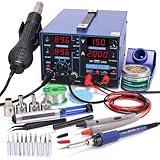
The YIHUA 853D is a 2-in-1 SMD hot air rework and soldering iron station with a built-in DC power supply rated 0–15 V at 0–2 A and a 5 V USB charging output. It suits someone assembling a bench from nothing who wants hot air, an iron and a bench power supply in one purchase, and who values covering several functions over perfecting one.
The DC supply is the reason to choose this over other mid-range 2-in-1 stations. A 0–15 V / 0–2 A adjustable supply is genuinely useful for board repair: powering a board on the bench to check voltages, testing a repaired rail under load, or confirming that a short has actually gone away before reassembling a device. The 5 V USB output is a convenience for powering small test gear and, more usefully, for charging a phone while you work on a different one.
- Type: 2-in-1 hot air rework and soldering iron station
- DC supply: 0–15 V, 0–2 A adjustable
- USB output: 5 V charging port
- Airflow: adjustable, budget-to-mid class low end
- Nozzle system: basic set, with limited aftermarket depth
- Typical workload: general SMD work, board bring-up, voltage checks
The strength is bench coverage per unit of space and money. Three functions in one housing is a real advantage when the bench is a desk in a spare room, and the adjustable supply means you are not improvising board power from a fixed wall adapter. The compromise is that each function is competent rather than excellent — the hot air lacks the low-airflow finesse of a premium station, and the iron lacks the tip ecosystem of a dedicated one.
Pros
- Hot air, iron and adjustable 0–15 V / 0–2 A supply in one unit
- 5 V USB output for charging and powering small accessories
- Enables board bring-up and voltage checks without extra gear
- Mid-range pricing for three functions
- Compact compared with three separate instruments
Cons
- Shared housing — one failure takes down all three functions
- Hot air low-end airflow is less refined than premium stations
- Limited nozzle and tip availability compared with Hakko
- 2 A at 15 V is modest for powering larger boards under load
Compared with the WEP 882D, the YIHUA 853D is the better pick if you need board power and the worse pick
Ready to decide? Our #1 pick for 2026 is the Hakko FR810B-05.
Live price & availability on Amazon.




Write Your Review
No reviews yet. Be the first to share your experience!