
- Top Pick: CAROTE 7-Piece Baking Pans Set, Nonstick Bakeware Sets, Gray & Khaki
- Best Value: NutriChef 10-Piece Nonstick Kitchen Oven Baking Pans – Premium & Stylish Non-Stick Carbon Steel – Commercial Grade Restaurant Quality Metal Bakeware with Silicone Handles – Easy to Clean, NCSBS10S
- Premium Choice: 11-Piece Nonstick Baking Pans Set – Professional Grade Carbon Steel Bakeware with Premium Coating- Dishwasher Safe, Stackable, Oven Safe to 450°F (Black)
The best bakeware sets for most home bakers are aluminized-steel sets with a durable nonstick coating: they spread heat more evenly than thin bare steel, resist warping better than inexpensive pans, and release cookies, cakes, and roasted foods with less cleanup. Choose ceramic-coated pans for attractive serving and easy release at moderate temperatures, or uncoated aluminized steel when browning, longevity, and high-temperature flexibility matter most.
As an Amazon Associate we earn from qualifying purchases at no extra cost to you.
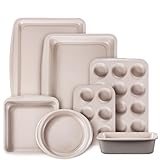


Best bakeware sets by baking situation
| Best for | Recommended pan type | Look for | Main compromise |
|---|---|---|---|
| Frequent baking and mixed recipes | Aluminized steel with nonstick coating | Heavy-gauge steel, rolled rims, oven rating of at least 450°F | Coating eventually wears and requires gentler utensils |
| Maximum browning and long ownership | Uncoated aluminized steel | 18- or 20-gauge construction, reinforced rims, parchment-compatible surfaces | More sticking and hand-washing |
| Occasional baking and attractive presentation | Ceramic-coated metal | Metal core, smooth coating, clear temperature limits | Coating can chip or lose release performance |
| Small kitchen or limited storage | Compact six- to eight-piece set | Nested storage, one 9-by-13-inch pan, removable dividers | May omit a second cake pan or loaf pan |
| High-temperature roasting and broiling | Uncoated heavy-gauge steel | At least 500°F rating and sturdy wire or rolled handles | Requires oil, parchment, or careful release technique |
Aluminized steel versus nonstick and ceramic
Aluminized steel: the best foundation for even baking
Aluminized steel combines a steel body with an aluminum-silicon surface layer. The steel supplies rigidity, while aluminum improves heat response compared with ordinary thin steel. This construction is common in professional-style pans and is used in products such as USA Pan and Chicago Metallic bakeware.
Its most useful advantage is dimensional stability. A heavy pan with a rolled or reinforced rim is less likely to twist when moved between a hot oven and a cooler countertop. That matters because a warped sheet pan can pool oil, bake cookies unevenly, and fail to sit flat on an oven rack.
Uncoated aluminized steel generally gives stronger browning on the bottom of cookies, biscuits, and pastries than pale ceramic-coated surfaces. It also tolerates high oven temperatures when the individual pan is rated for them. The trade-off is cleanup: sugary or starchy foods can adhere unless the pan is lined, greased, or allowed to cool before soaking.
Nonstick-coated steel: the easiest everyday choice
Nonstick-coated bakeware usually starts with a steel or aluminized-steel body and adds a low-friction coating. A good set is convenient for sheet-pan dinners, brownies, muffins, and quick breads because food releases with less oil and residue.
Nonstick is not automatically the most durable option. The coating is the part most likely to show wear first, especially on muffin cups, knife-cut brownies, and sheet pans cleaned with abrasive pads. Use silicone, wood, or nylon tools; avoid stacking pans without protection; and follow the maker’s maximum temperature rather than assuming every nonstick piece is broiler-safe.
For a versatile set, prioritize coating quality and pan thickness over the largest piece count. A sturdy six-piece set can outperform a thin 14-piece collection because it heats more consistently and is less prone to distortion.
Ceramic-coated pans: attractive, slick at first, but temperature-sensitive
Ceramic-coated bakeware normally means a metal pan finished with a ceramic-based nonstick layer, not a solid ceramic dish. It often has a smooth, colorful exterior and releases food well when new. Ceramic coatings can be appealing for bakers who want pans that move from oven to table with a more finished appearance.
The main limitation is changing release performance. Oils, cooking sprays, dishwasher detergents, and repeated high heat can leave residue or degrade the slick surface. Ceramic-coated sets also vary widely in their temperature limits. Some are suitable for temperatures around 450°F, while others have lower recommendations, so check each set’s instructions before using it for pizza, broiling, or heavily browned roasting.
What pieces should a useful bakeware set include?
For most households, the practical core is a 9-by-13-inch rectangular pan, two 9-inch round cake pans, a 12-cup muffin pan, one 9-by-5-inch loaf pan, and a rimmed half-sheet pan measuring approximately 13 by 18 inches. This combination covers cakes, brownies, muffins, quick breads, cookies, vegetables, and one-pan meals.
| Piece | Typical size | Approximate capacity or coverage | Most useful recipes |
|---|---|---|---|
| Half-sheet pan | 13 by 18 inches | About 234 square inches of top surface | Cookies, vegetables, pastries, roasting |
| Rectangular baking pan | 9 by 13 inches, 2 to 3 inches deep | Approximately 3 to 4 quarts | Brownies, casseroles, slab cakes |
| Round cake pans | Two 9-inch pans, about 2 inches deep | Roughly 8 cups per pan | Layer cakes and deep pies |
| Muffin pan | 12 cups, usually 2.5 to 3 inches wide | About 4 to 6 fluid ounces per cup | Muffins, cupcakes, individual frittatas |
| Loaf pan | 9 by 5 inches | About 8 by 4-inch recipe capacity | Banana bread, pound cake, sandwich loaves |
Be cautious with sets that count cooling racks, silicone cups, spatulas, or storage bands as full bakeware pieces. Those accessories may be useful, but they do not replace a second cake pan or a sturdy rimmed sheet pan.
Decision matrix: choosing the right set
| Your situation | Best choice | Why |
|---|---|---|
| Beginner baking once or twice a month | Six- to eight-piece nonstick-coated set | Simple release and enough pieces for common recipes without excess storage |
| Weekly cookies, cakes, or bread | Heavy aluminized-steel set, coated or uncoated | Better rigidity and more consistent heat over repeated use |
| Limited cabinet space | Nested set with a half-sheet, rectangular pan, loaf pan, and muffin pan | These pieces cover the widest range without duplicate shapes |
| Budget-conscious replacement | Uncoated heavy-gauge pieces bought selectively | Fewer consumable coatings and better value if parchment is already used |
| High-heat roasting or pizza-style baking | Uncoated steel rated for 500°F or higher | More suitable for intense heat than many decorative or coated sets |
| Easy cleanup is the priority | Quality nonstick-coated steel | Less scrubbing and easier release from muffin cups and brownie pans |
How to judge heat distribution and warp resistance
Do not use color alone as a shortcut for performance. Dark coatings absorb heat efficiently and may brown food faster, while shiny aluminum-colored surfaces can reflect more heat and produce gentler browning. Recipe timing may need adjustment when switching between light and dark pans.
Thickness and construction are better indicators of stability. Look for a pan that feels rigid when held by one edge, has a rolled or reinforced rim, and does not flex when pressed at the center. Very thin pans heat quickly but can develop hot spots and bend more readily. Heavy pans are steadier, though they also take slightly longer to preheat and are heavier when loaded.
Measure your oven before buying a large set. A nominal 13-by-18-inch half-sheet needs clearance around its rim and handles, and some ovens cannot comfortably accommodate it alongside another pan. For reliable airflow, leave roughly 1 to 2 inches between the pan and the oven walls whenever possible.
Ownership costs and maintenance
A set’s price is only part of its value. Consider a simple usage calculation: a $60 set used twice a month for four years provides approximately 96 uses, or about 63 cents per use. If the coating begins sticking after two years, the effective cost doubles unless individual replacement pans are available. A $100 uncoated set used weekly for six years provides about 312 uses, or roughly 32 cents per use, before accounting for parchment, oil, or replacement accessories.
- Let pans cool before washing. Sudden temperature changes can stress coatings and encourage distortion.
- Use warm water and a soft sponge for coated pans. Avoid steel wool, abrasive powders, and aggressive scraping.
- Dry aluminized-steel pans promptly. Prolonged moisture can discolor exposed edges or affect unfinished surfaces.
- Do not use aerosol cooking spray on ceramic-coated pans unless the manufacturer permits it; baked-on propellant residue can reduce release.
- Use parchment on uncoated sheet pans for sticky cookies, caramelized vegetables, and sugary pastries.
- Replace a coated pan when the surface is peeling, deeply scratched, or no longer releases food despite proper cleaning.
Bottom line
For the broadest mix of even baking, warp resistance, and easy cleanup, select a heavy-gauge aluminized-steel set with a well-documented nonstick coating and an oven rating of at least 450°F. Choose uncoated aluminized steel if you bake often, value strong browning, or regularly use high temperatures. Ceramic-coated bakeware makes sense when presentation and initial release matter more than maximum lifespan. Whichever material you choose, a smaller set with the right core pieces is usually more useful than a larger set padded with duplicate pans and accessories.
Ready to decide? Our #1 pick for 2026 is the Frequent baking and mixed recipes.
Live price & availability on Amazon.



Write Your Review
No reviews yet. Be the first to share your experience!