
The best marine battery charger for most boats is the NOCO GEN5X2 12V 10A 2-Bank OnBoard Marine Battery Charger & Maintainer. It matches the setup that the majority of 18–26 ft boats actually run — one starting battery plus one house bank — and it delivers 5 amps to each bank at the same time, in a sealed housing built to live permanently inside an engine compartment. If your boat has only a single battery, the NOCO GEN5X1 does the same job for less money. If you run three or four banks, or you want the house bank refilled in a single overnight session rather than two, step up to the NOCO GENPRO10X3 or GENPRO10X4.
- Top 3 Picks
- Quick Comparison
- How We Chose
- 1. NOCO GEN5X2 – Best for Two-Battery Boats
- 2. NOCO GEN5X1 – Best Budget Single-Bank Onboard Charger
- 3. NOCO GEN5X3 – Best for Three-Battery Boats
- 4. NOCO GENPRO10X2 – Best for Faster Two-Bank Recharging
- 5. NOCO GENIUS1 – Best Budget Maintainer for Winter Storage
- 6. NOCO GENPRO10X3 – Best Premium Three-Bank Charger
- 7. PZ.P 15-Amp 12V/24V Smart Charger – Best Budget Portable
- 8. NOCO GENPRO10X4 – Best for Four-Bank Offshore Setups
- 9. NOCO GENIUS2D – Best Permanent 2A Onboard Maintainer
- 10. NOCO GENPRO10X1 – Best Fast Single-Bank Onboard Charger
Everything else in this roundup is a variation on three numbers: how many banks you need, how many total amps those banks require, and whether the charger is going to sit in a wet bilge or on a shelf in the garage. Get those three right and the rest — brand, price tier, display, cable length — is preference. Get them wrong and you either cook a battery, wait two days for a recharge, or replace a charger that drowned in its first season. The picks below cover the full spread, from a 1-amp maintainer for winter storage to a 40-amp four-bank unit for a serious offshore boat.
Quick answer: For most people in 2026, the best marine battery chargers for boats and offshore use is the NOCO GEN5X2 — our #1 rated choice. See the full ranked comparison, alternatives and buying advice below.
Top 3 Picks
Best overall: NOCO GEN5X2 12V 10A 2-Bank OnBoard Charger
The two-bank sweet spot. Five amps per bank is enough to bring a 100Ah house battery back from 50% depth of discharge overnight, and the sealed waterproof housing means you can bolt it to a bulkhead next to the batteries without worrying about spray, humidity or the occasional bilge splash. It suits the very common two-battery boat: a start battery and a house bank, or a house bank plus a bow thruster battery.
Best budget: NOCO GEN5X1 12V 5A 1-Bank OnBoard Charger
If you own a small outboard boat, a tender, a jet ski or a single-battery fishing rig, the one-bank GEN5X1 covers it at the lowest entry point in the onboard lineup. Five amps into a single 12V bank, permanently mounted, waterproof. Pair it with a portable maintainer only if you store multiple batteries off the boat.
Best premium: NOCO GENPRO10X3 12V 30A 3-Bank OnBoard Charger
Ten amps per bank across three banks is a genuine step change: a deeply drawn house bank plus a start battery plus a thruster battery all recharge in one night, and the higher current is what makes that possible. It is the right answer for a 28–40 ft boat with a real electrical panel and three distinct batteries.
Quick Comparison
The table below is the short version of this article. Bank count tells you how many batteries can be charged independently and simultaneously; total amps tells you how fast. “Sealed onboard” means the unit is designed to be permanently mounted in the boat; “portable” means it is a bench or dock charger that moves.
| Product | Best for | Banks | Output | Chemistry | Mounting / waterproofing | Price tier |
|---|---|---|---|---|---|---|
| NOCO GEN5X2 | Two-battery boats 18–26 ft | 2 | 10A total (5A per bank) | 12V lead-acid & LiFePO4 | Sealed onboard, waterproof | Mid-range |
| NOCO GEN5X1 | Single-battery boats, tenders | 1 | 5A | 12V lead-acid & LiFePO4 | Sealed onboard, waterproof | Budget |
| NOCO GEN5X3 | Three-battery boats under 30 ft | 3 | 15A total (5A per bank) | 12V lead-acid & LiFePO4 | Sealed onboard, waterproof | Mid-range |
| NOCO GENPRO10X2 | Two-bank boats needing faster recharge | 2 | 20A total (10A per bank) | 12V lead-acid & LiFePO4 | Sealed onboard, waterproof | Premium |
| NOCO GENIUS1 | Winter storage, one battery at a time | 1 (portable) | 1A | 6V/12V lead-acid, 12V lithium | Portable, splash-resistant | Budget |
| NOCO GENPRO10X3 | Larger three-bank systems, 28–40 ft | 3 | 30A total (10A per bank) | 12V lead-acid & LiFePO4 | Sealed onboard, waterproof | Premium |
| PZ.P 15A Smart Charger | Budget portable for 12V or 24V banks | 1 (portable) | 15A | 12V/24V LiFePO4 & lead-acid | Portable, not for permanent wet mount | Budget |
| NOCO GENPRO10X4 | Four-bank offshore and twin-engine boats | 4 | 40A total (10A per bank) | 12V lead-acid & LiFePO4 | Sealed onboard, waterproof | Premium |
| NOCO GENIUS2D | Permanent 2A maintenance of one battery | 1 | 2A | 12V lead-acid & lithium | Sealed onboard, waterproof | Budget |
| NOCO GENPRO10X1 | One large bank, fast single-bank recharge | 1 | 10A | 12V lead-acid & LiFePO4 | Sealed onboard, waterproof | Mid-range |
| ProMariner ProSport HD 20A | Two-bank conventional setups, larger boats | 2 | 20A total (10A per bank) | 12V lead-acid (flooded, AGM, gel) | Waterproof, fully potted onboard | Premium |
| ProMariner ProSport HD 12A | Two-bank boats at a lower entry point | 2 | 12A total (6A per bank) | 12V lead-acid (flooded, AGM, gel) | Waterproof, fully potted onboard | Mid-range |
How We Chose
These picks were assembled from published manufacturer specifications, category norms and the way marine electrical systems are actually laid out — not from bench testing. The first filter was category fit: a charger has to be either genuinely onboard (sealed, permanently mountable, designed for a wet compartment) or genuinely portable, and we kept the two groups clearly separated because mixing them is the single most common buying mistake. The second filter was bank count against real boat configurations: one battery, the classic start-plus-house pair, three-bank setups with a thruster or windlass battery, and four-bank offshore layouts. The third was amp output relative to bank capacity, using the widely accepted rule that a charger should supply roughly 10% of a bank’s amp-hour rating to charge efficiently without stressing the battery.
We also weighted the upgrade path and the ownership realities: whether the same product line offers a step up in amps or banks when your needs change, whether the chemistry profiles cover both lead-acid and lithium, and what typically fails first on a permanently mounted charger — cable lugs, fuses and mounting hardware rather than the electronics. Price tiers reflect the general market position of each unit, not a specific figure, because pricing on this category moves constantly. Where an exact spec was not something we could confirm from the listing, we described it by class rather than inventing a number.
1. NOCO GEN5X2 – Best for Two-Battery Boats
As an Amazon Associate we earn from qualifying purchases at no extra cost to you.
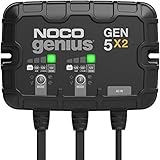
The GEN5X2 is the charger that fits the most boats. A two-bank onboard unit with 5 amps per bank and 10 amps total, it is built for the near-universal configuration of a 12V starting battery plus a 12V house battery — or a house bank plus a second battery serving a windlass, thruster or trolling motor. It mounts permanently, wires to each battery with its own set of leads, and charges both simultaneously without you having to move clamps around.
It suits the owner of an 18–26 ft boat with an outboard or sterndrive, a battery switch, and a shore power connection or a garage outlet at the storage rack. It also suits anyone who is tired of dragging a portable charger down to the dock, clipping it on, and hoping the rain holds off. If your boat lives on a trailer and gets plugged in at home, the GEN5X2 turns “charging the boat” into a permanently installed routine: plug in the shore cord, walk away.
Key specs
- Banks: 2, independently charged and maintained
- Output: 5A per bank, 10A total
- Voltage: 12V nominal
- Chemistry: 12V lead-acid (flooded, AGM, gel) and 12V lithium (LiFePO4) profiles
- Mounting: onboard, sealed waterproof housing for permanent installation
- Modes: charge, maintain, and a force/activation mode for deeply discharged batteries
- Input: standard AC shore power
The strength here is proportionality. Five amps per bank is not a fast charger, but it is the correct rate for the battery sizes that dominate this class — a 75–110Ah house battery, and a 50–100Ah start battery. Ten amps total spread across two banks also stays comfortably inside what a standard household or dock circuit can supply, so you are not hunting for a 20-amp outlet at the marina. Because the banks are isolated, a weak or deeply discharged start battery will not drag down the house bank’s charging.
The sealed housing is the other half of the value. Onboard chargers live in the worst environment on the boat: heat, vibration, humidity, salt air and the occasional wash-down. A unit designed for that environment, mounted above the bilge water line and wired properly, is a different product category from a portable charger left on a shelf. That distinction matters more than any single spec on this page.
Pros
- Exactly the bank count most two-battery boats need — no wasted capacity, no wasted money
- Waterproof sealed housing suits permanent engine-compartment mounting
- Independent banks mean different battery sizes and ages coexist safely
- Maintainer function means it can stay connected through the off-season
Cons
- 5A per bank is a slow recharge if you routinely draw a large house bank down past 50%
- Two banks is a hard ceiling — a third battery means a second charger or a step up
- Requires a permanent AC feed to the boat to be useful
- Installation means routing and terminating DC leads, not just clipping on
How it compares: Against the GEN5X1, the GEN5X2 buys you a second bank for a modest step up in price — and if you own two batteries, that is the difference between charging one and charging both. Against the GENPRO10X2, it gives up half the output per bank. If your house bank is 150Ah or larger, or you regularly return to the dock with a deeply drawn bank, the GENPRO10X2’s 10 amps per bank will roughly halve your recharge time. For a typical 100Ah house bank, the GEN5X2 is the better value.
2. NOCO GEN5X1 – Best Budget Single-Bank Onboard Charger
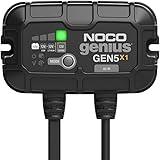
The GEN5X1 is the one-bank version of the same platform: 5 amps into a single 12V battery, permanently mounted, waterproof. It is the cheapest way to get a genuine onboard charging setup into a small boat, and for a lot of owners that is the entire requirement — one battery, one charger, plugged in whenever the boat is at the dock or in the driveway.
It suits small outboard boats, tenders, inflatables, personal watercraft, single-battery fishing boats and smaller pontoon setups. It also suits the owner of a two-battery boat who already has a battery switch and a combiner, and who is happy to charge the bank as a single 12V system rather than as two isolated batteries. That is a legitimate approach, and it costs less, though it does mean the charger cannot distinguish between a healthy battery and a failing one.
Key specs
- Banks: 1
- Output: 5A
- Voltage: 12V nominal
- Chemistry: 12V lead-acid (flooded, AGM, gel) and 12V lithium (LiFePO4) profiles
- Mounting: onboard, sealed waterproof housing
- Functions: charge, maintain, and activation of deeply discharged batteries
The case for the GEN5X1 is simplicity. One set of leads, one battery, one job. Five amps will bring a 50–100Ah battery back from a moderate discharge overnight, and the maintainer stage means the charger can stay connected indefinitely without overcharging — which is the real reason to own a smart charger rather than a fixed-output trickle unit. Left connected through winter, it keeps the battery topped up and reduces the sulfation that kills batteries in storage.
The limitation is scale. Five amps into a 200Ah bank that has been drawn down to 50% is a long night, and if you later add a second battery you will be buying another charger. That said, the GEN5X1 shares the same sealed, waterproof onboard design as the rest of the GEN5X family, so it is not a compromise on build quality — only on capacity.
Pros
- Lowest-cost entry into a genuinely waterproof onboard charger
- Simple single-bank installation with one set of leads
- Maintainer mode makes it usable as a permanent, always-connected unit
- Supports both lead-acid and lithium profiles, so it survives a future battery upgrade
Cons
- One bank only — no independent charging of two batteries
- 5A is slow for anything larger than roughly a 100Ah battery
- No upgrade path inside the unit itself; a second battery means a second charger
- Overkill if your real need is occasional top-ups rather than permanent installation
How it compares: The GEN5X1 versus the GEN5X2 is the clearest fork in this entire list. One battery, one bank, less money — that is the GEN5X1. Two batteries that you want charged and monitored independently, and the GEN5X2 is worth the step up. If you are considering the GEN5X1 but your house bank is above 100Ah, look instead at the GENPRO10X1, which delivers 10A into a single bank and roughly halves the recharge window.
3. NOCO GEN5X3 – Best for Three-Battery Boats
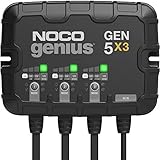
The GEN5X3 takes the same 5-amp-per-bank platform and stretches it to three banks, for 15 amps total. That covers the three-battery layout that shows up on a lot of mid-size boats: a starting battery, a house battery, and a third battery dedicated to a bow thruster, windlass or trolling motor. Each bank is charged and maintained independently, which matters when those three batteries are different sizes, different ages and different chemistries.
It suits owners of roughly 22–32 ft boats with a genuine electrical panel, a battery switch or two, and three separate batteries in separate locations. It is also the right pick when one of those batteries is a long cable run away from the others — a bow thruster battery, for example — because each bank’s leads can be run to wherever the battery physically sits rather than forcing everything into one location.
Key specs
- Banks: 3, independently charged and maintained
- Output: 5A per bank, 15A total
- Voltage: 12V nominal
- Chemistry: 12V lead-acid (flooded, AGM, gel) and 12V lithium (LiFePO4) profiles
- Mounting: onboard, sealed waterproof housing
- Functions: charge, maintain, and deep-discharge activation per bank
The independent-bank architecture is the whole point. If your thruster battery is a small AGM and your house bank is a large flooded deep-cycle, a single shared charger would have to compromise on charge profile or risk undercharging one and overcharging the other. Three isolated banks mean three separate profiles running simultaneously, each terminating when its own battery is full. That is what makes a multi-bank charger worth the money rather than a luxury.
The trade-off is the 5A per bank ceiling. Fifteen amps total sounds substantial, but it is spread three ways, so each battery still sees a modest charge rate. For batteries in the 50–100Ah range that is fine and gentle. For a 200Ah house bank it is slow. If you have three batteries and one of them is large, the GENPRO10X3 — same three banks, double the current per bank — is the more honest match.
Pros
- Three fully independent banks cover the classic start / house / accessory layout
- Leads can run to batteries in physically separate locations
- Waterproof sealed housing suits permanent installation
- Mixed battery sizes, ages and chemistries coexist without compromise
Cons
- 5A per bank is slow for a large house bank
- Costs meaningfully more than a two-bank unit for only 5A of extra total output
- Requires more installation work — three sets of leads, three terminations, three fuses
- Overkill if two of your three batteries are rarely used
How it compares: The GEN5X3 versus the GEN5X2 is purely a bank-count decision — same output per bank, one more battery covered. If your third battery is a thruster or trolling motor battery that gets drawn down hard and needs to be ready on short notice, the GENPRO10X3’s 10A per bank is the difference between ready by morning and ready by tomorrow evening. For a third battery that mostly sits as a backup, the GEN5X3 is enough.
4. NOCO GENPRO10X2 – Best for Faster Two-Bank Recharging

The GENPRO10X2 is the two-bank charger for boats whose house bank is bigger than average. It doubles the per-bank output of the GEN5X2 — 10 amps per bank, 20 amps total — while keeping the same onboard, waterproof, permanently mounted format. That extra current is the difference between a house bank that is ready by morning and one that is ready the following evening.
It suits owners of 24–34 ft boats with a house bank in the 150–300Ah range, and anyone who returns to the dock with deeply drawn batteries after a weekend of refrigeration, electronics and overnight anchoring. It also suits boats where the charger has a limited window to work: a mooring with a shared dock outlet, a marina with metered power, or a trailer boat that gets plugged in for a single night before the next trip.
Key specs
- Banks: 2, independently charged and maintained
- Output: 10A per bank, 20A total
- Voltage: 12V nominal
- Chemistry: 12V lead-acid (flooded, AGM, gel) and 12V lithium (LiFePO4) profiles
- Mounting: onboard, sealed waterproof housing
- Functions: multi-stage charging, maintenance, deep-discharge activation
Here is the arithmetic that justifies the step up. A 200Ah house bank drawn to 50% depth of discharge needs roughly 100Ah returned, plus about 15–20% for charging inefficiency — call it 115–120Ah. At 10A that is about 12 hours of charging, which fits comfortably in an overnight session. At 5A it is roughly 24 hours, which usually does not. Multiply that difference across a season of weekend trips and the premium tier pays for itself in usable battery capacity rather than in convenience.
The second benefit is gentler treatment of large batteries. The widely used rule of thumb is that a charger should supply around 10% of a bank’s amp-hour rating. For a 200Ah bank, 10A per bank is right on target; 5A is half of what the bank would ideally see. Undercharging a big deep-cycle bank repeatedly is one of the quiet ways batteries die early.
Pros
- 10A per bank fits the 10%-of-capacity rule for 100Ah banks and up
- Overnight recharge of a 200Ah house bank is realistic
- Same sealed waterproof onboard format as the rest of the GEN series
- Handles mixed chemistries and battery sizes across its two banks
Cons
- Premium tier pricing for a two-bank unit
- 20A total draw needs to be accounted for in your shore power setup
- Still only two banks — a third battery requires a different unit
- Overkill for boats whose house bank is under about 120Ah
How it compares: Against the GEN5X2, this is a straightforward amps-versus-price trade. If your house bank is 100Ah or smaller, the GEN5X2 charges it adequately and the GENPRO10X2 is money spent on speed you do not need. Above 150Ah, the GENPRO10X2 stops being a luxury and starts being the correct spec. If you need the same output across three batteries instead of two, the GENPRO10X3 is the direct step sideways.
5. NOCO GENIUS1 – Best Budget Maintainer for Winter Storage
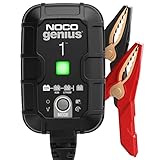
The GENIUS1 is a different kind of product from everything else on this page: a small, portable 1-amp smart charger and maintainer for 6V and 12V batteries. It is not designed to live permanently in a bilge, and it is not designed to recharge a deeply drawn house bank quickly. What it does extremely well is keep a battery healthy over long periods of disuse, one battery at a time.
It suits the boat owner who pulls batteries out for the winter and stores them in a garage or basement, the owner of a small boat or jet ski that sits for months between uses, and anyone with a collection of batteries — boat, motorcycle, lawn tractor, RV — that all need occasional topping up. It is also the right first purchase for someone who is not ready to commit to a permanent onboard installation.
Key specs
- Banks: 1, portable with clamps
- Output: 1A
- Voltage: 6V and 12V
- Chemistry: lead-acid (flooded, AGM, gel) and 12V lithium (LiFePO4) profiles
- Mounting: portable; splash-resistant but not intended for permanent wet installation
- Functions: multi-stage charging plus long-term maintenance
At 1 amp, the GENIUS1 is a maintenance device first and a charger second. Bringing a 100Ah battery from 50% to full at 1A is measured in days, not hours. But that is not the job. The job is holding a fully charged battery at the correct float voltage for four or five months so that self-discharge and sulfation do not erode its capacity. A battery that goes into storage at 100% and stays there will typically come out of storage in far better condition than one that was left at 70% and allowed to drift down.
The 6V capability is a genuine differentiator in this list — no other product here covers 6V, which matters if you own a classic boat, a golf-cart-style battery setup, or certain older trolling motor configurations. The multi-stage profile and lithium support mean it also works as an everyday maintainer for a modern AGM or LiFePO4 battery that sees light use.
Pros
- Lowest-cost way to keep a stored battery healthy through the off-season
- Covers 6V as well as 12V, unlike the onboard chargers in this list
- Portable — moves between boat, motorcycle, tractor and RV
- Multi-stage profile with lithium support for modern battery chemistries
Cons
- 1A is far too slow to recharge a drawn-down marine bank
- One battery at a time; a multi-battery winter means rotating it
- Not built for permanent installation in a wet engine compartment
- No bank isolation — it cannot manage two batteries simultaneously
How it compares: The GENIUS1 and the GENIUS2D occupy similar ground from opposite directions. The GENIUS2D is a 2A onboard unit meant to be mounted permanently on the boat and left connected; the GENIUS1 is a 1A portable unit meant to travel with the battery to the garage. If your boat stays in the water year-round with shore power available, the GENIUS2D is the more practical installation. If you pull batteries for winter, the GENIUS1’s portability and 6V support make it the better fit.
6. NOCO GENPRO10X3 – Best Premium Three-Bank Charger
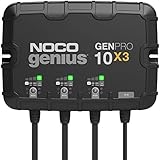
The GENPRO10X3 is the three-bank version of the high-output platform: 10 amps per bank, 30 amps total, permanently mounted in a sealed waterproof housing. It is the unit for a boat with three real batteries and a real electrical demand — a house bank that runs refrigeration and electronics, a dedicated starting battery, and a third battery for a thruster, windlass or inverter.
It suits owners of 28–40 ft boats, particularly those used for extended cruising or offshore work where the house bank is large and getting it recharged overnight is not optional. It also suits twin-engine boats where each engine has its own starting battery plus a shared house bank, since three banks map neatly onto that layout.
Key specs
- Banks: 3, independently charged and maintained
- Output: 10A per bank, 30A total
- Voltage: 12V nominal
- Chemistry: 12V lead-acid (flooded, AGM, gel) and 12V lithium (LiFePO4) profiles
- Mounting: onboard, sealed waterproof housing
- Functions: multi-stage charging, maintenance, deep-discharge activation per bank
Thirty amps total is where multi-bank charging stops feeling like a compromise. A 300Ah house bank at 50% depth of discharge needs roughly 165–175Ah returned including losses; at 10A that is about 17 hours, which is a long night but achievable with a full overnight plus a few hours. Step up the bank to 400Ah and you are looking at 22–23 hours, at which point you are realistically charging over a full day at the dock rather than overnight. That is the honest ceiling of this unit, and it is why very large banks often use a higher-output charger or a separate inverter-charger.
The independent-bank design is what separates this from simply buying a bigger single-output charger. Each of the three batteries terminates on its own profile. A flooded start battery, an AGM thruster battery and a lithium house bank can all be connected at once without any of them being mistreated — something no single-bank charger can do, regardless of its output.
Pros
- 10A per bank satisfies the 10%-of-capacity rule for banks up to about 100Ah each
- 30A total makes overnight recovery realistic on a 250–300Ah house bank
- Three independent profiles handle mixed chemistries on one charger
- Sealed waterproof construction for permanent engine-room installation
Cons
- Premium tier pricing — the most expensive way to cover three batteries in this list
- 30A total requires a shore power feed that can actually supply it
- Installation complexity: three lead pairs, three fuses, careful routing
- Still not enough current for a house bank above roughly 350–400Ah
How it compares: The GEN5X3 and GENPRO10X3 have identical bank counts; the difference is purely current, and it is a large difference — 15A total versus 30A. For a boat with three small-to-medium batteries, the GEN5X3 is the sensible buy. For a boat where one of those three is a large house bank that gets drawn down every trip, the GENPRO10X3 is the one that keeps up. If your layout has four batteries rather than three, the GENPRO10X4 covers it without a second charger.
7. PZ.P 15-Amp 12V/24V Smart Charger – Best Budget Portable

The PZ.P 15-amp unit is the odd one out in this roundup and a useful one: a portable smart charger that handles both 12V and 24V systems and supports LiFePO4 as well as lead-acid batteries, in charger, maintainer and trickle-charger roles. It is not an onboard unit and should not be permanently mounted in a wet compartment, but as a bench or dock charger it covers a lot of ground for the price.
It suits owners who are not ready to wire a permanent charger into the boat, owners of boats that live on trailers and get charged in the driveway, and anyone running a 24V system — a trolling motor setup, for example — which none of the 12V onboard chargers in this list can address. The 12V/24V auto-detect capability is genuinely uncommon at the budget tier.
Key specs
- Banks: 1 (portable, clamp connection)
- Output: 15A
- Voltage: 12V and 24V
- Chemistry: LiFePO4 and lead-acid (flooded, AGM, gel) profiles
- Functions: charge, maintain, trickle charge, plus battery repair/desulfation modes
- Mounting: portable only — keep it dry and out of standing water
Fifteen amps is a genuinely useful charge rate for a portable unit, and it puts this in a different performance class from a 1A or 2A maintainer. A 100Ah battery at 50% depth of discharge needs roughly 55–60Ah returned including losses; at 15A that is around four hours, which is a realistic afternoon job. For a 24V trolling motor bank made of two 12V batteries in series, the 24V mode charges the pair as one unit, which is exactly how they should be treated.
The trade-off is durability and permanence. A portable charger sitting on a dock box or in a garage is fine; one left permanently in a damp bilge is not, and no amount of smart circuitry compensates for a wet circuit board. If your goal is a charger that lives on the boat and gets plugged in with the shore cord, this is the wrong category of product — go with a sealed onboard unit. If your goal is flexibility and multi-voltage coverage at a low entry price, it is a strong choice.
Pros
- Covers both 12V and 24V systems, which the onboard 12V chargers here cannot
- Supports LiFePO4 alongside lead-acid chemistries
- 15A is a real charge rate, not a maintenance-only trickle
- Portable — moves between boats, vehicles and equipment
Cons
- Not designed for permanent mounting in a wet engine compartment
- Single output — no independent banks for multiple batteries
- Requires manual connection and disconnection each time
- Portable chargers are the ones that get left in the rain; storage discipline matters
How it compares: Against the GENIUS1, the PZ.P gives up portability-plus-6V support in exchange for far more current and 24V capability — a trade most boat owners would happily make. Against the NOCO GENPRO10X1, it is the opposite trade: the GENPRO10X1 is slower but permanent, waterproof and hands-free, while the PZ.P is faster and more flexible but must be hooked up and stored every time. Choose based on whether you want an installation or a tool.
8. NOCO GENPRO10X4 – Best for Four-Bank Offshore Setups
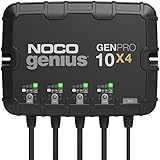
The GENPRO10X4 is the largest unit in this roundup by bank count and total output: four independent banks at 10 amps each, 40 amps total, in the same sealed waterproof onboard housing as the rest of the GENPRO series. Four banks covers the full offshore layout — two engine start batteries on a twin-engine boat, a house bank, and a fourth battery for a thruster, windlass or generator start.
It suits owners of 32 ft and up, twin-engine boats, and anyone whose battery inventory has outgrown three banks. It also suits boats where the batteries are scattered: a start battery in each engine room or lazarette, a house bank amidships, and a bow thruster battery forward. Four sets of leads running to four locations is exactly what this unit is built for.
Key specs
- Banks: 4, independently charged and maintained
- Output: 10A per bank, 40A total
- Voltage: 12V nominal
- Chemistry: 12V lead-acid (flooded, AGM, gel) and 12V lithium (LiFePO4) profiles
- Mounting: onboard, sealed waterproof housing
- Functions: multi-stage charging, maintenance, deep-discharge activation per bank
Forty amps total is a serious AC load, and that is the first practical consideration. A charger of this size needs a shore power feed that can supply it continuously, along with appropriately sized AC wiring and a breaker that will not nuisance-trip when all four banks are calling for current at once. On a boat with a modest shore power inlet, the GENPRO10X4 can be more than the inlet comfortably supports — worth checking before you buy, not after.
Where it earns its place is in eliminating the second charger. Two separate two-bank units mean two AC feeds, two mounting locations and two sets of failure points. One four-bank unit means one installation, one set of status indicators and a single point of control. On a boat where the electrical system is already complex, consolidation has real value. The 10A per bank ceiling is unchanged from the rest of the GENPRO series, so a house bank above roughly 350Ah will still want more current than any one bank can deliver.
Pros
- Four independent banks cover the full offshore battery inventory in one unit
- 40A total output is the highest in this roundup
- Consolidates what would otherwise be two separate chargers and two AC feeds
- Sealed waterproof housing and mixed-chemistry support per bank
Cons
- Highest price tier in this list
- 40A AC demand may exceed what a small shore power inlet can supply
- Four sets of leads and fuses make installation the most involved here
- Overkill for any boat with fewer than four batteries
How it compares: The GENPRO10X4 versus the GENPRO10X3 is simply whether you have a fourth battery. If you have three, the GENPRO10X3 does the same job with the same per-bank current for less. If you have four — or expect to add a bow thruster battery later — the four-bank unit avoids a second installation down the road. If your boat has four batteries but they are all small, the GEN5X3 plus a small maintainer may cover it for less, though with less current per bank.
9. NOCO GENIUS2D – Best Permanent 2A Onboard Maintainer
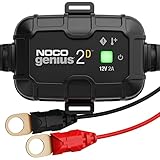
The GENIUS2D is a small onboard charger — 2 amps, 12V, sealed and waterproof — designed to be mounted permanently on the boat and left connected. It is not a fast charger and it does not pretend to be. It is a maintainer that lives where the battery lives, so the battery is always topped up and ready.
It suits boats with a single battery that sees intermittent use: a small fishing boat, a runabout, a jet ski, a pontoon, a tractor or a utility vehicle that sits for weeks at a time. It also suits a specific and very practical use case — a starting battery that is only lightly drawn and mostly needs to be held at full charge, or a second battery that gets occasional use and would otherwise self-discharge between trips.
Key specs
- Banks: 1
- Output: 2A
- Voltage: 12V nominal
- Chemistry: 12V lead-acid and 12V lithium (LiFePO4) profiles
- Mounting: onboard, sealed waterproof housing
- Functions: charging and long-term maintenance
Two amps is a deliberate specification. It is enough to counteract self-discharge and to slowly bring a lightly depleted battery back to full, and it is gentle enough to leave connected indefinitely without stressing a small battery. On a boat that gets plugged in every few weeks, that is all that is required. The onboard mounting is the differentiator against the GENIUS1: this unit stays on the boat, so there is no clamp to attach, no charger to remember, and no reason the battery should ever be found flat at the start of a trip.
Where it falls short is recovery. If a battery has been drawn down significantly — say a trolling motor run or a weekend of anchoring with lights and a stereo — 2A will take a very long time to restore it. A 100Ah battery at 50% depth of discharge needs around 55–60Ah returned including losses, which at 2A is measured in days. This is a maintainer for batteries that are already close to full, not a charger for batteries that are empty.
Pros
- Permanent onboard mounting removes the “I forgot to charge it” failure mode entirely
- Sealed waterproof housing survives an engine compartment
- Safe to leave connected indefinitely as a maintainer
- Supports lithium as well as lead-acid, so it survives a battery upgrade
Cons
- 2A is too slow to recharge a drawn-down battery in any reasonable timeframe
- Single bank only
- Costs more than a portable maintainer with more features
- Requires a permanent AC feed to be useful
How it compares: Against the GENIUS1, the GENIUS2D trades portability and 6V support for permanent mounting and twice the current. If your battery stays in the boat, the GENIUS2D is the better installation; if it comes out for winter, the GENIUS1 is more useful. Against the GEN5X1, the GENIUS2D is less than half the output — the GEN5X1 is the one to choose if you actually need to recharge, not just maintain.
10. NOCO GENPRO10X1 – Best Fast Single-Bank Onboard Charger
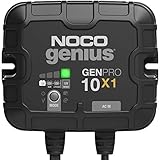
The GENPRO10X1 takes the high-output platform and applies it to a single bank: 10 amps into one 12V battery, permanently mounted, sealed and waterproof. It is the charger for a boat that has one battery but a large one, or one battery that gets drawn down hard and needs to come back quickly.
It suits single-battery fishing boats with a big deep-cycle bank running a trolling motor, small boats with a substantial house battery and no separate starting battery, and boats where a single large bank serves everything through a battery switch. It is also the right answer for anyone who wants a permanent installation without paying for bank capacity they will never use.
Key specs
- Banks: 1
- Output: 10A
- Voltage: 12V nominal
- Chemistry: 12V lead-acid (flooded, AGM, gel) and 12V lithium (LiFePO4) profiles
- Mounting: onboard, sealed waterproof housing
- Functions: multi-stage charging, maintenance, deep-discharge activation
Ten amps into a single battery is the correct rate for a bank up to roughly 100Ah, and it delivers a genuinely useful recharge window: a 100Ah battery at 50% depth of discharge needs about 55–60Ah returned with losses, which is roughly six hours at 10A — an overnight job, comfortably. Compare that with the 5A GEN5X1, which takes about twelve hours for the same task, and the value of the extra current becomes clear.
Because it only has one bank, it is also the simplest of the high-output units to install: one set of leads, one fuse, one termination. There is no bank-isolation wiring to think about and no risk of cross-connecting leads between batteries. On a boat with a single battery, that simplicity is worth more than extra features.
Pros
- 10A is the right charge rate for banks up to about 100Ah
- Roughly halves recharge time versus a 5A single-bank charger
- Simplest installation of the high-output onboard units
- Waterproof sealed housing and full chemistry support including LiFePO4
Cons
- One bank only — no path to charging two batteries independently
- Costs more than the GEN5X1 for the same single-bank job, slower than
Ready to decide? Our #1 pick for 2026 is the NOCO GEN5X2.
Live price & availability on Amazon.
Explore Our Guides & Free Tools







Write Your Review
No reviews yet. Be the first to share your experience!