
As an Amazon Associate we earn from qualifying purchases.
A 10-inch screen changes what resin printing can do for product work. The build plate fits full housings, larger display models, and batches of smaller parts in one run, while modern 12K and 16K screens keep XY detail fine enough for crisp edges and readable surface texture. For studios printing high detail product models regularly, this class balances size and sharpness better than any other.
The four printers below were checked on Amazon US. Each section states the actual screen size from the listing: three are 10-inch machines and one is a 10.1-inch near neighbour, labelled as such. Compare the XY micron figure and the build dimensions together, because those two numbers define what you can print and how sharp it will look.
Disclosure: This article contains affiliate links. If you buy through these links, we may earn a commission at no additional cost to you.
How to Choose
Screen size is the starting point, but pixel density is what decides visible detail. A smaller screen concentrates its pixels, so a 7-inch class machine can produce extremely fine XY detail for miniatures and jewellery-scale work, while larger screens spread similar pixel counts over more area in exchange for bigger build volume. Always compare the XY resolution figure in microns alongside the headline K number.
Build volume should match the models you actually print. Product models, prototypes, and display pieces often need width more than height, so read all three dimensions rather than the litre figure alone. Light source design matters too: COB and matrix sources aim for even curing across the plate, and features such as automatic levelling, resin tank heating, and residue detection reduce failed prints, which is where much of the real cost of resin printing sits. Finally, plan the workspace: resin needs ventilation, gloves, washing, and curing, whatever the screen size.
The Picks in Detail
ELEGOO Saturn 4 Ultra 16K

Amazon US: https://www.amazon.com/dp/B0DT938SDK
The Saturn 4 Ultra 16K uses a 10-inch 16K mono LCD with an XY resolution of 14 by 19 microns across 15120 x 6230 pixels, a build volume of 8.33 by 4.66 by 8.66 inches, tilt release, a heated resin tank, a smart mechanical sensor for residue and resin level, and automatic levelling. Stated top speed is 150 mm/h, and a flip-up lid keeps the footprint manageable.
Who it suits: Studios whose product models need the finest available detail at this size, and who print often enough to value the sensor and heating features.
Considerations: It is the most feature-dense machine here, so new users face a longer learning curve. The heated tank and camera features add complexity that casual users may not need.
ELEGOO Saturn 4 Ultra 12K
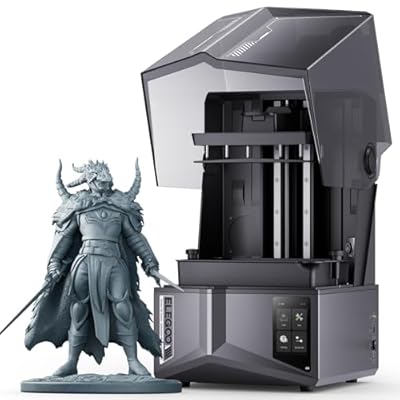
Amazon US: https://www.amazon.com/dp/B0D12Q82KC
The Saturn 4 Ultra 12K uses a 10-inch 12K mono LCD with a resolution of 11520 x 5120 and an XY resolution of 19 by 24 microns. Build volume is 8.62 by 4.84 by 8.66 inches, slightly wider than the 16K version, and it shares the tilt release system, smart automatic levelling, and a stated top speed of 150 mm/h.
Who it suits: Product designers who want the wider plate and the tilt release workflow, and who do not need the 16K pixel count for their model scale.
Considerations: Detail is a step behind the 16K sibling on the finest textures. As with the 16K, the automatic systems reward users who keep firmware and slicer settings current.
ELEGOO Saturn 3

Amazon US: https://www.amazon.com/dp/B0C5JK56W1
The Saturn 3 uses a 10-inch 12K mono LCD with a resolution of 11520 x 5120 and an XY resolution of 19 by 24 microns. Its build volume is 8.62 by 4.84 by 9.84 inches, the tallest in this group, and stated top speed is 70 mm/h. It uses the Voxeldance Tango slicer and a more conventional release system than the tilt release Ultra models.
Who it suits: Modellers printing tall product pieces, lamp and vase style forms, or stacked batches who value build height over raw speed.
Considerations: It lacks the tilt release and smart sensor features of the Ultra line, and its speed is lower. Manual setup plays a bigger role in consistent results.
ANYCUBIC Photon Mono M7 Pro

Amazon US: https://www.amazon.com/dp/B0CYSBZX61
The Photon Mono M7 Pro is the 10.1-inch near neighbour in this class, with a 14K mono LCD, a COB LighTurbo 3.0 light source, and a build volume of 8.78 by 4.95 by 9.05 inches. It adds dynamic resin heating with temperature control and a stated top speed of 170 mm/h in its fast mode, the highest figure in this group.
Who it suits: Busy benches that batch product parts and want heating for consistent curing in cooler rooms, plus the widest plate here.
Considerations: The screen is 10.1 inches rather than exactly 10, which is stated plainly here so you can judge the class fit. Top speed depends on resin and settings, so plan on less in daily use.
Comparison Table
| Product | Key specification | Best for |
|---|---|---|
| ELEGOO Saturn 4 Ultra 16K | 10-inch 16K mono LCD, build 8.33 x 4.66 x 8.66 in, tilt release | Highest detail in the 10-inch class |
| ELEGOO Saturn 4 Ultra 12K | 10-inch 12K mono LCD, 11520 x 5120, build 8.62 x 4.84 x 8.66 in | Proven 10-inch performance with smart levelling |
| ELEGOO Saturn 3 | 10-inch 12K mono LCD, build 8.62 x 4.84 x 9.84 in, up to 70 mm/h | Taller builds in the 10-inch class |
| ANYCUBIC Photon Mono M7 Pro | 10.1-inch 14K mono LCD, build 8.78 x 4.95 x 9.05 in, up to 170 mm/h | Fast 10-inch class printing with dynamic heating |
Frequently Asked Questions
Does a bigger screen mean better detail?
Not automatically. Detail follows XY resolution in microns, which depends on pixel count divided by screen area. A large screen with a high pixel count can match a small screen, but a large screen with a modest pixel count will show softer edges on fine product details.
What else do I need besides the printer?
A wash and cure station or a manual washing setup, nitrile gloves, resin suited to your models, spare release film, and a ventilated workspace. Budget bench space for post-processing, not just for the printer itself.
How important is automatic levelling?
It removes one of the most common causes of failed first layers and saves setup time on every build plate change. Experienced users can level manually, but automatic systems make results more repeatable for product work.
Which resin suits high detail product models?
Standard and 8K-style resins are formulated for fine detail and smooth surfaces, while tougher ABS-like resins trade a little crispness for strength on functional parts. Match the resin to whether the model is for display, fitting, or handling.
Conclusion
The Saturn 4 Ultra 16K leads on detail, the M7 Pro on speed and plate width, the Saturn 4 Ultra 12K is the balanced middle, and the Saturn 3 serves taller builds. For most product studios, the choice comes down to whether your models need maximum sharpness or maximum throughput.
Write Your Review
No reviews yet. Be the first to share your experience!