
As an Amazon Associate we earn from qualifying purchases.
The 12-inch class sits between the mainstream 10-inch machines and the very large formats, offering a wider plate for bigger product models and batch work without the full cost and footprint of the largest printers. It is a thin class on Amazon US. Checking the major brands there confirmed one machine in the near-12-inch band with a verifiable listing: a 12.8-inch model, covered here with its actual screen size stated, rather than a list padded with 10-inch printers relabelled upward.
If your product models outgrow a 10-inch plate but do not need the largest formats, this class is the natural step. The guide explains the verified option in depth and sets out how to judge whether the extra plate width will actually change what you can print.
Disclosure: This article contains affiliate links. If you buy through these links, we may earn a commission at no additional cost to you.
A Note on This Class
Only one printer in the near-12-inch band had a verifiable Amazon US listing in this check. Rather than fill the guide with 10-inch models, this article covers that machine in depth and states its actual screen size, keeping the comparison honest.
How to Choose
The key comparison for this class is against the 10-inch machines. List the parts that fail to fit a 10-inch plate, including support bases, and see whether the wider area here solves them in one piece. Fewer split parts means fewer seams to finish on product models, which is often the real gain.
Detail still follows the XY micron figure, and a 12.8-inch 6K screen spreads its pixels wider than a 10-inch 12K screen, so surface detail will be a little softer. For large display and prototype work that trade is usually welcome, but for fine texture work it may not be. Also plan for the larger resin vat, the heavier plate, and wash and cure capacity that matches the build area, because post-processing is where large-format ownership is felt daily.
The Picks in Detail
ELEGOO Jupiter SE

Amazon US: https://www.amazon.com/dp/B0CLP5GQMC
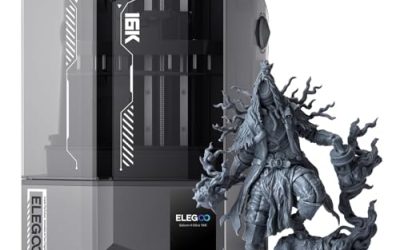
The Jupiter SE uses a 12.8-inch 6K monochrome LCD with a resolution of 5448 x 3064, stated here at its actual size as the closest verified option in the 12-inch band. Build volume is 10.94 by 6.15 by 11.81 inches, giving both width and height well beyond the 10-inch class. A 3.5-inch touchscreen handles control, and the machine is designed for large models and batch layouts on a single plate.
Who it suits: Product designers and studios whose housings, display pieces, or part batches no longer fit a 10-inch plate, and who accept a small detail trade for the size gain.
Considerations: The screen is 12.8 inches rather than exactly 12, and its 6K pixel count means softer fine detail than 12K 10-inch machines. It is also a large, heavy machine that needs a permanent station and matching post-processing capacity.
Comparison Table
| Product | Key specification | Best for |
|---|---|---|
| ELEGOO Jupiter SE | 12.8-inch 6K mono LCD, 5448 x 3064, build 10.94 x 6.15 x 11.81 in | Large product models beyond the 10-inch class |
When the Wider Plate Earns Its Keep
The clearest case for this class is the part that almost fits. Product housings, stands, enclosures, and display bases often miss a 10-inch plate by a small margin in one direction, and splitting them adds seams, alignment work, and finishing time to every unit. A wider plate removes that whole category of labour, which is why studios feel the gain in throughput rather than in any single specification.
Batch layout is the second case. A 12.8-inch area arranges a full product set, or a grid of identical smaller parts, in one run with one resin and one set of settings. For small production runs of product models, that consistency simplifies quality control, because every part in the set shares the same cure history.
There are habits that make the class work well. Large plates benefit from slower, more deliberate lift settings on big cross-sections, from hollowing large solids with drain holes placed where they will not show, and from support patterns that favour the faces carrying the most suction. None of this is difficult, but it is different from small-machine practice, where almost any layout succeeds.
Ownership planning matters too. The vat holds more resin, the plate is heavier to handle when loaded, and the wash and cure step needs containers that fit the build area. Buyers who arrange that chain before the printer arrives get the benefit of the class immediately, while buyers who improvise it tend to underuse the plate they paid for. Measured against your own part list, those practical points decide whether this class is an upgrade or simply a larger version of what you already own.
A final check is service and consumables. Screens, release film, and vats for large machines are model-specific, so confirm that the parts for the Jupiter family are easy for you to source before you commit. Studios that keep one spare release film and a screen protector routine in place avoid the most common large-format interruption, which is waiting on a consumable while a deadline moves closer.
Frequently Asked Questions
Does a bigger screen mean better detail?
Not automatically. Detail follows XY resolution in microns, which depends on pixel count divided by screen area. A large screen with a high pixel count can match a small screen, but a large screen with a modest pixel count will show softer edges on fine product details.
What else do I need besides the printer?
A wash and cure station or a manual washing setup, nitrile gloves, resin suited to your models, spare release film, and a ventilated workspace. Budget bench space for post-processing, not just for the printer itself.
How important is automatic levelling?
It removes one of the most common causes of failed first layers and saves setup time on every build plate change. Experienced users can level manually, but automatic systems make results more repeatable for product work.
Which resin suits high detail product models?
Standard and 8K-style resins are formulated for fine detail and smooth surfaces, while tougher ABS-like resins trade a little crispness for strength on functional parts. Match the resin to whether the model is for display, fitting, or handling.
Conclusion
The Jupiter SE, at an actual 12.8 inches, is the verified near-12-inch choice from this Amazon US check, and it earns its place on plate size rather than detail. Studios printing the finest textures should stay with the 10-inch class; studios splitting parts to fit should step up to this machine.
Write Your Review
No reviews yet. Be the first to share your experience!