
As an Amazon Associate we earn from qualifying purchases.
- Quick Picks
- How We Selected These Picks
- 1. Sky-Watcher Heritage 150 Tabletop Dobsonian Telescope – Best For Portable Grab-and-Go Observing
- 2. Celestron StarSense Explorer 150AZ Tabletop Dobsonian Telescope – Best For Phone-Guided Finding
- 3. Orion SkyQuest XT6 Classic Dobsonian Telescope – Best For Floor-Standing Backyard Observing
- 4. HandyDob6 Ultra Light Portable Dobsonian Telescope – Best For Travel Observing
- Buying Guide: What to Look For
- Comparison Table
- FAQ
- Final Verdict
Disclosure: This article contains affiliate links. If you buy through links on this page, we may earn a commission at no extra cost to you. Product availability on Amazon US can change; check the product page for current details before ordering.
A 6-inch Dobsonian is the upgrade that turns casual sky watching into real visual astronomy. A 150mm mirror resolves globular clusters into stars at the edges, shows galaxy cores and brighter nebulae with genuine structure, and delivers crisp lunar and planetary views. At the same time, the 6-inch class stays light enough to carry outside in one or two trips and set up in minutes — which is why many observers keep a 6-inch Dobsonian even after buying larger scopes.
This guide compares four verified 6-inch options on Amazon US: the Sky-Watcher Heritage 150 Tabletop, the Celestron StarSense Explorer 150AZ Tabletop, the Orion SkyQuest XT6 Classic, and the HandyDob6 Ultra Light Portable. Three run at 750mm f/5 in tabletop or travel formats; the Orion XT6 is the traditional floor-standing design at 1200mm f/8. That split is the heart of the decision. One support note applies to the Orion model: Orion Telescopes & Binoculars wound down operations in 2024, so warranty and parts support are limited. Verify the seller and warranty terms before ordering any Orion scope.
Quick Picks
| Product | Best For | Key Spec | ASIN |
|---|---|---|---|
| Sky-Watcher Heritage 150 Tabletop | Portable tabletop grab-and-go observing | 150mm, 750mm, f/5 collapsible tabletop | B09DGT69G1 |
| Celestron StarSense Explorer 150AZ | Phone-guided finding in a 6-inch tabletop scope | 150mm, 750mm, f/5 with StarSense dock | B0CBQY8NGZ |
| Orion SkyQuest XT6 Classic | Floor-standing starter for Moon, planets, and bright deep-sky | 150mm, 1200mm, f/8 solid tube | B001DDW9UW |
| HandyDob6 Ultra Light Portable | Airline-portable travel observing | 150mm, 750mm, f/5 ultra-light travel Dobsonian | B0FG7NT9LX |
How We Selected These Picks
We selected these telescopes by verifying aperture, optical design, mount type, and included accessories for a visual upgrade at 6 inches. Every pick is a 150mm Newtonian on a manual Dobsonian mount — floor-standing rocker, tabletop base, or travel Dobsonian. We confirmed each model carries a real Amazon US ASIN with a listing signal at the time of writing, and recorded focal length, focuser type, finder type, and included eyepieces from manufacturer specifications.
The four picks span the formats available at this aperture. The Orion XT6 represents the traditional floor-standing design, included with the support caveat noted in its section. The Sky-Watcher Heritage 150 and Celestron StarSense Explorer 150AZ are current-production tabletop models, one collapsible and one with phone-guided finding. The HandyDob6 is an ultra-light travel design for air travel. We excluded models that could not be confirmed as currently available on Amazon US.
1. Sky-Watcher Heritage 150 Tabletop Dobsonian Telescope – Best For Portable Grab-and-Go Observing

ASIN: B09DGT69G1
Amazon US: https://www.amazon.com/dp/B09DGT69G1
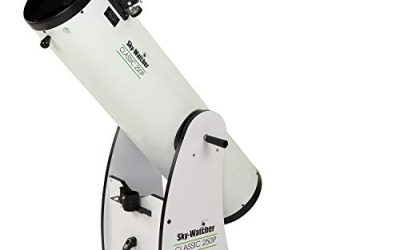
The Sky-Watcher Heritage 150 (S11710) is a 150mm parabolic Newtonian at 750mm f/5 in a collapsible FlexTube design on a tabletop Dobsonian base. The tube slides down to a compact length for storage and transport, then extends to full focal length for observing. For an upgrade from binoculars or a small starter scope, real 6-inch aperture in grab-and-go size is the main appeal: the telescope can live on a shelf and be outside in minutes.
Sky-Watcher includes 25mm and 10mm Super eyepieces, giving 30x and 75x — a sensible pairing for sweeping star fields and closer views of the Moon, planets, and bright clusters. A red-dot finder handles initial pointing. The focuser is a 1.25-inch helical design, adequate for the included eyepieces, though it accepts only 1.25-inch eyepieces.
The tabletop format is the key consideration. The base needs a sturdy table, stand, or other stable surface at a comfortable height, and observing quality depends on that surface being solid. If you have a stable outdoor table or plan to add a stand, the Heritage 150 is the most portable conventional option here. If you prefer standing at a floor-standing scope, the Orion XT6 format suits you better.
Pros
– 150mm parabolic mirror at f/5 in a collapsible tabletop design
– Two eyepieces included (25mm and 10mm) for 30x and 75x
– Compact collapsed length for shelf storage and car transport
– Red-dot finder included
– Current production model with active support
Cons
– Requires a sturdy table or stand at a comfortable height
– 1.25-inch helical focuser only — no 2-inch eyepiece option
– Open tube section benefits from a shroud in bright surroundings
2. Celestron StarSense Explorer 150AZ Tabletop Dobsonian Telescope – Best For Phone-Guided Finding

ASIN: B0CBQY8NGZ
Amazon US: https://www.amazon.com/dp/B0CBQY8NGZ
The Celestron StarSense Explorer 150AZ (22482) is a 150mm Newtonian at 750mm f/5 in a solid tube on a manual tabletop Dobsonian base, fitted with Celestron’s StarSense smartphone dock. The StarSense Explorer app plate-solves the sky through the phone camera, then guides you to push the tube to your target. For observers who find star-hopping the hardest part of the hobby, guided finding in a 6-inch tabletop scope removes that barrier.
Celestron includes 25mm and 10mm eyepieces (30x and 75x) and a StarPointer red-dot finder for initial alignment and phone-free pointing. The solid tube holds collimation well and keeps stray light out without a shroud. As with every manual Dobsonian here, there is no tracking: you center the object, then nudge the tube as it drifts.
The limitations are the tabletop requirement — a sturdy surface at the right height — plus dependence on a compatible smartphone for StarSense guidance. Confirm phone compatibility before ordering. If you already find objects comfortably with charts, the Heritage 150 offers a collapsible tube in the same class. If finding objects ends your sessions early, the StarSense dock is the feature that changes your observing.
Pros
– StarSense dock for app-guided push-to finding
– 150mm Newtonian at f/5 in a solid tabletop tube
– Two eyepieces included (25mm and 10mm)
– StarPointer red-dot finder included
– Solid tube holds collimation well
Cons
– Guidance depends on a compatible smartphone
– Requires a sturdy table or stand
– Manual mount with no tracking
3. Orion SkyQuest XT6 Classic Dobsonian Telescope – Best For Floor-Standing Backyard Observing

ASIN: B001DDW9UW
Amazon US: https://www.amazon.com/dp/B001DDW9UW
The Orion SkyQuest XT6 Classic is the traditional 6-inch formula: a 150mm parabolic Newtonian at 1200mm f/8 in a solid steel tube on a floor-standing Dobsonian rocker base. The longer f/8 ratio is forgiving — collimation tolerances are relaxed, coma is minimal, and standard eyepieces perform well across the field. The included 25mm Sirius Plossl gives 48x, and the 1200mm focal length reaches planetary magnifications with ordinary eyepieces.
The XT6 uses a 1.25-inch rack-and-pinion focuser and an EZ Finder II reflex finder. The floor-standing base puts the eyepiece at a comfortable height without a table, which many backyard observers prefer for longer sessions. The solid tube holds collimation well between sessions.
Support is the deciding factor. Orion Telescopes & Binoculars wound down operations in 2024, so warranty coverage and factory parts support are limited. Remaining units are typically new-old-stock or successor-channel inventory. Check the Amazon listing for seller identity, unit condition, and warranty terms before ordering. Where a reputable new-unit listing is confirmed, the XT6 is a capable floor-standing scope. Where the listing is unclear, the Heritage 150 or StarSense 150AZ provide 6-inch aperture with current support in tabletop form.
Pros
– 150mm parabolic mirror at f/8 — forgiving collimation and minimal coma
– Floor-standing base for comfortable observing height
– Solid tube holds collimation well
– 1200mm focal length reaches planetary magnifications with standard eyepieces
Cons
– Orion wound down in 2024 — verify seller, condition, and warranty terms before ordering
– Only one eyepiece included (25mm)
– 1.25-inch rack-and-pinion focuser is basic
– Full-length tube needs more storage space than tabletop models
4. HandyDob6 Ultra Light Portable Dobsonian Telescope – Best For Travel Observing

ASIN: B0FG7NT9LX
Amazon US: https://www.amazon.com/dp/B0FG7NT9LX
The HandyDob6 (HD6-G) from BuiltAstro / HANDYDOB is a 150mm parabolic Newtonian at 750mm f/5 built as an ultra-light collapsible travel Dobsonian. The design breaks down into a compact package with a light shroud and smartphone mount, aimed at observers who fly to dark skies or travel where a conventional tube will not fit. It is the only scope here designed around airline-portable dimensions rather than backyard storage.
The focuser is a 1.25-inch CNC slide design, and a red-dot finder is included. The light shroud addresses stray light in the open structure, and the smartphone mount supports phone-assisted finding and basic phone photography of bright targets.
The trade-offs are clear in the package: eyepieces are not included, and collimation tools are not included either. Budget for at least two eyepieces and a collimation tool, and expect assembly and collimation at every setup. This scope suits an observer who already owns eyepieces or will build a small travel kit. For a first upgrade used mostly at home, the Heritage 150 or StarSense 150AZ is the simpler path.
Pros
– Ultra-light collapsible design packs for travel
– 150mm parabolic mirror at f/5
– Light shroud included
– Smartphone mount included
– Red-dot finder included
Cons
– Eyepieces are not included — budget separately
– Collimation tools are not included
– Assembly and collimation skill required at each setup
– 1.25-inch focuser only
Buying Guide: What to Look For
Aperture and Light Grasp
All four scopes share 150mm (6-inch) aperture, so light grasp is equal across the list. A 150mm mirror shows the Moon and planets in fine detail, resolves the outer regions of bright globular clusters, and reveals structure in brighter galaxies and nebulae under reasonably dark skies. Because aperture is constant, decide on format — floor-standing, tabletop, or travel — plus finder type and included accessories.
Focal Ratio and Eyepiece Planning
The three compact models run at f/5 (750mm), while the Orion XT6 runs at f/8 (1200mm). At f/5, a 25mm eyepiece gives 30x and a 10mm gives 75x. At f/8, the same eyepieces give 48x and 120x, better suited to lunar and planetary detail. The f/8 design is more forgiving of eyepiece quality and collimation; the f/5 designs give wider fields in a shorter tube. Plan low power for finding, mid power for clusters, and higher power for the Moon and planets.
Focuser Type
Focuser designs at 6 inches are simpler than at larger apertures: a 1.25-inch helical on the Heritage 150, a 1.25-inch rack-and-pinion on the XT6, and a 1.25-inch CNC slide on the HandyDob6. All accept standard 1.25-inch eyepieces. None accepts 2-inch eyepieces, so the widest low-power fields of larger Dobsonians are out of reach — an acceptable trade at this size. What matters is smooth movement without image shift at high magnification.
Finder Type
Three scopes use a red-dot or reflex finder for initial pointing, fast and intuitive for bright targets. The Celestron StarSense 150AZ adds phone plate-solving guidance, the fastest route to faint targets with a compatible smartphone. None includes a magnified optical finder, so star-hopping relies on the red dot plus low-power eyepiece sweeping. If you hunt faint galaxies by chart, factor in low-power views as your finding tool, or choose the StarSense model.
Portability and Collimation
The XT6 stores as a full-length tube and base. The Heritage 150 collapses to shelf size and observes from a table. The StarSense 150AZ is a solid-tube tabletop scope. The HandyDob6 breaks down for travel but requires assembly and collimation each session. At f/8 the XT6 holds collimation with minimal attention; at f/5 the compact models deserve a quick check after transport. A basic collimation cap is sufficient at these ratios for visual observing.
Comparison Table
| Feature | Sky-Watcher Heritage 150 | Celestron StarSense 150AZ | Orion XT6 Classic | HandyDob6 |
|---|---|---|---|---|
| Aperture | 150mm | 150mm | 150mm | 150mm |
| Focal length / ratio | 750mm, f/5 | 750mm, f/5 | 1200mm, f/8 | 750mm, f/5 |
| Format | Collapsible tabletop | Solid-tube tabletop | Floor-standing solid tube | Ultra-light travel |
| Focuser | 1.25-inch helical | Tabletop Dobsonian focuser | 1.25-inch rack-and-pinion | 1.25-inch CNC slide |
| Finder / guidance | Red-dot finder | StarPointer + StarSense dock | EZ Finder II reflex | Red-dot finder + phone mount |
| Eyepieces included | 25mm, 10mm | 25mm, 10mm | 25mm | None |
| ASIN | B09DGT69G1 | B0CBQY8NGZ | B001DDW9UW | B0FG7NT9LX |
FAQ
Is a 6-inch Dobsonian enough for deep-sky observing?
Yes. A 150mm mirror shows all the Messier objects under reasonably dark skies, resolves the outer regions of bright globular clusters, and reveals structure in brighter galaxies and nebulae. Fainter targets benefit from darker skies more than from any accessory.
Tabletop or floor-standing: which format should I choose?
Choose floor-standing if you observe mostly from one backyard spot and want a comfortable eyepiece height without furniture. Choose tabletop if storage is limited or you travel by car — provided you have a sturdy table or stand. Choose the travel design only if packed size for flights is the priority and you accept assembly and collimation at each setup.
What else do I need besides the telescope?
At minimum, a basic collimation tool and a second eyepiece if your scope includes only one. Tabletop models need a sturdy table or stand. A red flashlight, a star atlas or astronomy app, and a comfortable chair complete a practical starter kit. For the HandyDob6, eyepieces and collimation tools must be purchased separately.
Final Verdict
Choose the Sky-Watcher Heritage 150 for the most portable conventional 6-inch package with two eyepieces and a collapsible tube. Choose the Celestron StarSense Explorer 150AZ if finding objects is your main obstacle and your smartphone is compatible. Choose the Orion XT6 Classic for floor-standing backyard observing at a forgiving f/8, only where the listing confirms a reputable seller and acceptable warranty terms given Orion’s 2024 wind-down. Choose the HandyDob6 if you travel by air to dark skies and will build a small eyepiece and collimation kit around it. At 6 inches, aperture is equal here — let format and finding method decide.


Write Your Review
No reviews yet. Be the first to share your experience!