
Disclosure: As an Amazon Associate, this site may earn from qualifying purchases made through links on this page.
A loud compressor can dominate a workshop, making conversation hard and long sessions tiring. When the best quiet workshop air compressors for shop upgrades are on the shortlist, the aim is air power that stays in the background: a low noise level, a pump that cycles less often, and a tank that matches the tools in use. The four models below all carry a quiet or low-noise claim in their Amazon listings, and all use oil-free pumps. They range from a compact two-gallon unit to a large twenty-gallon unit. Before choosing, think about where the compressor will sit and which tools will draw air most often.
At a Glance
| Product | Standout feature | Best for |
|---|---|---|
| California Air Tools 8010 | 60 dBA noise, 8-gallon steel tank | Quiet everyday shop work |
| California Air Tools 2010A | 60 dBA noise, 2-gallon aluminum tank | Small shops and easy carry |
| Makita MAC210Q | Quiet Series design, 2-gallon tank | Trim work in noise-sensitive spaces |
| Stealth SAQ-12018 | 68 dB noise, 20-gallon tank | Large reserve with lower noise |
How to Choose for Quiet Workshop Upgrades
Noise level is the first filter, and it is usually listed in decibels, written as dBA or dB. A lower number means a quieter unit, and a small change in the number can feel like a large change in a closed room. Models listed at 60 dBA are a good target for a home workshop, while models listed near 68 dB can still feel calm beside a standard pancake unit. Check the listing for the noise figure.
Next, match tank size and airflow to the work. A larger tank means fewer motor cycles and fewer bursts of sound. Airflow at 90 PSI shows how well the pump can keep up while a tool is running. Finish nailers need modest airflow, while spray guns and sanders need far more. Placement matters too: a longer hose lets you move the unit away from the work area. Finally, confirm power, weight, and dimensions.
The Picks
California Air Tools 8010

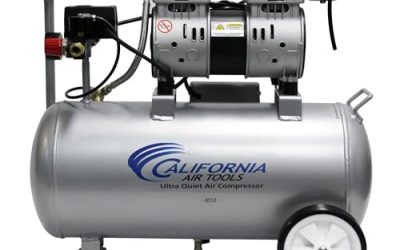
The California Air Tools 8010 is a strong all-round pick for a quiet workshop, with a listed noise level of 60 dBA, a 1.0 HP oil-free pump, and an 8-gallon steel tank. The listing gives 3.0 CFM at 40 PSI and 2.2 CFM at 90 PSI, with a maximum pressure of 120 PSI, which covers finish nailers, brad nailers, staplers, blow guns, and tire inflation. The oil-free pump removes oil checks from the routine. The 8-gallon reserve gives useful run time between cycles, which helps keep sound levels low during intermittent work. Its limits are the steel tank, which needs regular draining, and the airflow ceiling, which will not sustain air-hungry tools for long. For a typical home workshop, this model balances quiet operation, tank size, and portability well.
California Air Tools 2010A

The California Air Tools 2010A brings the same 60 dBA noise level as the 8010 into a much smaller and lighter package, with a 1.0 HP oil-free pump and a 2-gallon aluminum tank. The listing gives 3.1 CFM at 40 PSI and 2.2 CFM at 90 PSI, with a maximum pressure of 120 PSI and a listed weight of around 35 pounds. The aluminum tank resists rust, and the compact frame stores easily under a bench. Its small reserve is the main trade-off: the motor will cycle more often during continuous work, and the tank will run low quickly with tools that draw a lot of air. For trim work, inflation, and light nailing in a small shop, or for a buyer who needs to carry the unit between rooms, this is the quietest practical size in this set.
Makita MAC210Q

The Makita MAC210Q is part of Makita Quiet Series, a line built around lower noise, and it pairs a 1 HP oil-free pump with a 2-gallon tank in a compact frame. The listing gives a maximum pressure of 135 PSI and airflow of 2.0 CFM at 90 PSI, which suits finish nailers, pin nailers, and light trim work in homes, offices, and other noise-sensitive spaces. A roll cage helps protect the unit, while the oil-free design removes oil checks. Check the listing for the noise figure for this exact model, since sources vary on the decibel value, and confirm the tank, weight, and dimensions before you buy. The two-gallon reserve is the main limit, so it will cycle during longer sessions, yet for quiet trim work in a lived-in space, its compact Quiet Series design is a clear advantage.
Stealth SAQ-12018

The Stealth SAQ-12018 is the large-tank pick in this set, with a 20-gallon vertical tank, a 1.8 HP oil-free induction motor, and a listed noise level of 68 dB. The listing gives 5.5 CFM at 40 PSI and 5.0 CFM at 90 PSI, with a peak pressure of 150 PSI, so it can support longer tool runs and more demanding intermittent work than the compact models here. The large tank means fewer motor cycles, which helps keep the workshop calmer. Its weight is listed at around 121.4 pounds, so it is a roll-into-place machine rather than a carry unit, and it needs clear floor space and a sound electrical supply. At 68 dB it is louder on paper than the 60 dBA models, yet it pairs a far larger reserve with a still modest noise claim.
Comparison Table
| Feature | 8010 | 2010A | MAC210Q | SAQ-12018 |
|---|---|---|---|---|
| Pump type | Oil-free | Oil-free | Oil-free | Oil-free |
| Motor | 1.0 HP | 1.0 HP | 1.0 HP | 1.8 HP |
| Tank | 8-gallon steel | 2-gallon aluminum | 2-gallon | 20-gallon vertical |
| Airflow at 90 PSI | 2.2 CFM | 2.2 CFM | 2.0 CFM | 5.0 CFM |
| Maximum pressure | 120 PSI | 120 PSI | 135 PSI | 150 PSI peak |
| Listed noise level | 60 dBA | 60 dBA | Check the listing | 68 dB |
| Portability | Wheels and handle | Around 35 pounds | Compact, roll cage | Wheels, 121.4 pounds |
Which One Fits Your Situation
Choose the California Air Tools 8010 for the quietest practical balance in a general workshop, with a 60 dBA noise level and an 8-gallon tank.
Choose the California Air Tools 2010A for tight space and the lightest 60 dBA unit here, for short, intermittent tasks rather than long runs.
Choose the Makita MAC210Q for homes or other noise-sensitive spaces, where a compact Quiet Series unit for trim work is needed.
Choose the Stealth SAQ-12018 for a large reserve and strong airflow with a lower noise level than a standard large compressor, provided you have floor space.
FAQ
How quiet is 60 dBA in a workshop?
A unit listed at 60 dBA is close to normal conversation level. Room size and distance change how it sounds, so place the compressor away from the bench.
Does a bigger tank make a compressor quieter?
A bigger tank does not change the pump sound, but it can reduce how often the pump runs. Fewer cycles mean fewer bursts of sound during intermittent work, so a large, low-noise unit can feel calmer than a small unit that cycles often.
What tools work well with a quiet two-gallon compressor?
A two-gallon unit suits finish nailers, pin nailers, brad nailers, staplers, blow guns, and tire inflation. Those tools use air in short bursts, so the tank can recover between shots. Tools that need continuous air, such as sanders and spray guns, will drain a small tank quickly.
How can I make a quiet compressor even quieter in use?
Move it away from the work area on a longer hose, set it on a rubber mat to cut vibration, keep the intake filter clean, and fix hose leaks promptly. A leak can force the motor to cycle far more often than it should. Drain the tank after use.
Final Take
A quiet workshop upgrade is about more than a low decibel number. It is about a pump that cycles less, a tank that fits the work, and a layout that keeps sound away from the bench. The California Air Tools 8010 is the most balanced pick here, the 2010A is the lightest 60 dBA pick, the Makita MAC210Q is the compact Quiet Series pick for trim work, and the Stealth SAQ-12018 is the large-tank pick for longer runs. Begin from your tools and your room.




Write Your Review
No reviews yet. Be the first to share your experience!