
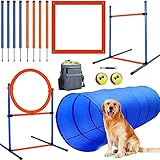
- Top Pick: JMMPOO Dog Agility Training Equipment, 60-piece Dog Obstacle Course Training Starter Kit Pet Outdoor Game with Tunnel, Agility Hurdle, Weave Poles, Jump Ring, Pause Box, Toy Balls and Storage Bag
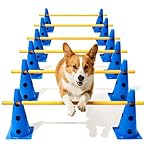
- Best Value: Lupar Dog Agility Course Backyard Set, Dog Agility Hurdle Cone Set with Height Adjustable Crossbar for Rehabilitation & Beginners, Dog Agility Equipment for Dog Obstacle Course – 12 Inch
- Premium Choice: POPMOON Agility Training Equipment for Dogs, 13 PCS Dog Agility Equipment
Best Dog Agility Equipment for Backyard Training
The best dog agility equipment for most backyards is a low, adjustable jump set, a lightweight tunnel that can be anchored securely, and a compact set of weave poles; buy based on your available space and how quickly each item can be packed away, not on how many obstacles come in the box.
For a first setup, prioritize rounded, breakaway jump cups, a tunnel with stakes or sandbags, and weave poles that can be arranged in a beginner-friendly line. These choices are easier to store and safer to adjust than a large, fixed course. Dimensions and weights below are typical ranges, since specifications vary by model.
As an Amazon Associate we earn from qualifying purchases at no extra cost to you.


Quick comparison for a home course
| Equipment | Useful home size | Typical weight | Assembly and storage | What wears or fails first |
|---|---|---|---|---|
| Adjustable jump | Bar about 90–120 cm long; height adjustable from roughly 10–60 cm | About 1–3 kg per jump | Usually 2–5 minutes; bar and uprights can store along a wall | Plastic cups, loose connectors, or a bar that becomes brittle in sun |
| Agility tunnel | About 3–5 m long and 60 cm diameter | About 2–6 kg | Often 3–8 minutes to unfold and anchor; folds into a bag roughly 50–75 cm across | Fabric abrasion, seam damage, or bent wire hoops from poor folding |
| Weave poles | 6 poles, typically spaced about 50–60 cm apart | About 2–6 kg for a set | About 3–10 minutes; portable bases take more floor space than individual stakes | Joints, base clips, and stakes loosen with repeated setup |
Weights and dimensions are comparison ranges, not standards. Check the product’s actual measurements, especially tunnel diameter and weave-pole spacing, before ordering. A tunnel needs clear space beyond both openings, and a six-pole line at 50–60 cm spacing uses roughly 2.5–3 m from first pole to last.
Choose by yard, dog, and training routine
| Your situation | Best starting choice | Why |
|---|---|---|
| Small yard or shared patio | One low jump and six poles with a compact, modular base | Both can be rearranged or stored without leaving a permanent course. |
| New handler or dog learning obstacles | Adjustable jump, short tunnel, and poles that can be set in a wide beginner pattern | Low heights and gradual layouts let you focus on calm, clear cues. |
| Windy or uneven yard | Heavier tunnel or a lighter tunnel with secure anchors; stakes for suitable ground | Unanchored fabric can shift, while portable pole bases may wobble on uneven surfaces. |
| Frequent setup and pack-away | Snap-together jump components and a tunnel with a carry bag | Shorter setup makes brief sessions more practical; verify that storage dimensions fit your shed or closet. |
| Occasional weekend practice | Basic jump plus a six-pole set; add a tunnel if you have a clear, level run | You can build skills without buying a full course that occupies the yard. |
What to look for in each obstacle
Jumps: favor adjustability and easy replacement
A home jump should have several height settings, stable feet, and a bar that falls or dislodges rather than acting as a rigid barrier. A light plastic or foam bar is easier to move and less troublesome if it is knocked down. For an adult beginner dog, start with the bar on the ground or at a very low setting; do not treat a high maximum setting as a training target.
Check whether the cups and connectors are replaceable. Small plastic fittings are often the first pieces to crack after exposure to sun or repeated assembly. If the jump will stay outside, look for UV-resistant material and bring removable parts indoors when practical. Avoid metal-edged or sharp components near the dog’s path.
Tunnels: anchoring matters more than a small weight difference
A tunnel’s advertised length is less useful than its diameter, fabric construction, and anchoring method. A tunnel around 60 cm in diameter suits many home-training setups, but it may not suit every dog. Confirm fit and use with a qualified agility instructor if your dog is unusually small, large, or inexperienced.
Use the supplied stakes only where the ground is suitable, and keep them outside the tunnel’s path. On hard surfaces, use purpose-made sandbags or weights instead of improvised objects that could roll or create a trip hazard. Inspect the wire supports and seams before each session. Fold the tunnel according to its instructions; forcing a tight twist can kink supports or stress the fabric.
Weave poles: modularity saves storage space
Weave poles are available as individual stakes, connected sections, and freestanding base systems. Stakes are compact and often inexpensive, but need appropriate soil and take time to place evenly. A base system is quicker on patios or lawns where staking is difficult, though its frame takes more room to store and can be less stable on uneven ground.
For learning, choose poles that can be set in a straight or gradually curved arrangement. A full, closely spaced competition-style line can be harder to introduce and less forgiving of uneven placement. Look for secure joints and a way to replace bent or missing poles rather than replacing the entire set.
Work out whether the course fits
Measure the clear training area, not just the obstacle footprint. A 4 m tunnel needs additional room at both ends for a straight approach and exit. Six weave poles spaced 55 cm apart span about 2.75 m between the first and last poles; allow extra room on each side for safe entry, exit, and turning. A jump also needs a clear approach and landing area.
For a simple storage check, measure the longest component after disassembly and the tunnel’s packed diameter. A setup that fits the lawn but cannot fit through a shed door may become inconvenient. If you train weekly, paying somewhat more for faster assembly and a bag or wall-friendly components may be better value than buying the cheapest set.
Ownership, upkeep, and common mistakes
- Inspect before sessions: Check jump cups, tunnel seams and supports, pole joints, and anchors. Replace cracked or unstable parts instead of taping over a structural problem.
- Clean and dry: Brush off dirt and wipe fabric with mild soap and water when needed. Let tunnels dry fully before storage to reduce mildew and odors.
- Limit weather exposure: Sun can degrade plastics and fabric, while wind can move lightweight equipment. Store portable obstacles indoors when they are not in use.
- Keep the course level: Avoid slippery, muddy, or uneven footing. Secure stakes and weights outside the running line, and give the dog room to slow down after each obstacle.
- Build skills gradually: Start low and simple, use short sessions, and stop if the dog is tired or reluctant. For a dog with an injury, mobility concern, or uncertain readiness, ask a veterinarian or qualified agility instructor before training.
For most beginners, a modest set—one adjustable jump, a six-pole system, and a securely anchored tunnel—offers more useful practice than a large bundle of obstacles. Choose the jump for safe adjustment, the tunnel for stable anchoring and sound seams, and the poles for a layout you can change and store without hassle.
Ready to decide? Our #1 pick for 2026 is the Adjustable jump.
Live price & availability on Amazon.



Write Your Review
No reviews yet. Be the first to share your experience!