
As an Amazon Associate we earn from qualifying purchases.
A high-capacity office shredder is defined by endurance: a continuous duty motor that does not need cool-down breaks, a bin measured in tens of gallons rather than a few, and a feed that takes thick stacks without jamming. It is the machine a department shares, the one that absorbs the end-of-quarter clear-out and the archive purge without becoming the bottleneck. Upgrading to this class ends the familiar cycle of a small shredder overheating, jamming and being replaced within the year.
Disclosure: This article contains affiliate links. If you buy through these links, we may earn a commission at no additional cost to you.
The three models in this guide are high-capacity machines sold on Amazon US. Two are Fellowes Powershred commercial units, a 22-sheet cross-cut model with a 16-gallon bin and a 38-sheet strip-cut departmental machine with a 30-gallon bin, both built for continuous running. The third is an Aurora heavy duty 24-sheet cross-cut shredder with a 40-minute run time for offices that need capacity in a smaller footprint. They cover the realistic departmental upgrade range from a busy team floor to a central records room.
How to Choose a High-Capacity Office Shredder
Continuous duty is the headline requirement. A shredder that must rest after ten minutes cannot serve a department. Continuous duty motors shred all day, which is what shared use actually looks like. Where a machine is not continuous, its stated run time, such as 40 minutes, should be matched honestly against your peak sessions.
Sheet capacity and throat width set the pace. Sheets per pass in the twenties and thirties, and a wide throat that takes folded and oversized paper without fuss, decide how fast a backlog clears. A wide 12-inch class throat also handles the awkward items, junk mail, envelopes and stapled packs, that slow down narrow machines.
Bin capacity is a workflow feature. A 16-gallon bin serves a team; a 30-gallon bin serves a department and halves the emptying trips during a purge. Pull-out bins and bag-friendly designs matter when the machine is emptied by whoever is nearest rather than by facilities staff.
Cut type is a security decision. Cross-cut at P-4 is the departmental standard for general office documents. Strip-cut produces long strips that are less secure but supports the highest sheet capacities and fastest throughput, which is why it persists in very high-volume rooms where documents are low-sensitivity or are pulped afterwards. Choose consciously rather than by default.
Jam handling and safety protect uptime. Jam-proof feed systems that power through misfeeds, sheet capacity indicators that warn before an overload, and touch-sensitive openings that stop the cutters are the features that keep a shared machine in service and out of the repair queue.
The Best High-Capacity Office Shredders
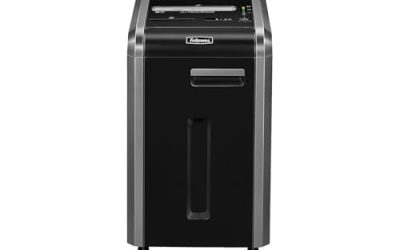
Fellowes Powershred 225Ci

- Amazon link: https://www.amazon.com/dp/B002M819JO
The 225Ci is the balanced departmental choice: it shreds up to 22 sheets per pass into cross-cut particles at the P-4 security level, runs on a continuous duty motor and empties into a 16-gallon pull-out bin with an LED full indicator. The Jam Proof system is designed to prevent misfeeds before they stall the machine, and SafeSense technology stops the cutters when hands touch the paper opening. It also takes staples, paper clips, credit cards and CDs or DVDs, so preparation before feeding is minimal.
Who it suits: Shared office floors and departments of around ten users that need cross-cut security, all-day running and a bin that does not demand constant attention.
Considerations: It is a substantial floor-standing unit at over ninety pounds, so plan its position and floor space rather than expecting to move it between rooms. For very large archive purges, its 22-sheet pass is steady rather than fast, and the 425i below clears volume more quickly.
Fellowes Powershred 425i

- Amazon link: https://www.amazon.com/dp/B00006JNXJ
The 425i is the throughput flagship of this group: 38 sheets per pass, a 30-gallon waste bin and a continuous duty motor behind a 12-inch throat. It is a strip-cut machine, which is the deliberate trade that allows this class of capacity and speed: long strips instead of small particles. In a central records or mailroom setting where volume is the problem and shredded output is handled securely afterwards, that trade is rational, and the machine’s scale, built for ten or more users, matches departmental reality.
Who it suits: Centralised shredding points, records rooms and large departments whose problem is sheer daily volume and whose document sensitivity suits strip-cut output.
Considerations: Strip-cut is the lowest security form factor here, so it should not be the machine for confidential, legal or personnel records; those belong on a cross-cut or micro-cut unit. Confirm the current listing’s feature set before ordering, as this long-running model line has been sold in several configurations.
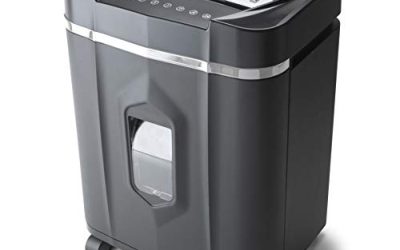
Aurora AU2442XA Heavy Duty 24-Sheet Crosscut Shredder

- Amazon link: https://www.amazon.com/dp/B0C59WGSNS
The Aurora AU2442XA brings high capacity to a smaller footprint: a 24-sheet cross-cut feed with anti-jam behaviour, a 40-minute run time and a 7-gallon pull-out basket. Twenty-four sheets per pass exceeds the Fellowes 225Ci’s figure, and the cross-cut output keeps general office security at a sensible level. It suits offices that shred in serious bursts, a weekly records session or a project clear-out, rather than in a truly continuous stream.
Who it suits: Mid-sized offices and workgroups that need genuine sheet capacity and cross-cut security without committing floor space to a full departmental cabinet machine.
Considerations: The 40-minute run time, while long, is not continuous duty, so an all-day purge needs pauses or a second machine. The 7-gallon bin fills quickly during those bursts, so assign emptying to the session routine rather than discovering a full bin mid-stack.
Comparison Table
| Model | ASIN | Cut Type | Sheets per Pass | Bin | Duty |
|---|---|---|---|---|---|
| Fellowes Powershred 225Ci | B002M819JO | Cross-cut, P-4 | 22 | 16 gallons | Continuous |
| Fellowes Powershred 425i | B00006JNXJ | Strip-cut | 38 | 30 gallons | Continuous |
| Aurora AU2442XA | B0C59WGSNS | Cross-cut | 24 | 7 gallons | 40-minute run time |
Frequently Asked Questions
What makes a shredder high-capacity rather than just large?
The combination of sheets per pass, bin volume and duty cycle. A machine that takes 22 or more sheets, holds 16 or more gallons and runs continuously will clear departmental volume; a big bin on a light-duty motor will not.
Is strip-cut acceptable for office use?
It depends on the documents. Strip-cut output can potentially be reassembled, so it suits low-sensitivity, high-volume material and settings where shredded waste is then pulped or handled securely. Confidential records should go through cross-cut at P-4 or finer.
How do I stop a shared shredder from jamming?
Respect the sheet capacity, use the capacity indicator where fitted, keep the cutters oiled on schedule and avoid feeding folded stacks thicker than a flat pass. Machines with jam-proof feed systems forgive occasional overloads, but routine overfeeding defeats any design.
Where should a departmental shredder live?
At the point where paper accumulates: beside the copier and mail station, on a floor route staff already walk. A high-capacity machine in a distant room gets used less, and documents wait in piles instead of being destroyed promptly.
Conclusion
Choose by duty and by document type. The Fellowes 225Ci is the all-round departmental upgrade, with P-4 cross-cut security, continuous running and a 16-gallon bin. The Fellowes 425i is the volume answer for central shredding points where strip-cut output is acceptable. The Aurora AU2442XA delivers 24-sheet cross-cut capacity in a smaller body for offices whose shredding comes in heavy bursts. Any of the three ends the overheating and jamming cycle that makes a light-duty shredder a recurring expense.


Write Your Review
No reviews yet. Be the first to share your experience!