
Our Short List of 3


All 5 Picks at a Glance
| Product | Specs | Action |
|---|---|---|
| 1. Yamaha PSR-E473 – Best For Quick One-Shot and Loop Capture in Tight Spaces | Check price on Amazon | |
| 2. Korg Pa700 – Best For Built-In Speakers With True Onboard Sampling | Check price on Amazon | |
| 3. Alesis Harmony 61 Pro – Best For Simple Microphone Sampling Without Extra Gear | Check price on Amazon | |
 4. Korg Pa1000 – Best For Deeper Sample Editing in a 61-Key Format | Check price on Amazon | |
 5. Yamaha PSR-SX920 – Best For Computer-Prepared Custom Voices and Styles, Import-Only | Check price on Amazon |
As an Amazon Associate we earn from qualifying purchases.
- Quick Picks
- How We Selected These Picks
- 1. Yamaha PSR-E473 – Best For Quick One-Shot and Loop Capture in Tight Spaces
- 2. Korg Pa700 – Best For Built-In Speakers With True Onboard Sampling
- 3. Alesis Harmony 61 Pro – Best For Simple Microphone Sampling Without Extra Gear
- 4. Korg Pa1000 – Best For Deeper Sample Editing in a 61-Key Format
- 5. Yamaha PSR-SX920 – Best For Computer-Prepared Custom Voices and Styles, Import-Only
- Buying Guide: What to Look For
- Comparison Table
- FAQ
- Final Verdict
Disclosure: This article contains affiliate links. If you buy through links on this page, we may earn a commission at no extra cost to you. Product availability on Amazon US can change; check the product page for current details before ordering.
Small rehearsal rooms need a keyboard that fits a compact stand, sets up quickly, and handles backing styles plus custom sounds without a separate computer rig. A 61-key arranger with sampling or sample-import support can cover that role if the approach matches rehearsal work: a short loop, a one-shot, or a prepared custom voice.
Quick Sampling models record a few seconds for immediate playback. User PCM models load WAV, AIFF, and SoundFont files with onboard editing. One pick here uses computer-prepared expansion import rather than onboard recording, flagged below. These five picks favor compact 61-key designs for tight spaces.
Quick Picks
| Product | Best For | Key Spec | ASIN |
|---|---|---|---|
| Yamaha PSR-E473 | Quick one-shot and loop capture | Quick Sampling, 4 samples, approx. 9.6 sec total | B09PRSNDGJ |
| Korg Pa700 | Built-in speakers, true sampling | 128 MB compressed User PCM, 2 x 25W speakers | B075DFV156 |
| Alesis Harmony 61 Pro | Simple microphone sampling | 5 samples up to 2 sec each, built-in microphone | B0BC7VK45B |
| Korg Pa1000 | Deeper editing in 61 keys | 300 MB compressed User PCM, Full Edit, Time Slice | B075L7G89G |
| Yamaha PSR-SX920 | Computer-prepared, import-only | Approx. 2 GB expansion via Expansion Manager | B0D94QQ7XP |
How We Selected These Picks
Picks come from sampling-capable arrangers with Amazon US availability verified at time of writing and sampling support confirmed in manufacturer specifications. Priority went to 61-key models with backing styles and sampling usable without a large external setup. Short-sample models were favored for one-shots and loops, and Korg User PCM models for longer instruments.
A flagship model was set aside here because weight and a separate speaker bar work against a compact setup. The Yamaha PSR-SX920 is import-only: custom voices and styles are prepared on a computer and imported, not recorded live. Touchscreen displays are noted only where specifications confirm them.
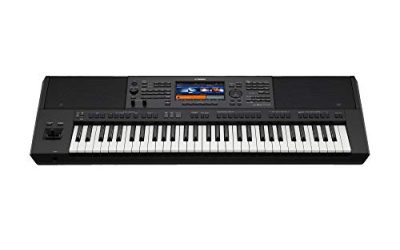
1. Yamaha PSR-E473 – Best For Quick One-Shot and Loop Capture in Tight Spaces
The Yamaha PSR-E473 is a 61-key portable arranger for fast rehearsal capture, with 820 Voices including Super Articulation Lite, 290 Styles, and Groove Creator. Quick Sampling records through AUX IN, microphone input, USB audio, or WAV files, covering a vocal phrase or prepared file without a separate sampler.
Specifications list 4 samples totaling approximately 9.6 seconds at 44.1 kHz 16-bit stereo, with one-shot and loop playback for a short hook or looped riff under a style. L/R outputs support a small mixer or powered speaker. Four short samples cannot support chromatic multisampled instruments.
Pros
– Quick Sampling via AUX IN, microphone, USB audio, and WAV
– Compact 61-key format, 820 Voices and 290 Styles
– Groove Creator for pattern-based ideas
Cons
– Only 4 samples, approx. 9.6 seconds total
– Not a chromatic multisampler
– No touchscreen display
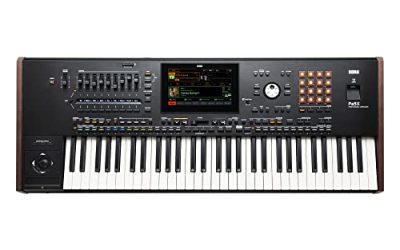
2. Korg Pa700 – Best For Built-In Speakers With True Onboard Sampling
The Korg Pa700 combines a 61-key arranger, true onboard sampling, and built-in 2 x 25W speakers in one unit. It uses the EDS-X engine with 1,700+ sounds, 370+ Styles, 128-note polyphony, and a 7-inch Wide capacitive TouchView TFT display.
Sampling provides 128 MB compressed User PCM (256 MB linear) loading KORG, WAV, AIFF, and SoundFont files. Imported kits and loops recall alongside factory sounds without a computer connected. Keys are velocity-sensitive without aftertouch, and memory is the smallest among the Korg models here.
Pros
– Built-in 2 x 25W speakers
– User PCM sampling with WAV, AIFF, and SoundFont loading
– 7-inch TouchView touchscreen, 128-note polyphony
Cons
– Velocity-only keys, no aftertouch
– Smallest Korg sample memory here
– Large libraries need memory management
3. Alesis Harmony 61 Pro – Best For Simple Microphone Sampling Without Extra Gear
The Alesis Harmony 61 Pro records through its built-in microphone and plays back from the keys, with no cables or computer needed. It provides 61 keys, 580 sounds, 180 rhythms, 64-note polyphony, and an X/Y touchpad for triggering sampled sounds alongside rhythms.
Specifications list 5 user samples up to 2 seconds each (10 seconds total) with SD-card WAV storage, fitting short effects and vocal fragments. Microphone-only capture depends on room acoustics, and clean isolated recordings are harder with other instruments playing, so this model suits experiments rather than detailed instruments.
Pros
– Built-in microphone sampling, no extra gear
– Compact 61-key format, 580 sounds and 180 rhythms
– SD-card WAV storage
Cons
– Microphone-only, no line-input sampling
– Only 5 samples up to 2 seconds each
– 64-note polyphony
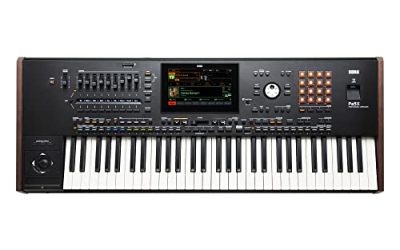
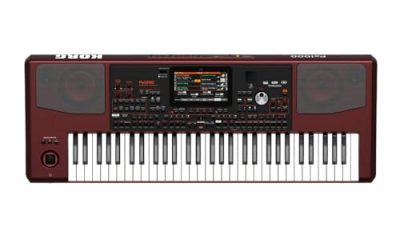
4. Korg Pa1000 – Best For Deeper Sample Editing in a 61-Key Format
The Korg Pa1000 adds sampling depth in a 61-key format, with the EDS-X engine, 1,700 sounds, 420+ Styles, a 7-inch Wide capacitive TouchView TFT display, TC-Helicon microphone processing, and Defined Nuance Control.
Sampling provides 300 MB compressed User PCM (600 MB linear) loading KORG, WAV, AIFF, and SoundFont files with Full Edit and Time Slice for shaping samples and slicing loops for key triggering. Memory exceeds the Pa700, though it remains below flagship class and needs more learning time than Quick Sampling models.
Pros
– 300 MB compressed User PCM, Full Edit and Time Slice
– Loads KORG, WAV, AIFF, and SoundFont files
– 7-inch TouchView display, TC-Helicon processing
Cons
– Memory below flagship class
– More editing complexity than Quick Sampling models
– Needs preparation time for libraries
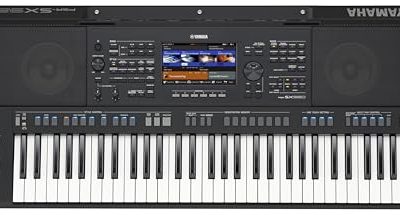
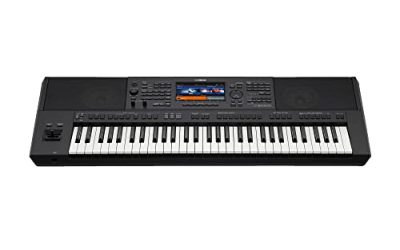
5. Yamaha PSR-SX920 – Best For Computer-Prepared Custom Voices and Styles, Import-Only
The Yamaha PSR-SX920 suits players who prepare custom sounds on a computer and import them for playback. Sampling support is import-only: custom voices and styles are made with Yamaha Expansion Manager and EXPANSION EXPLORER, not recorded live on the keyboard.
Specifications list 61 keys, 1,587 Voices plus 63 Drum and SFX Kits and 480 XG Voices, 575 Styles, 128-note polyphony, a 7-inch TFT touch screen, approximately 2 GB expansion memory, and approximately 4 GB internal memory. Chord Looper and a 16-track recorder help capture ideas, but there is no onboard Quick Sampling or live WAV multisample editor.
Pros
– Approx. 2 GB expansion memory for prepared libraries
– 7-inch TFT touch screen, Chord Looper, 16-track recorder
– 1,587 Voices and 575 Styles
Cons
– Import-only, no onboard live sampling
– Custom sounds require computer preparation
– Less suited to spontaneous capture
Buying Guide: What to Look For
Sample Type and Sample Time
Quick Sampling models record a few seconds for one-shots and loops. User PCM models load WAV, AIFF, and SoundFont files into memory in megabytes for kits and chromatic instruments. Import-only expansion covers prepared voices but does not record live audio. Confirm live capture, file import with editing, or computer-prepared expansion first.
Size, Weight, and Speaker Setup for Small Rooms
All five picks use 61 keys for small stands. The Pa700 lists built-in 2 x 25W speakers. For other models, check speaker and output details on the product page. Weight matters when the keyboard moves between sessions, and a compact unit one person can place quickly will see more use.
Styles, Polyphony, and Rehearsal Workflow
Styles range from 180 rhythms to 575 Styles here. Polyphony sets how many notes can sound together: 64-note fits simpler arrangements, 128-note handles denser layers. Touchscreens on the Pa700, Pa1000, and PSR-SX920 speed up selection between songs. Match workflow features to how often you change sounds.
Compatibility and Setup Notes
Korg models here load KORG, WAV, AIFF, and SoundFont files. Yamaha expansion follows Expansion Manager workflows, and Alesis samples use SD-card WAV storage. Confirm sampling inputs and monitoring outputs, and keep backup copies of user samples on separate storage.
Comparison Table
| Feature | PSR-E473 | Pa700 | Harmony 61 Pro | Pa1000 | PSR-SX920 |
|---|---|---|---|---|---|
| Keys | 61 | 61 velocity-sensitive | 61 | 61 | 61 |
| Sampling | Quick Sampling | User PCM | Microphone sampling | User PCM | Expansion import only |
| Capacity | 4 samples, approx. 9.6 sec total | 128 MB compressed, 256 MB linear | 5 samples up to 2 sec each | 300 MB compressed, 600 MB linear | Approx. 2 GB expansion |
| Files | WAV via inputs, USB audio | KORG, WAV, AIFF, SoundFont | WAV on SD card | KORG, WAV, AIFF, SoundFont | Expansion Manager |
| Touchscreen | No | Yes, 7-inch TouchView | No | Yes, 7-inch TouchView | Yes, 7-inch TFT |
| Voices/styles | 820 Voices, 290 Styles | 1,700+ sounds, 370+ Styles | 580 sounds, 180 rhythms | 1,700 sounds, 420+ Styles | 1,587 Voices, 575 Styles |
| Polyphony | Not listed | 128-note | 64-note | Not listed | 128-note |
FAQ
Do small rehearsal rooms need full multisampling or are short samples enough?
Short samples cover one-shot effects, vocal fragments, and looped riffs, as on the PSR-E473 and Harmony 61 Pro. Full multisampling is needed for chromatic instruments, large kits, or longer loops with editing, where Korg User PCM memory applies.
Can these keyboards work without external speakers or a computer?
The Pa700 lists built-in 2 x 25W speakers. For other models, check speaker and output details on the product page. Quick Sampling and Korg models can capture or load files for playback, while the PSR-SX920 needs computer preparation before import.
What is the difference between onboard sampling and sample import?
Onboard sampling records audio on the keyboard through a microphone, AUX IN, or USB audio. Sample import loads WAV, AIFF, or SoundFont files into memory for playback and, on Korg models, editing. The PSR-SX920 uses import-only expansion prepared on a computer.
Final Verdict
For most small rooms, the Yamaha PSR-E473 fits with compact size and fast Quick Sampling. Choose the Korg Pa700 for built-in speakers plus true import, the Alesis Harmony 61 Pro for simple microphone sampling, and the Korg Pa1000 for deeper editing. Choose the PSR-SX920 only for computer-prepared expansion workflows.
Write Your Review
No reviews yet. Be the first to share your experience!