
Learning how to choose a USB C cable is less about finding the longest or cheapest cord and more about matching the cable to your devices. Many shoppers make the same mistakes: buying a cable rated for charging but not data transfer, assuming every USB-C cable supports fast charging, or paying for 240W power when their phone only accepts 30W. Others overlook length, connector durability, and whether the cable supports a monitor, dock, or external drive.
- Decide These 3 Things First
- Size: Choose Length and Thickness for the Location
- Material: Look for Flexibility, Not Just a Fancy Finish
- Construction: Inspect the Connectors and Strain Relief
- Comfort and Performance: Match the Cable to the Job
- Price Tiers: Spend on the Specification You Need
- Warranty: Use Coverage as a Quality Signal
- Availability, Delivery, and Setup
- Spec Checklist
- Red Flags
- FAQ
USB-C describes the connector shape, not the cable’s complete capabilities. Two cables can look identical while having very different power, data, and video performance. Before you buy, identify what you need the cable to do, then check the numbers printed on the package or listed in the specifications.
As an Amazon Associate we earn from qualifying purchases at no extra cost to you. Product prices and availability are accurate as of the date shown and are subject to change.
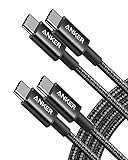


Decide These 3 Things First
- What are you charging? A phone may need 20W to 45W, a tablet 30W to 65W, and a laptop anywhere from 45W to 140W. A cable rated above your device’s requirement is fine, but it will not make the device charge faster than its own limit.
- Do you need data or video? A charging-only cable may be adequate for a wall charger, but it is the wrong choice for an SSD, monitor, docking station, or phone-to-computer transfer. Look for a stated data rate, such as 480Mbps, 5Gbps, 10Gbps, 20Gbps, or 40Gbps.
- How will you use it? A 3-foot cable works well on a desk or nightstand, while a 6-foot cable is more practical beside a bed or sofa. If the cable will be packed daily, prioritize flexibility and reinforced strain relief over maximum wattage.
Size: Choose Length and Thickness for the Location
USB-C cables commonly range from 1 foot to 10 feet. Choose the shortest length that comfortably reaches the device, because extra cable creates clutter and can be more difficult to coil. For a desk, 3 to 4 feet is usually enough. For a nightstand, sofa, or floor-level outlet, 6 feet is more convenient. A 10-foot cable can be useful in a room with a distant outlet, but it may be heavier and less portable.
Longer cables can also introduce performance limitations, particularly at high data rates. If you need USB 3.2 or USB4 speeds, a short cable—often 3 feet or less—is the safer choice unless the manufacturer specifically certifies the longer length. For basic charging, 6-foot cables are widely available and practical.
Thickness matters, too. A slim cable is easier to store, while a thicker cable may better handle high power or shielding for fast data. Do not assume thickness alone proves quality. Check the stated wattage and data speed rather than judging by diameter.
Material: Look for Flexibility, Not Just a Fancy Finish
Most USB-C cables use a PVC, TPE, silicone, or braided outer jacket. PVC is usually the least expensive and can be perfectly suitable for occasional charging. TPE tends to feel softer and more flexible. Silicone is especially pleasant for bedside or desktop use because it resists sharp kinks and remains flexible in a wider range of temperatures.
Nylon braiding adds abrasion resistance and can help a cable survive being dragged across a floor or placed in a travel bag. However, a braided jacket does not automatically mean the cable supports higher wattage or faster data. Some braided cords are stiff, and rough edges can snag on fabric.
For everyday use, choose a cable that bends smoothly rather than folding sharply at the connector. A cable that feels extremely rigid may place more stress on the charging port when used at an angle. If you travel frequently, a 3- to 6-foot braided or silicone cable weighing roughly 1.5 to 3 ounces is a reasonable balance between durability and portability.
Construction: Inspect the Connectors and Strain Relief
The connector housing and the first 1 to 2 inches of cable are the areas most likely to fail. Look for a molded strain-relief section that tapers gradually instead of stopping abruptly at the plug. This design distributes bending over a larger area and is less likely to develop an internal break.
Metal connector shells can resist wear, but the shell finish is less important than the fit. The plug should slide into the port without excessive force and should not wobble noticeably once inserted. Avoid cables with loose housings, uneven seams, or a connector that feels hot during ordinary charging.
Some cables include an identification chip, especially models rated for 100W or more. For USB Power Delivery, a cable supporting more than 60W should generally be marked for its maximum power capability. A 240W cable is useful for compatible high-power laptops and accessories, but it does not increase charging speed when paired with a 30W phone charger.
Comfort and Performance: Match the Cable to the Job
Charging performance is measured in watts. A cable labeled 60W is suitable for many phones, tablets, handheld gaming systems, and smaller laptops. A 100W cable provides more headroom for larger laptops, while a 240W cable is intended for newer high-power USB-C devices. The charger, cable, and device all need to support the desired wattage.
Data performance requires a separate check. A cable advertised only as “fast charging” may transfer data at the basic USB 2.0 rate of 480Mbps. That is adequate for charging and occasional photos, but slow for large video files or external drives. For routine file transfers, look for at least 5Gbps. For a fast SSD, 10Gbps is a sensible baseline; USB4 cables can reach 20Gbps or 40Gbps when the connected devices and ports support those speeds.
Video support is also not guaranteed. If you plan to connect a laptop to a USB-C monitor, check for DisplayPort Alt Mode or an explicit monitor-resolution specification. A charging cable may fit the port perfectly and still produce no image.
Price Tiers: Spend on the Specification You Need
Basic USB-C charging cables generally cost about $5 to $10 for one or more cords. At this level, expect charging support around 60W, basic USB 2.0 data, and lengths of 3 to 6 feet. The Anker 60W two-pack listed at $9.99 is an example of the type of value-oriented option that works well for phones, tablets, and general household charging.
Midrange cables usually cost $10 to $20 each or around $10 to $18 for a multipack. They may offer 100W charging, better strain relief, a braided jacket, or 5Gbps to 10Gbps data. A 100W two-pack priced at $9.99 can be compelling, but confirm whether the product is intended for charging only or includes faster data transfer.
Premium cables typically cost $20 to $40 or more. You are paying for certified USB4 performance, 40Gbps data, video support, e-marker identification, unusually durable construction, or a longer warranty. A 240W cable priced below $10, such as the listed 6.6-foot LISEN example at $8.97, may be excellent for power, but verify its data and video specifications before using it with a monitor or SSD.
Warranty: Use Coverage as a Quality Signal
Check the warranty period before buying, especially if the cable will be used daily. A basic cable may include a 12-month warranty, while more established brands sometimes offer 18 months, 24 months, or longer coverage. Keep the receipt and note whether the warranty covers ordinary defects, connector failure, or only manufacturing problems.
A warranty does not prove that a cable is fast or safe, but an easy-to-find warranty is a positive sign. Be cautious when a listing makes broad claims such as “military grade” or “indestructible” without stating the actual power, data, and testing details. For a multipack, confirm whether the warranty applies to every cable in the package.
Availability, Delivery, and Setup
For a replacement charging cable, delivery within 1 to 3 days may matter more than premium materials. If you are outfitting several rooms, buying a two-pack or five-pack can lower the per-cable cost. The listed LISEN 60W five-pack at $8.97, for example, works out to less than $2 per cord, but confirm the length and whether all five cables have the same specification.
There is no assembly requirement for a USB-C cable, but setup still deserves attention. Leave about 6 to 12 inches of slack near the device so the connector is not pulled sideways. Keep the cable away from sharp furniture edges and avoid wrapping it tightly around a charger. Label different cables by purpose—charging, monitor, or high-speed data—to prevent an ordinary cord from being used where a certified high-speed cable is required.
Spec Checklist
| Spec | Budget | Mid | Premium |
|---|---|---|---|
| Typical price | $5–$10 | $10–$20 | $20–$40+ |
| Charging rating | 60W | 100W | 140W–240W |
| Data speed | 480Mbps | 5Gbps–10Gbps | 20Gbps–40Gbps |
| Useful lengths | 3–6 feet | 3–6 feet | 3–10 feet, as specified |
| Jacket | PVC or TPE | Braided, TPE, or silicone | Reinforced braided or silicone |
| Best for | Phones and basic charging | Tablets, laptops, and storage | High-power laptops, monitors, and docks |
Red Flags
- The listing says “fast charging” but does not state wattage.
- A cable claims 240W but does not identify an e-marker or USB Power Delivery support.
- Data speed is omitted, or the description says only “sync” without a rate.
- The product photo shows a monitor or SSD, but video or high-speed data support is not specified.
- The connector housing is loose, sharply joined to the cable, or unusually hot during use.
- A 10-foot cable promises maximum data speed without providing certification or testing details.
- The price is dramatically lower than comparable products and the warranty, length, or specifications are unclear.
FAQ
Do all USB-C cables charge at the same speed?
No. Charging speed depends on the cable’s power rating, the charger’s output, and the device’s charging limit. A 100W cable can safely connect to a phone that accepts 30W, but it will not force the phone to charge at 100W.
Is a 60W USB-C cable enough for a laptop?
It is enough for many compact laptops and tablets, but not every laptop. Check the computer’s included charger. If it is rated above 60W, choose a cable rated for at least the charger’s output, such as 100W or 140W.
Can I use any USB-C cable with a monitor?
No. The cable must support video through DisplayPort Alt Mode or the connection standard specified by the monitor. Many inexpensive USB-C cables handle charging and basic data only.
When is a 240W cable worth buying?
A 240W cable is worthwhile for a compatible high-power laptop or other device that can use USB Power Delivery above 100W. For most phones, tablets, and ordinary laptops, a 60W or 100W cable is sufficient and usually easier to handle.
Ready to decide? Our #1 pick for 2026 is the Typical price.
Live price & availability on Amazon.



Write Your Review
No reviews yet. Be the first to share your experience!