
The Short Answer
Phone cases are sized to the exact iPhone model, not simply to the screen size. A case made for the 6.1-inch iPhone 15 may look similar to one for the iPhone 14, but camera-bump placement, button locations, corner shape, thickness, and charging-port openings can differ. The same rule applies to the iPhone 8, iPhone 7, and second- or third-generation iPhone SE: many cases fit more than one of these phones, but not every listing does.
Use the phone’s model name and generation before buying. For the most reliable iphone case dimensions by model comparison, measure the handset itself, then allow room for the case’s raised edges and camera protection. A protective case usually adds about 0.08 to 0.20 inch (0.2 to 0.5 cm) to each side and 0.08 to 0.16 inch (0.2 to 0.4 cm) to the phone’s thickness. Rugged cases can add more.
As an Amazon Associate we earn from qualifying purchases at no extra cost to you. Product prices and availability are accurate as of the date shown and are subject to change.


Standard Sizes
The table below lists Apple’s published phone dimensions, not the outside dimensions of a case. Case measurements vary by brand and design. Dimensions are shown as height × width × thickness.
| iPhone model or family | Phone dimensions (inches) | Phone dimensions (cm) | Approx. weight | Typical case fit notes |
|---|---|---|---|---|
| iPhone 7 | 5.44 × 2.64 × 0.28 | 13.83 × 6.71 × 0.71 | 4.87 oz / 138 g | Fits many iPhone 8 and SE 2/3 cases |
| iPhone 8 | 5.45 × 2.65 × 0.29 | 13.84 × 6.73 × 0.73 | 5.22 oz / 148 g | Common shared case size with SE 2/3 |
| iPhone SE (2nd and 3rd generation) | 5.45 × 2.65 × 0.29 | 13.84 × 6.73 × 0.73 | 5.22 oz / 148 g | Uses the iPhone 8 body style |
| iPhone 12 and 12 Pro | 5.78 × 2.82 × 0.29 | 14.67 × 7.15 × 0.74 | 5.78–6.66 oz / 164–189 g | Similar exterior size, but camera cutouts differ |
| iPhone 13 | 5.78 × 2.82 × 0.30 | 14.67 × 7.15 × 0.76 | 6.14 oz / 174 g | Use an iPhone 13-specific case |
| iPhone 14 | 5.78 × 2.82 × 0.31 | 14.67 × 7.15 × 0.78 | 6.07 oz / 172 g | Usually not interchangeable with iPhone 13 cases |
| iPhone 15 | 5.81 × 2.82 × 0.31 | 14.76 × 7.16 × 0.79 | 6.02 oz / 171 g | Needs a USB-C and Dynamic Island opening |
| iPhone 16 | 5.81 × 2.82 × 0.32 | 14.76 × 7.16 × 0.81 | 6.00 oz / 170 g | Requires the correct camera-control opening |
| iPhone 12 Pro Max and 13 Pro Max | 6.33 × 3.07 × 0.29–0.30 | 16.08 × 7.81 × 0.74–0.76 | 7.97–8.46 oz / 226–240 g | Large case family; camera cutouts are generation-specific |
| iPhone 14 Plus and 14 Pro Max | 6.33 × 3.07 × 0.31 | 16.08 × 7.81 × 0.79 | 7.16–8.47 oz / 203–240 g | Do not assume Plus and Pro Max cases are interchangeable |
| iPhone 15 Plus and 15 Pro Max | 6.33 × 3.05 × 0.32 | 16.08 × 7.76 × 0.81 | 7.09–7.81 oz / 201–221 g | Separate Plus and Pro Max case designs |
| iPhone 16 Plus | 6.33 × 3.06 × 0.32 | 16.08 × 7.76 × 0.81 | 7.03 oz / 199 g | Use a case with the correct camera-control cutout |
| iPhone 16 Pro Max | 6.42 × 3.06 × 0.32 | 16.30 × 7.76 × 0.81 | 7.99 oz / 227 g | Largest current Pro Max body in this chart |
For buyers, the most important differences are often not the overall height and width. A phone can be only a fraction of an inch different yet require a new case because of a larger camera island, a relocated button, a USB-C port, or a new side control. Slim cases commonly cost about $6 to $20, while branded protective cases often range from $20 to $60 or more. Magnetic or MagSafe-compatible versions generally cost about $8 to $35, depending on materials and protection.
How to Measure Your Space
- Identify the exact iPhone model. Open Settings, select General, then About, and check the model name. This is more dependable than guessing from the screen size or the phone’s appearance.
- Remove the existing case. Measure the phone body, not the old case. A worn case may have stretched, and a rugged case may be substantially larger than the handset.
- Measure height and width. Place the phone on a flat surface and use a ruler or digital caliper. Measure from the straight outer edges, excluding rounded corners and the camera bump.
- Measure thickness. Check the middle of the phone’s body rather than the camera area. Record the camera bump separately if the phone will slide into a tight compartment.
- Measure the storage space. For a drawer, shelf, vehicle console, or phone pocket, measure the opening and the usable depth. Include hinges, lips, dividers, and nearby cables.
- Add case clearance. Leave at least 0.12 inch (0.3 cm) of width and height clearance for a slim case. Allow 0.25 inch (0.6 cm) or more for a protective case, grip, wallet, or magnetic accessory.
- Check openings and accessories. Confirm access for the charging cable, speakers, mute or Action button, side buttons, camera lenses, and wireless charging. A case that fits dimensionally can still be unsuitable if an opening is misplaced.
By Room or Use Case
Desk, Nightstand, or Charging Station
A slim case is usually best for a desk dock or bedside stand. Look for a case under about 0.45 inch (1.14 cm) total thickness when the phone must sit in a narrow charging cradle. A MagSafe-compatible case can make alignment easier, but the magnet ring adds a small amount of thickness and may affect fit in a tightly molded stand. Confirm that the stand supports the phone’s weight, which can range from roughly 4.9 to 8.5 ounces before adding a case.
Car Console or Cup-Holder Storage
Measure the console compartment opening, not just its advertised capacity. A case with raised corners or a built-in grip can make a 3.06-inch-wide Pro Max phone feel much larger. Allow at least 0.25 inch of side-to-side clearance for easy removal. If the phone stays in a vehicle mount, verify that the mount arms can open wide enough for the case and that the camera bump does not prevent a secure grip.
Kitchen, Workshop, or Travel Bag
Choose a case with raised bezels and reinforced corners when the phone may encounter drops, moisture, or hard surfaces. Rugged cases can add 0.20 to 0.40 inch to the phone’s overall width or height. Check the bag pocket’s zipper opening, since the opening may be narrower than the pocket itself. A case with a built-in screen protector may also require extra clearance around the display edges.
Children, Outdoor Use, or Heavy Protection
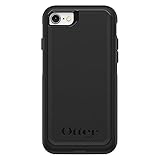
Prioritize impact protection over the smallest footprint. A rugged case may weigh 3 to 8 ounces, increasing the finished phone weight noticeably. Confirm that port covers do not interfere with the charging cable and that the case has a precise camera opening. For older phones, products such as OtterBox cases made for the iPhone 7, iPhone 8, and iPhone SE generations can be practical, but the listed compatibility should match the specific phone body.
Common Sizing Mistakes
- Buying by screen size alone: Several iPhones have 6.1-inch displays but different bodies, cameras, buttons, and port layouts.
- Confusing Plus and Pro Max: These large phones have similar heights, yet their camera modules and body widths are not identical.
- Assuming every SE case fits: The second- and third-generation SE share the iPhone 8 body, while older SE models use a smaller iPhone 5-style body.
- Ignoring the camera bump: A case can fit the phone’s edges while leaving lenses exposed or creating glare around the camera opening.
- Forgetting new controls and ports: iPhone 15 models use USB-C, and newer generations may need a dedicated opening for side controls.
- Measuring the case instead of the phone: Use the handset’s dimensions when comparing it with a compartment, then add the case allowance separately.
FAQ
Do iPhone 7 and iPhone 8 cases fit the iPhone SE?
Many iPhone 7, iPhone 8, and second- or third-generation iPhone SE cases are sold as compatible because the iPhone 8 and SE 2/3 share the same basic body. However, iPhone 7 cases may have differences around the camera or button area. Check the manufacturer’s full compatibility list before ordering.
Are iPhone 14 and iPhone 15 cases the same size?
They are close in height and width, but they are not reliably interchangeable. The iPhone 15 uses USB-C, has a slightly different body profile, and includes the Dynamic Island. Choose an iPhone 15-specific case for proper port, screen, and camera alignment.
How much larger is a case than an iPhone?
A slim case commonly adds about 0.08 to 0.16 inch to overall width and height. A protective case may add 0.20 to 0.40 inch, while a rugged model with a built-in screen protector or belt clip can be larger still. Always check the case’s listed external dimensions when fitting a tight compartment.
What is the best way to check compatibility before buying?
Match the case listing to the exact model name and generation, then compare the camera, port, and button openings in product photos. For a 2026 purchase, also confirm whether the case supports your accessories, including MagSafe chargers, wireless charging stands, car mounts, and screen protectors.
Ready to decide? Our #1 pick for 2026 is the iPhone 7.
Live price & availability on Amazon.





Write Your Review
No reviews yet. Be the first to share your experience!