
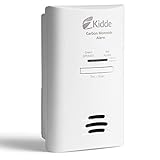
- Top Pick: Kidde Carbon Monoxide Detector, AA Battery Powered, Portable for Travel or Home, 85 dB Alarm, LED Status Indicators, 3rd Edition
- Best Value: Kidde Carbon Monoxide Detector, Plug-in Carbon Monoxide Detector with AA Battery Backup, 85 dB Alarm, LED Status Light Indicators, 3rd Edition
- Premium Choice: Kidde Carbon Monoxide Detector, Plug-in & AA Battery Backup, COP
The best carbon monoxide detectors for most homes are a combination of a plug-in detector with battery backup in living areas and a battery-powered alarm near bedrooms; choose a hardwired interconnected model when your home already has compatible wiring and you want every alarm to sound together.
Carbon monoxide (CO) is an invisible, odorless gas produced by fuel-burning appliances, fireplaces, generators, and vehicles. A detector is not a substitute for appliance maintenance or safe ventilation, but it provides an important warning. The right model depends less on brand than on alarm technology, power reliability, placement, and whether you need smart-home notifications.
As an Amazon Associate we earn from qualifying purchases at no extra cost to you.



Best carbon monoxide detectors by situation
| Situation | Best choice | Why | Typical cost |
|---|---|---|---|
| Low-cost basic protection | Battery-powered electrochemical alarm | Works during power outages and can be installed almost anywhere | $20–$40 |
| Rental or no electrical work | Plug-in alarm with battery backup | Fast installation and continuous wall power with outage protection | $25–$60 |
| Existing interconnected alarm wiring | Hardwired alarm with battery backup | One alarm can alert the whole home, depending on system compatibility | $35–$80 per unit |
| Apple-oriented smart home | Smart alarm with app alerts and compatible platform support | Useful for remote notifications, status checks, and household automations | $100–$150 |
| Home with a fireplace, gas appliances, or attached garage | Multiple alarms, including one outside sleeping areas | Extra coverage addresses more than one possible CO source | $60–$250 for a set |
Top choices and who should buy them
First Alert SCO7CN: a practical combination alarm
The First Alert SCO7CN combines carbon monoxide and smoke detection in a battery-powered unit. It is a sensible choice when you want one device to cover two hazards, particularly in a bedroom hallway or smaller home. Its voice announcements identify the type of danger, which can be more useful than an undifferentiated siren during a nighttime alarm.
The trade-off is maintenance: combination alarms should not encourage you to reduce the number of devices. A smoke-and-CO unit still needs to be placed according to both smoke-alarm and CO-alarm guidance, and its battery must be replaced as specified by the manufacturer. Combination alarms can also be larger and more expensive than a CO-only detector.
Kidde Nighthawk KN-COPP-3: a straightforward plug-in option
The Kidde Nighthawk KN-COPP-3 is a plug-in CO alarm with a digital display and battery backup. The display can show the current reading or peak level, depending on operating mode, giving you more information than an alarm that only reports “safe” or “danger.” Plug-in installation is convenient for renters and for rooms where placing a detector at a suitable wall outlet is practical.
Do not treat the display as a precision monitor. CO levels can change with airflow, appliance operation, and sensor response. The alarm’s audible warning is the safety-critical feature; the number on the screen is supporting information. Because it occupies an outlet, avoid putting it behind furniture or on a switched outlet that could be accidentally turned off.
Google Nest Protect: the feature-rich smart choice
Google Nest Protect is a connected smoke and carbon monoxide alarm available in battery-powered and wired versions. It uses spoken alerts, a status light, self-testing features, and app notifications. It can be attractive to households that want a phone alert when nobody is home, or that already use Google’s smart-home ecosystem.
Its main disadvantage is cost and platform dependence. Before buying, confirm that the current app, account requirements, wireless network, and supported integrations fit your household. Smart notifications should supplement, not replace, the loud local alarm: a phone may be muted, disconnected, out of battery, or left somewhere you cannot hear it.
Hardwired interconnected alarms: best for whole-home warning
Hardwired models from established alarm manufacturers, including compatible First Alert and BRK families, make the most sense when a home already has interconnected alarm wiring. Many use a 120-volt supply with a replaceable or rechargeable backup battery. When correctly matched, an alarm in one room can trigger alarms throughout the home.
Compatibility is the critical issue. Do not assume that alarms from different brands or generations can be interconnected. Check the wiring, connector, interconnect protocol, and replacement guidance before changing one unit. If new cable or electrical work is needed, use a qualified electrician. Hardwired units are less convenient to relocate, and a whole system may need replacement when its sensor service life ends.
Plug-in, battery, or hardwired: the head-to-head comparison
| Type | Typical size and weight | Backup power | Installation | Best feature | Main drawback |
|---|---|---|---|---|---|
| Plug-in CO alarm | About 100–160 mm tall; 200–350 g | Usually one 9-volt battery or equivalent backup | Plug into an appropriate wall outlet | Fast setup with a visible digital display on some models | Can be blocked, unplugged, or affected by outlet location |
| Battery-powered alarm | About 120–180 mm across; 180–350 g | Replaceable batteries, commonly rated for several years | Screws or bracket; flexible placement | Continues working during an electrical outage | Battery replacement and low-battery chirps |
| Hardwired alarm | About 130–180 mm across; 300–500 g | Battery or sealed backup, depending on model | Electrical box and compatible wiring | Interconnection across multiple rooms | More difficult installation and replacement |
| Smart alarm | About 130–150 mm across; 350–450 g | Battery or hardwired, model dependent | Mount, install app, connect to Wi-Fi | Remote alerts and device-status notifications | Higher price and dependence on software and network service |
These are typical market ranges rather than specifications for every model. Always confirm the exact battery type, dimensions, weight, and replacement interval on the manufacturer’s current documentation.
Alarm types and displays that matter
Look for an electrochemical CO sensor. It is the standard sensor technology used in many residential CO alarms and is generally preferred over vague “air-quality” devices that do not carry a recognized CO-alarm certification.
- Audible alarm: Choose a unit with a loud alarm and a clear low-battery or malfunction signal. A test button should be easy to reach.
- Voice alerts: Spoken messages can distinguish carbon monoxide, smoke, low battery, and sensor trouble.
- Digital display: Useful for peak readings and reassurance, but it does not eliminate the need to leave immediately when the alarm sounds.
- Visual status light: Helpful for checking whether a unit has power without pressing the test button.
- End-of-life warning: Prefer a model that clearly signals when the sensor has reached its replacement age.
Placement and setup: the mistakes that reduce protection
Install at least one CO alarm outside each separate sleeping area and place additional units on every level where local building guidance recommends them. Put an alarm near rooms containing fuel-burning appliances, but follow the manufacturer’s distance instructions. An alarm in a hallway outside bedrooms is often more useful at night than one hidden in a utility room.
Avoid placing the detector directly above or beside a fuel-burning appliance, next to a window or exterior door, in a bathroom, behind curtains, near a ceiling fan, or in an area with heavy dust and humidity. Do not place it where children can easily tamper with it, and do not paint over its vents.
- Read the manual and confirm the alarm’s certification and expiration guidance.
- Install the battery, or connect the unit to a suitable outlet or electrical box.
- Press the test button until the alarm sounds; this checks the horn and basic power circuit, not the sensor’s full accuracy.
- Record the installation date on the device or in a phone reminder.
- Test the alarm regularly according to the manual and replace batteries when indicated.
- Vacuum dust from exterior vents gently. Never spray cleaners, compressed air, or insecticide into the unit.
As a simple budgeting example, four battery-powered alarms costing $30 each cost about $120 initially. If each uses two $4 batteries annually, battery consumption adds roughly $32 per year, before eventual detector replacement. A hardwired system may cost more at installation but can reduce routine battery purchases; it still needs backup-power checks and eventual sensor replacement.
Smart-home and Apple considerations
If you use an iPhone or iPad, prioritize reliable app notifications, clear account recovery, and support for the smart-home platform you already use. Apple Home compatibility should be verified for the exact model and current software version rather than assumed from a product’s general “smart” label. Some alarms provide their own iPhone app but do not appear in Apple Home.
Useful smart features include remote alarm notifications, low-battery alerts, sensor-fault warnings, test reminders, and a history of alerts. Avoid buying a smart device solely for automations such as turning on lights: the local siren, backup power, and correct placement matter more than integrations. If Wi-Fi fails, the detector should still sound locally.
What to replace and when
CO sensors are consumable components. Replace the entire detector when its end-of-life warning appears or when the manufacturer’s specified service period expires; replacing only the battery does not renew the sensor. A unit that has been exposed to flooding, paint fumes, solvents, heavy contamination, or physical damage should be evaluated using the manufacturer’s guidance.
If a CO alarm sounds, move everyone and pets to fresh air, call emergency services or the appropriate local emergency number, and do not re-enter until professionals say it is safe. Do not silence the alarm and continue using a fuel-burning appliance to investigate the cause yourself.
Ready to decide? Our #1 pick for 2026 is the Low-cost basic protection.
Live price & availability on Amazon.





Write Your Review
No reviews yet. Be the first to share your experience!