
- Top Pick: IFGET 92.63" W Modern Arched Sideboard Buffet Cabinet with Storage, Natural
- Best Value: IFGET 92.63" W Modern Arched Sideboard Buffet Cabinet with Storage, Brown
- Premium Choice: Fatmok Buffet Cabinet with Storage, 59'' Modern Arched Sideboard Cabinet w/Adjustable Shelves, Wood Media TV Console Table Credenza for Living Room Hallway Entryway, Black Grey
The best sideboards balance usable storage, a footprint that leaves comfortable walking space, and materials that suit how often you use them; for most homes, a 60–72-inch-wide cabinet with adjustable shelves, concealed cable access, and a durable veneer or solid-wood frame is the strongest all-purpose choice.
As an Amazon Associate we earn from qualifying purchases at no extra cost to you.


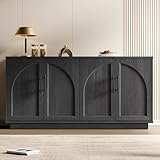

Best sideboards by shopping situation
| Situation | Best choice | Useful target specifications | Typical market range |
|---|---|---|---|
| Small apartment or narrow dining area | Compact two-door sideboard | 31–48 in wide, 14–16 in deep, 28–32 in high | $180–$550 |
| General living-room storage | Three-door or four-door sideboard | 60–72 in wide, 16–20 in deep, 28–34 in high | $350–$1,200 |
| Media console with hidden equipment | Ventilated cabinet with cable management | 60–84 in wide, 16–22 in deep, ventilation openings | $450–$1,500 |
| Frequent entertaining | Dining sideboard with drawers and adjustable shelves | 60–80 in wide, 18–22 in deep, 30–36 in high | $600–$2,000 |
| Low budget or changing needs | Modular storage system such as IKEA BESTÅ | Configurable width and height; confirm each combination | $150–$900 |
What makes the best sideboards worth buying?
Start with the inside, not the finish. A sideboard may look substantial but provide little practical storage if thick dividers, fixed shelves, or oversized drawers consume the cabinet. Measure the items you actually need to store: serving platters often need at least 14 inches of clear width, wine bottles need roughly 12–13 inches of vertical clearance when stored upright, and a standard stack of dinner plates commonly needs 10–12 inches of shelf height.
Adjustable shelves are more valuable than a large number of small compartments. They let you change the layout for tall vases, appliances, board games, or seasonal tableware. Soft-close hinges reduce noise and protect doors, while full-extension drawer runners make it easier to reach the back of a drawer. These details add cost, but they affect daily usability more than decorative door fronts.
Best for small spaces: a shallow two-door cabinet
For an apartment, hallway, or compact dining room, choose a sideboard no deeper than 16 inches. A 36–48-inch-wide model normally provides enough space for napkins, documents, small appliances, or games without making the room feel crowded. Sliding doors can be useful where a hinged door would interfere with a chair or walkway, although sliding hardware gives less access to the interior.
Check the door swing before ordering. Leave at least 30 inches of clear passage in front of the cabinet, and more if it sits beside a dining chair. A cabinet that technically fits against a wall can still be impractical if opening it blocks the main route through the room.
Best for dining storage: a wide cabinet with mixed storage
A dining-room sideboard works best when it combines drawers above cupboards. Drawers are convenient for cutlery, placemats, candles, and serving tools; cupboards handle larger and heavier objects. Look for a 60–80-inch width, at least one adjustable shelf per cabinet section, and a top rated for the weight of your display items.
Do not assume a long sideboard is automatically stronger. Wide shelves can sag when loaded with crockery. A central divider or shelf thickness of around three-quarters of an inch is preferable for heavy storage, and a rear support panel helps prevent the cabinet from racking when doors are opened.
Best for media equipment: a ventilated sideboard
A sideboard can replace a media console, but only if it accommodates heat and cables. Choose open-backed sections, rear cutouts, or ventilation slots around receivers, game consoles, and streaming hardware. An enclosed cabinet without airflow can trap heat and shorten the service life of electronics.
Measure the equipment, including plugs and cable bends. A cabinet listed as 16 inches deep may offer only 14 inches of usable depth after the back panel and door are accounted for. Allow at least 2 inches behind hot-running equipment where possible, and avoid placing a subwoofer inside a tightly enclosed compartment because vibration can cause rattling.
Materials compared: what you gain and what wears first
| Material | Advantages | Common weaknesses | Maintenance |
|---|---|---|---|
| Solid wood | Repairable, distinctive grain, long service life | Higher price; can move or crack with humidity changes | Dust with a soft cloth; wipe spills promptly |
| Wood veneer over engineered board | Stable panels, convincing appearance, moderate price | Edges can chip; water damage is difficult to repair | Use a barely damp cloth and dry immediately |
| Laminate or melamine | Affordable, consistent, easy to clean | Damaged corners and peeling edges are hard to disguise | Avoid abrasive cleaners and standing moisture |
| Metal | Strong, modern, resistant to many stains | Can dent, show fingerprints, or feel visually cold | Clean according to the coating; prevent trapped moisture |
| Rattan or cane panels | Light appearance, useful texture and ventilation | Can snag, loosen, or break under impact | Vacuum gently with a brush attachment |
The parts most likely to wear first are hinges, drawer runners, adjustable shelf pins, and thin edge banding. A beautiful cabinet with low-quality hardware may become frustrating sooner than a plainer model with robust runners and replaceable hinges. If children or pets use the room, prioritize rounded edges, stable legs, and a wall-anchoring kit over delicate cane or glass doors.
Assembly: how much work should you expect?
Fully assembled furniture usually costs more to ship but reduces the chance of alignment problems. Flat-pack sideboards are often good value, especially modular systems such as IKEA BESTÅ, but they require careful assembly and a perfectly level floor. Expect two adults and approximately 60–150 minutes for a medium cabinet, depending on the number of doors and drawers.
Use these steps to avoid the most common problems:
- Measure the boxed dimensions, not only the finished cabinet, to confirm it will pass through doors, stairwells, and elevators.
- Build on a blanket or cardboard sheet so the finish does not scratch.
- Separate screws by type before starting; similar-looking fasteners can damage panels if used in the wrong hole.
- Do not fully tighten every cam lock until the cabinet is square and the back panel is fitted.
- Level the feet or base before adjusting doors. Otherwise, hinge adjustments may hide a structural tilt rather than solve it.
- Anchor tall, narrow, or heavily loaded cabinets to the wall using the supplied hardware or an appropriate alternative.
A quick fit calculation before you buy
Suppose your available wall is 78 inches wide. A 72-inch sideboard leaves 3 inches on each side, which may be enough visually but leaves little tolerance for baseboards, uneven walls, or nearby door trim. If you want 6 inches of clearance on each side, the maximum practical width is:
78 inches − 6 inches − 6 inches = 66 inches.
In that room, a 60–66-inch cabinet is a safer choice than a nominal 72-inch model. Also measure the height of outlets and wall trim. A deep baseboard may prevent the cabinet from sitting flush, reducing usable interior depth and creating a dust-collecting gap.
How to choose between budget, mid-range, and premium
At the lower end of the market, expect laminate or veneer, basic hinges, limited adjustability, and more assembly. These cabinets can be sensible for occasional storage, but inspect the back panel and door alignment carefully. A thin back is not automatically a problem; a back that is poorly attached or leaves the cabinet twisting is.
Mid-range sideboards generally offer better drawer runners, thicker shelves, improved finishes, and more useful layouts. This is usually the best value for a frequently used dining or living-room cabinet. Premium models may add solid wood, hand-finished surfaces, joinery details, and heavier hardware, but the storage capacity is not always greater. Pay for construction quality when the sideboard will be used daily, moved rarely, and expected to last for many years.
Final buying checklist
- Record the maximum width, depth, and height, including baseboards and nearby doors.
- Compare internal shelf height and depth rather than external dimensions alone.
- Choose drawers for small items and adjustable cupboards for bulky items.
- Confirm cable openings and ventilation if electronics will be stored inside.
- Check the listed weight capacity for shelves and the top.
- Prefer replaceable or adjustable hardware and a supplied anti-tip kit.
- Confirm delivery, assembly, and return requirements before purchasing.
For most buyers, the best sideboard is a 60–72-inch-wide cabinet with mixed drawers and cupboards, adjustable shelves, durable veneer or solid wood, and straightforward wall anchoring. Smaller rooms should trade width for shallow depth, while media users should prioritize ventilation and cable access over decorative storage.
Ready to decide? Our #1 pick for 2026 is the Small apartment or narrow dining area.
Live price & availability on Amazon.




Write Your Review
No reviews yet. Be the first to share your experience!