
A cracked screen is the most common and most expensive phone repair, and a $15 tempered glass protector is the cheapest insurance against it. Here’s how to pick glass that protects, fits, and installs without bubbles in 2026. A good protector takes the scratches and the first impact so your actual display never has to, and replacing one costs a fraction of a screen repair — which is why it’s the first accessory we tell every new phone owner to buy.
![Ailun Screen Protector for iPad 11th A16 2025 [11 Inch] / 10th Generation 2022 [10.9 Inch], Tempered Glass [Face ID & Apple Pencil Compatible] Ultra Sensitive Case Friendly [2 Pack]](https://m.media-amazon.com/images/I/71Km-MVfzvL._AC_SL1500_.jpg)
Recommended Products

Microsoft Surface Pro Keyboard with Pen Storage, Compatible with Copilot+ (11th Edition), Surface 9 and 8, Alcantara Material, Black

PrimeMicrosoft Surface Keyboard (2nd Edition)

PrimeSurface Pro Keyboard, Bluetooth Wireless Type Cover for Microsoft Surface Pro 7 Plus 7/6/5/4/3 12.3 inch, Ultra-Slim Portable Magnetic Keyboard with 7 Color Backlit, Trackpad, USB-C Recharge, Black
As an Amazon Associate we earn from qualifying purchases. Product prices and availability are accurate as of the date/time indicated.
What Separates Good Glass From Cheap Glass
Quality protectors use aluminosilicate or soda-lime glass at 9H surface hardness with rounded 2.5D edges that don’t catch your finger. Cheap glass chips at the edges, scratches from sand, and shatters into the very screen it should protect. Look for full-adhesive (not dot-matrix) lamination — it prevents the rainbow effect and keeps touch response crisp. Thickness matters too: around 0.3mm is the sweet spot, thick enough to resist impact but thin enough to preserve touch feel and let a case bezel sit over the edge without lifting.
Edge-to-Edge Fit and Case Compatibility
Full-coverage protectors look best but can lift at the edges if they fight your case. ‘Case-friendly’ sizing leaves a hair of margin so the case bezel doesn’t pry the glass loose — the right choice for almost everyone. If you run a rugged case with a deep lip, measure before buying full-bleed glass. The interaction between case and protector is the number-one cause of edges peeling weeks after a clean install, so if you already know which case you’ll use, choose the protector to match it rather than the other way around.
Installation Frames Are Worth It
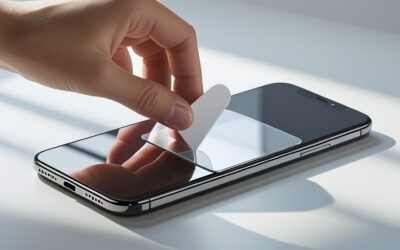
The era of bubble nightmares is over: the best kits include alignment trays or auto-install frames that center the glass and squeeze out air in one pull. If you’ve botched installs before, prioritize kits with a frame, dust stickers, and at least two glass panes in the box. Work in a bathroom just after a hot shower — the settled steam pulls floating dust out of the air — and clean the screen with the supplied alcohol wipe, then the microfibre, then a dust sticker for any last specks. A single trapped hair causes more failed installs than any hardware flaw.
Coatings That Matter
Oleophobic coating keeps fingerprints wipeable — it wears off cheap glass within weeks. Anti-glare matte versions help outdoors but slightly soften sharpness; privacy filters darken side views but cut brightness. For most users, clear glass with a durable oleophobic layer is the best daily experience. Gamers who slide their thumbs constantly may prefer a matte finish for lower friction, while anyone who works in an open office or on public transport may value a privacy filter enough to accept the dimmer, slightly narrower viewing angle it introduces.
How Many to Buy and When to Replace
Protectors are cheapest bought in two- or three-packs, and there is real logic to it: your first install may pick up a stray dust speck, and having a spare on hand removes the pressure. Keep the extras for the day the fitted glass chips or the coating finally stops shrugging off fingerprints. A protector is a consumable, not a permanent fixture — expecting to replace it once or twice a year is normal, and each replacement is a tiny cost compared with the screen it keeps intact underneath.
Related guides on our site:Best Fast iPhone Chargers in 2026: Top High-Speed Plugs·Best iPhone 16 Pro Cases in 2026: Top Slim and Tough Picks·Best USB-C Ethernet Hubs in 2026: Top Wired Adapters·Best 10000mAh Power Banks in 2026: Top Compact Chargers·Best Solar Power Banks in 2026: Top Outdoor Chargers.
Frequently Asked Questions
Do tempered glass protectors affect Face ID or touch?
No. Quality glass is precisely cut around the sensors and uses full-surface adhesive that maintains full touch sensitivity, so Face ID and normal tapping work exactly as before. Problems only appear with badly made protectors that use dot-matrix adhesive, sit misaligned over the sensor array, or are too thick. Buy a protector made for your exact phone model and install it cleanly to avoid any interference.
How often should I replace a screen protector?
Replace it whenever it cracks, chips at an edge, or the oleophobic coating wears down enough that fingerprints stop wiping off easily. With daily use that typically works out to every 6 to 12 months, though heavy use or a bad drop can shorten it. Since the protector is doing its job by absorbing damage the screen would otherwise take, treat a cracked one as a success and swap it promptly.
Is 9H hardness real?
9H refers to the pencil-scratch hardness scale, not the Mohs mineral scale, so it does not mean the glass is impervious. Good 9H glass reliably resists everyday threats like keys and coins in a pocket. However, sand and grit contain quartz, which is harder than glass and can scratch any protector — or your bare screen — which is exactly why the sacrificial protector earns its place.
Are installation frames really necessary?
They are not strictly necessary, but they dramatically raise your odds of a perfect, bubble-free install on the first try. A frame holds the glass in exact alignment and lowers it evenly so air is pushed out in one motion rather than trapped. If you have ever ended up with a crooked or bubbled protector before, a kit with an alignment tray, dust stickers and a spare pane is well worth the small premium.
Should I choose clear, matte, or privacy glass?
Clear glass with a durable oleophobic coating gives the sharpest image and best fingerprint resistance, and suits most people. Choose matte anti-glare if you often use your phone outdoors or game with sliding thumbs, accepting slightly softer sharpness. Pick a privacy filter only if you frequently view sensitive information in public, since it darkens the screen and narrows the viewing angle in exchange for blocking side-on snooping.
Top picks from this guide
 AilunAilun Screen Protector for iPad Air 11 Inch 2026/2025/2024 [8/7/6th…$8 \xc2\xb7 98/100
 AilunAilun 3 Pack Screen Protector for iPhone 17 / iPhone…$7 \xc2\xb7 98/100
 AilunAilun Screen Protector for iPhone 16 Plus/iPhone 15 Plus/iPhone 15…$6 \xc2\xb7 98/100
 AilunAilun 2 Pack Screen Protector for iPad Pro 12.9 Inch…$10 \xc2\xb7 98/100
Write Your Review
No reviews yet. Be the first to share your experience!