
As an Amazon Associate, we earn from qualifying purchases made through links on this page.
Teaching changes what a good keyboard means. A teacher needs an instrument that demonstrates harmony, rhythm and arrangement in real time, keeps a student’s attention with sounds worth exploring, and records ideas before they are forgotten. A 61-key arranger does all of that in a size that fits a classroom desk or a student’s bedroom, and its accompaniment styles turn abstract chord theory into something a learner can hear immediately.
The five models below were chosen for education: built-in lesson functions, clear displays, recorders that capture assignments, accompaniment that supports practice at slow tempos, and headphone-friendly practice features. They range from simple boards a beginner can operate unaided to workstations an advanced student can grow into for years.
What to look for
The shortlist in this guide was built from manufacturer-published specifications and feature lists, matched against the job described in the title. These are the criteria that matter most for this use case:
- Lesson and practice tools: Built-in songs, lesson modes and metronome support structure practice between classes. Look for keyboards that can slow accompaniment down without changing pitch so students can build speed gradually.
- Recording for assignments: A song recorder lets students capture homework, improvisations and compositions. Multi-track recording is a genuine teaching advantage because parts can be muted, discussed and rebuilt.
- Sounds that reward exploration: A wide voice library keeps lessons varied: piano one week, strings, brass and synth the next. Styles in many genres help teachers connect theory to music students already listen to.
- Simple, readable controls: In a classroom, time spent hunting menus is time lost. Direct buttons, a clear screen and one-press resets help students of different ages share the same instrument.
- Connections for the classroom: USB to a computer or tablet opens notation and learning apps, an audio input lets students play along with tracks, and a headphone socket keeps group classes manageable.
The picks in detail
Yamaha PSR-E473 — Lesson tools and creative controls for students

ASIN: B09PRSNDGJ · View on Amazon: https://www.amazon.com/dp/B09PRSNDGJ
The PSR-E473 pairs a large Yamaha style library with practical controls that invite experimentation. Two assignable Live Control knobs, a Groove Creator section and sampling pads make it easy to move from a simple chord backing to a fuller arrangement without opening a computer program.
Key features and specifications:
- 61 touch-sensitive keys with 48-note polyphony
- 820 voices and 290 auto-accompaniment styles
- Live Control knobs, pitch bend wheel and Groove Creator for building patterns in real time
- Quick Sampling pads and a microphone input with vocal effects
- USB audio and MIDI connection, plus line outputs for a PA or interface
- Built-in lesson functions and a two-track song recorder
Who it fits: Readers whose priority is lesson tools and creative controls for students will find this the most direct match in the group.
Limitations to note: No model leads on every criterion here, so check the criteria above against this specification set carefully. Other picks in this comparison cover the formats, libraries or recording systems outside this model’s focus.
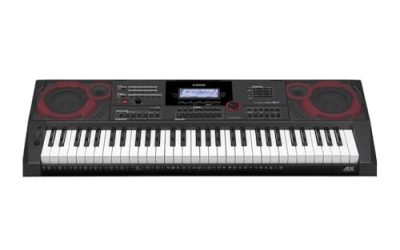
Casio CT-X5000 — Recorder-first choice for composition classes

ASIN: B07D7Y92KP · View on Amazon: https://www.amazon.com/dp/B07D7Y92KP
The CT-X5000 is built around Casio’s AiX sound source and a 17-track recorder, which makes it unusually capable as a stand-alone songwriting and arranging tool. Phrase pads, editable DSP effects and proper line outputs help it move between practice room, classroom and small stage.
Key features and specifications:
- 61 touch-response keys driven by the Casio AiX sound source
- 800 tones and 235 rhythm accompaniments
- 17-track MIDI recorder for capturing complete songs on board
- Phrase pads, pitch bend wheel and modulation button
- Microphone input, stereo line outputs and USB MIDI
- Twin speakers rated by Casio at 15 watts per side
Who it fits: Readers whose priority is recorder-first choice for composition classes will find this the most direct match in the group.
Limitations to note: No model leads on every criterion here, so check the criteria above against this specification set carefully. Other picks in this comparison cover the formats, libraries or recording systems outside this model’s focus.
Korg EK-50 L — One-press simplicity for younger learners

ASIN: B07H8RLGBP · View on Amazon: https://www.amazon.com/dp/B07H8RLGBP
The EK-50 L keeps operation deliberately simple: styles, sounds and Keyboard Sets sit behind clear buttons, and a dedicated grand piano key resets the instrument in one press. The L version adds a more powerful speaker system, which matters when the keyboard has to fill a room on its own.
Key features and specifications:
- 61 touch-sensitive keys with 64-note polyphony
- More than 700 sounds and more than 280 styles
- Keyboard Sets that store a complete sound combination under one button
- Grand piano button for instant return to a piano setup
- USB host and device ports, audio input and pedal input
- Larger speaker system than the standard EK-50, designed for room-filling sound
Who it fits: Readers whose priority is one-press simplicity for younger learners will find this the most direct match in the group.
Limitations to note: No model leads on every criterion here, so check the criteria above against this specification set carefully. Other picks in this comparison cover the formats, libraries or recording systems outside this model’s focus.
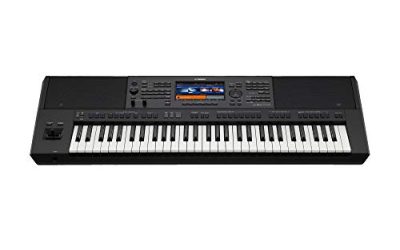
Yamaha PSR-SX600 — Classroom-ready workstation features

ASIN: B08F7HX4GK · View on Amazon: https://www.amazon.com/dp/B08F7HX4GK
The PSR-SX600 is the entry point into Yamaha’s SX workstation line. It adds a colour screen, a joystick for pitch and modulation, Multi Pads and a proper playlist system to the familiar PSR formula, so complete songs and set lists can be stored and recalled as single setups.
Key features and specifications:
- 61 touch-sensitive keys with 128-note polyphony
- 415 accompaniment styles with Smart Chord and full-band follow modes
- Colour display, joystick controller and assignable live controls
- Microphone and guitar input with vocal effects
- USB audio recording and playback, plus Multi Pad triggers
- Playlist and registration memory for saving complete setups
Who it fits: Readers whose priority is classroom-ready workstation features will find this the most direct match in the group.
Limitations to note: No model leads on every criterion here, so check the criteria above against this specification set carefully. Other picks in this comparison cover the formats, libraries or recording systems outside this model’s focus.
Yamaha PSR-SX700 — Advanced arranging for older students

ASIN: B07W3PTMJQ · View on Amazon: https://www.amazon.com/dp/B07W3PTMJQ
The PSR-SX700 steps up to a touch screen, a Chord Looper and expansion memory. For players who build complete arrangements on the keyboard itself, the larger style library, vocal tools and on-board recording make it the most self-contained option in this group.
Key features and specifications:
- 61 keys with 128-note polyphony and a 7-inch colour touch screen
- More than 1,000 voices and more than 400 accompaniment styles
- Joystick controller, Chord Looper and Multi Pad audio link
- Microphone input with vocal harmony and vocoder options
- USB audio recording, expansion memory for additional content
- Registration memory and playlist functions for organised live sets
Who it fits: Readers whose priority is advanced arranging for older students will find this the most direct match in the group.
Limitations to note: No model leads on every criterion here, so check the criteria above against this specification set carefully. Other picks in this comparison cover the formats, libraries or recording systems outside this model’s focus.
Quick comparison
| Product | Format | Standout strength |
|---|---|---|
| Yamaha PSR-E473 (ASIN B09PRSNDGJ) | 61 touch-sensitive keys | Lesson tools and creative controls for students |
| Casio CT-X5000 (ASIN B07D7Y92KP) | 61 touch-response keys | Recorder-first choice for composition classes |
| Korg EK-50 L (ASIN B07H8RLGBP) | 61 touch-sensitive keys | One-press simplicity for younger learners |
| Yamaha PSR-SX600 (ASIN B08F7HX4GK) | 61 touch-sensitive keys | Classroom-ready workstation features |
| Yamaha PSR-SX700 (ASIN B07W3PTMJQ) | 61 touch-sensitive keys | Advanced arranging for older students |
Buying notes for this use case
Match the keyboard to the lesson plan, not just the student. If lessons centre on reading and technique, prioritise touch response, lesson songs and a clear display. If the curriculum includes songwriting, ensembles or exams with a technology element, the recorder, style editing and computer connection move to the top of the list. Teachers running group classes should also check how quickly each board resets to a clean grand piano; that single feature saves minutes in every session.
Frequently asked questions
Are 61 keys enough for piano lessons?
For early and intermediate lessons, yes. Most method-book material fits comfortably, and arrangers add styles and recording that a basic piano does not. Students heading toward advanced classical repertoire will eventually need 76 or 88 keys, which is why this guide notes where each model sits in that path.
Can students practise quietly in a group class?
Yes. All of these keyboards work with headphones, and the accompaniment can be kept in the headphones too, so several students can work at different tempos in one room.
Which features help most with composition homework?
A built-in recorder is the big one, followed by styles that supply drums and bass so a melody idea becomes a complete piece. Phrase pads and multi-track recording, where fitted, make structure easier to teach.
Should a teacher choose different keyboards for different ages?
Often, yes. Younger beginners benefit from one-press simplicity and lesson songs, while older students use recorders, editors and larger style libraries. Many studios keep one simple board and one workstation model.
Conclusion
For most teaching studios, the Yamaha PSR-E473 offers the best mix of lesson support, creative controls and approachable operation, while the Casio CT-X5000 suits teachers who set recording and composition work. The Korg EK-50 L is the easiest for young beginners to run unaided, and the SX models serve advanced students who are ready to arrange complete songs.
Write Your Review
No reviews yet. Be the first to share your experience!