
The Short Answer
For most people, a 10,000mAh power bank is the best everyday size. It is compact enough for a purse, work bag, or small travel pouch and typically provides about one to one-and-a-half full phone charges. Choose 20,000mAh if you want two to three phone charges, use a tablet, or spend long days away from an outlet.
Move up to 50,000mAh or more only when you need backup power for several devices, camping, travel, or a group. These models are substantially larger and heavier. An 80,000mAh unit can be useful outdoors, but it is closer to a portable battery station than a pocket charger.
As an Amazon Associate we earn from qualifying purchases at no extra cost to you. Product prices and availability are accurate as of the date shown and are subject to change.
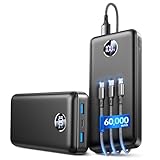


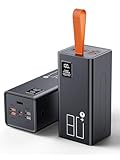
Capacity is listed in milliamp-hours, or mAh, but that number does not equal the amount of power delivered to your phone. A power bank loses energy during voltage conversion, heat, and charging. As a practical estimate, divide the advertised capacity by about 1.2 to 1.3 to estimate usable capacity. A 20,000mAh bank may therefore deliver roughly 15,000 to 17,000mAh under normal conditions.
For phones, also check output wattage. A 20W to 30W USB-C power bank is generally sufficient for fast charging many current phones. Higher capacity does not automatically mean faster charging.
Standard Sizes
The following are common size categories rather than universal standards. Actual dimensions vary by battery cells, ports, display, built-in cables, and casing. The measurements are useful when deciding whether a bank will fit in a pocket, drawer, backpack, or travel organizer.
| Capacity | Approximate dimensions | Approximate weight | Practical use |
|---|---|---|---|
| 5,000mAh | 3.5–4.5 × 2.3–2.8 × 0.5–0.8 in (8.9–11.4 × 5.8–7.1 × 1.3–2.0 cm) |
3.5–5.5 oz (100–155 g) |
Emergency top-up; about half to one phone charge |
| 10,000mAh | 5.0–5.8 × 2.5–3.0 × 0.6–0.9 in (12.7–14.7 × 6.4–7.6 × 1.5–2.3 cm) |
6.5–8.5 oz (185–240 g) |
Daily carry; about one to one-and-a-half phone charges |
| 20,000mAh | 5.5–6.5 × 2.7–3.2 × 0.9–1.2 in (14.0–16.5 × 6.9–8.1 × 2.3–3.0 cm) |
11–16 oz (310–455 g) |
Travel, tablets, and multiple phone charges |
| 50,000–60,000mAh | 6.0–7.5 × 3.0–4.0 × 1.3–2.0 in (15.2–19.1 × 7.6–10.2 × 3.3–5.1 cm) |
2.2–3.5 lb (1.0–1.6 kg) |
Camping, group travel, and several devices |
| 80,000mAh | 7.0–9.0 × 3.5–5.0 × 1.5–2.5 in (17.8–22.9 × 8.9–12.7 × 3.8–6.4 cm) |
3.5–5.5 lb (1.6–2.5 kg) |
Extended outdoor use; not a pocket-size charger |
For a sense of current pricing, compact 20,000mAh models commonly cost about $25 to $35. Large 50,000mAh to 60,000mAh models often range from $30 to $40, while 80,000mAh models are commonly around $40 to $60. Built-in cables, wall plugs, screens, extra ports, and higher USB-C output can raise the price.
How to Measure Your Space
- Choose the storage location first. Measure the pocket, drawer, console, backpack compartment, or organizer where the power bank will live. Do not measure only the open area; zippers, seams, and interior padding reduce usable room.
- Measure length, width, and depth. Record all three dimensions in inches. If the space is tight, convert them to centimeters by multiplying each measurement by 2.54.
- Allow clearance for cables. Add at least 1 inch (2.5 cm) near the port if a cable will remain plugged in. A rigid connector or built-in cable may need more room than a thin charging cord.
- Account for access. A bank can physically fit in a compartment but still be inconvenient if you cannot press its button, read its display, or unplug a cable without removing it.
- Check the weight limit. A 20,000mAh bank can weigh around 12 to 16 ounces, while a 50,000mAh model may weigh more than 2 pounds. Include that weight when packing a small purse, camera bag, or daypack.
- Compare the bank’s listed dimensions. Use the product’s external measurements, not battery capacity alone. A bank with built-in cables or a wall plug may be thicker than a basic model with the same mAh rating.
By Room or Use Case
Everyday carry
Choose 5,000mAh for an emergency boost during a commute, dinner, or short outing. A 10,000mAh model is more versatile if you regularly use navigation, streaming, photography, or mobile hotspots. Look for a body less than about 6 inches long and under 9 ounces if portability matters.
Work, school, or commuting
A 10,000mAh to 20,000mAh bank is usually the right range. Choose 20,000mAh when you carry a phone and wireless earbuds, tablet, or handheld game system. At least 20W USB-C Power Delivery is helpful for faster phone charging; 30W gives more flexibility for tablets and some smaller laptops.
Travel and airports
For a full day of sightseeing, 10,000mAh is convenient and 20,000mAh is more comfortable for multiple devices. A 20,000mAh bank is also easier to pack than a 50,000mAh model. Check your airline’s current rules before flying: very high-capacity batteries may require approval or may not be accepted in passenger baggage. Keep portable batteries in carry-on luggage rather than checked bags when required.
Camping and road trips
Choose 20,000mAh for a weekend when you can recharge periodically, or 50,000mAh to 60,000mAh for several people and devices. A high-capacity example such as a 60,000mAh unit may include multiple outputs and a display, but expect a heavier case. Prioritize a rugged exterior, reliable USB-C input, and a clear battery indicator over maximum capacity alone.
Extended outdoor use
An 80,000mAh bank makes sense for long periods without an outlet, especially when charging phones, cameras, lights, GPS devices, or other USB equipment. Its approximate 3.5- to 5.5-pound weight makes it better for a vehicle, base camp, or substantial backpack than a day bag. Confirm that its 30W or higher output matches the devices you intend to use.
Tablets and laptops
For a tablet, start at 20,000mAh and check the required wattage. For USB-C laptops, capacity is only half the decision: many need 45W, 65W, or more. A 20,000mAh phone-focused bank may not charge a laptop effectively even if it has a USB-C port. Check both the laptop’s input requirement and the power bank’s maximum USB-C output.
Common Sizing Mistakes
- Buying by mAh alone: Capacity does not tell you charging speed, port compatibility, or usable energy.
- Ignoring dimensions: A 50,000mAh bank may not fit a purse or jacket pocket, even if its price looks attractive.
- Overestimating charges: Conversion losses mean a 20,000mAh bank will not usually provide four full charges to a typical phone.
- Choosing too much capacity: Extra battery adds cost and weight. Do not carry 60,000mAh for a commute if 10,000mAh covers your routine.
- Forgetting output limits: A large bank with a low-wattage port may charge slowly. Match wattage to the device.
- Neglecting recharge time: A large battery can take many hours to refill. USB-C input wattage matters when you need the bank ready quickly.
FAQ
How much power bank capacity do I need for one phone?
Choose 10,000mAh for everyday use and approximately one to one-and-a-half full phone charges. Choose 20,000mAh if you want two or more charges or use your phone heavily.
Is a 20,000mAh power bank too big for daily use?
Not necessarily. It is practical in a backpack or work bag, but its roughly 11- to 16-ounce weight is noticeable in a pocket. For most daily carry, 10,000mAh is the better balance.
How many watts should a power bank have?
Choose at least 18W to 20W for fast-charging many phones. A 22.5W or 30W bank offers more flexibility for tablets and multiple devices. Laptops may require 45W, 65W, or higher.
What is the best capacity for camping?
Use 20,000mAh for short trips and 50,000mAh to 60,000mAh for several people or multiple days. Consider 80,000mAh only when extended runtime outweighs its size and weight.
Ready to decide? Our #1 pick for 2026 is the 5,000mAh.
Live price & availability on Amazon.




Write Your Review
No reviews yet. Be the first to share your experience!