
Buying a power bank can look simple: choose a capacity, check the price, and add it to your cart. That approach often leads to the wrong charger. People regularly buy a model that is too heavy for everyday carry, mistake advertised capacity for usable capacity, overlook charging speed, or assume every USB-C port supports fast input and output. Others pay for wireless charging they rarely use or choose a bargain model with vague safety information.
Knowing what to look for in power banks means balancing capacity, size, charging performance, ports, safety, and warranty. A compact 5,000mAh magnetic battery may be ideal for topping up a phone during a commute, while a 20,000mAh USB-C model makes more sense for travel or several devices. The best choice in 2026 is not necessarily the largest or most powerful option; it is the one that fits your routine without adding unnecessary bulk.
As an Amazon Associate we earn from qualifying purchases at no extra cost to you. Product prices and availability are accurate as of the date shown and are subject to change.


Decide These 3 Things First
- How much backup power do you need? For occasional emergency use, 5,000mAh to 10,000mAh is usually sufficient. Frequent travelers, tablet owners, and people charging multiple devices should consider 20,000mAh or more.
- What will you carry and charge? A phone-only power bank has different requirements from one intended for a tablet, handheld game console, earbuds, smartwatch, or laptop. Check the device’s required charging wattage before shopping.
- Will you use cables or wireless charging? Wired USB-C charging is generally faster and more efficient. Magnetic wireless models are convenient, but they tend to have lower capacity, cost more per usable watt-hour, and work best with compatible phones or cases.
Size and Capacity
Capacity is measured in milliamp-hours, or mAh, but that number does not translate directly into the same amount of power delivered to your phone. Conversion losses, voltage changes, and the power bank’s electronics reduce the usable output. As a practical rule, a 10,000mAh bank may provide roughly one full phone recharge plus additional top-up power, while a 20,000mAh bank is better suited to multiple recharges or several devices. Actual results vary by phone, cable, temperature, and charging method.
For a pocket-friendly model, look for dimensions around 3.5 to 5 inches long, 2 to 3 inches wide, and about 0.6 to 1 inch thick. Weight commonly falls between 6 and 8 ounces for 10,000mAh models. A 20,000mAh bank can weigh approximately 11 to 16 ounces and may be closer to paperback-book size.
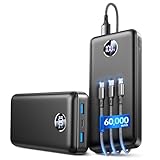
A 5,000mAh magnetic bank is often slimmer and easier to carry, but it may add noticeable weight to the back of a phone. A compact 10,000mAh model, such as the type represented by the INIU 10,000mAh 45W portable charger, is a more versatile everyday choice. For longer trips, a 20,000mAh option similar to the INIU 22.5W model provides more reserve but takes up more room.
Material and Surface Finish
Most power banks use a plastic, polycarbonate, or aluminum shell. Plastic is usually lighter and less expensive, while aluminum can feel more substantial and may help spread heat. Neither material alone guarantees better performance. Look for a surface that resists slipping and does not have sharp seams or exposed edges.
Matte or lightly textured finishes are preferable for daily carry because they show fewer fingerprints and are less likely to slide off a nightstand. A smooth glossy finish can look attractive but may be harder to grip. If you plan to carry the bank in a small bag with keys, consider a model with a scratch-resistant finish or use a separate pouch.
Wireless magnetic models need special attention to the exterior. The magnetic ring should sit flat, hold the phone securely, and avoid blocking the camera or buttons. A silicone or rubber contact surface can help prevent scratches, but it may collect lint over time.
Construction and Port Layout
Inspect the details around the ports, buttons, seams, and display. USB-C ports should be centered securely in the housing, with no visible movement when a cable is connected. Buttons should not activate accidentally inside a pocket, and indicator lights should be visible without being excessively bright at night.
Port layout matters when charging more than one device. A useful everyday arrangement is one USB-C port for input and output plus one or two USB-A ports for older cables. Confirm the specifications: some USB-C ports only recharge the power bank and cannot charge another device. If you need to charge a phone and earbuds simultaneously, check the total output when multiple ports are active; it may be lower than the headline single-port rating.
Look for basic protections against overcharging, overheating, overcurrent, and short circuits. Reputable listings should identify the manufacturer, electrical ratings, and included accessories rather than relying only on phrases such as “super safe” or “ultra powerful.”
Comfort and Charging Performance
Wattage is the key performance number. A 10W to 15W output is adequate for basic phone charging, while 18W to 25W supports faster charging on many phones. A 30W to 45W USB-C power bank is more useful for tablets, handheld consoles, and compatible phones. Some laptops require 60W, 65W, or more, so a 45W bank may maintain battery life or charge slowly rather than provide full-speed charging.
Do not confuse total wattage with the rating of every port. A power bank advertised as 45W may deliver 45W through USB-C alone but divide power when another device is connected. Check whether the product supports USB Power Delivery, commonly written as USB-PD, and whether its voltage profiles match your device.
Comfort also includes how the bank feels in use. A 6-ounce charger is easier to hold with a phone than a 14-ounce model. For bedside or desk use, a built-in cable or digital percentage display may be convenient. For a pocket, a slim shape and rounded corners are more important. Wireless charging reduces cable clutter, but it can be slower and less efficient, especially if the phone and battery are not aligned correctly.
Price Tiers
Budget power banks generally cost about $15 to $25 for 5,000mAh to 10,000mAh capacity. For example, a 10,000mAh two-pack similar to the Miady slim travel battery pack may fall near the $20 range, making it practical for keeping one at home and one in a bag. At this price, expect basic displays or LED indicators, moderate charging speeds, and plastic housings.
Midrange models typically cost $25 to $60 and often offer 10,000mAh to 20,000mAh capacity, USB-C input and output, faster charging, improved port layouts, or a more refined enclosure. A compact 20,000mAh model priced around $27, such as the example INIU unit, illustrates why capacity-per-dollar can be attractive for travel.
Premium power banks commonly cost $60 to $150 or more. They may include 45W to 100W USB-C output, higher-quality displays, integrated cables, stronger thermal management, or laptop compatibility. Wireless magnetic models can range from about $20 to $100 depending on capacity, magnetic alignment, brand, and charging standard. A $19.99 5,000mAh magnetic charger may be convenient, but it should not be compared directly with a 20,000mAh wired bank on capacity alone.
Warranty and Support
A warranty is one of the clearest differences between an established brand and an anonymous listing. Look for at least a one-year limited warranty, a readable return policy, and a manufacturer support address or contact method. Keep the receipt and packaging until you have tested both charging and recharging.
Check what the warranty excludes. Normal capacity loss, cosmetic damage, water exposure, and damage from unsupported chargers may not be covered. A warranty does not replace basic safety checks: stop using a bank if it swells, becomes unusually hot, smells burnt, leaks, or makes a crackling sound.
Delivery and Setup
Power banks do not require assembly, but delivery and initial setup still matter. Lithium-ion batteries may have shipping restrictions, and delivery dates can vary by seller, warehouse, and destination. Confirm that the package includes the expected USB-C cable, manual, and any magnetic ring or alignment accessory before discarding the box.
When it arrives, inspect the housing for dents, cracks, lifted seams, or a loose port. Charge the bank with a compatible wall adapter before relying on it for travel. Test each port, the power button, the battery indicator, and wireless alignment if applicable. Avoid charging it under pillows, inside luggage, or in a hot car. Store it partially charged if it will sit unused for several months.
Spec Checklist
| Spec | Budget | Mid | Premium |
|---|---|---|---|
| Capacity | 5,000–10,000mAh | 10,000–20,000mAh | 20,000–27,000mAh |
| Typical weight | 5–9 ounces | 7–16 ounces | 12–24 ounces |
| USB-C output | 10–18W | 18–45W | 45–100W |
| Ports | USB-C plus one USB-A | USB-C input/output plus one or two USB-A | USB-C PD plus multiple ports or integrated cables |
| Wireless option | Optional 5W–10W magnetic or pad charging | Optional 7.5W–15W magnetic charging | Standard-specific wireless charging with alignment features |
| Typical price | $15–$25 | $25–$60 | $60–$150+ |
Red Flags
- Capacity is listed, but watt-hours, output profiles, or input limits are missing.
- The listing promises “fast charging” without stating wattage or identifying USB-PD support.
- The product claims 20,000mAh capacity while showing unusually small dimensions and very low weight.
- There is no manufacturer name, safety information, warranty, or customer-service contact.
- Ports feel loose, the shell has uneven seams, or the battery arrives swollen or damaged.
- A magnetic charger does not clearly state compatibility, wireless output, or whether a case affects attachment.
- The price is dramatically lower than comparable products without explaining the difference.
FAQ
How many mAh should a power bank have?
Choose 5,000mAh for emergency top-ups, 10,000mAh for everyday phone carry, and 20,000mAh for travel, multiple phones, tablets, or several days away from an outlet. Remember that usable output is lower than the printed capacity.
Is a higher-wattage power bank always better?
No. Higher wattage can reduce charging time and support larger devices, but it may increase price, size, and weight. Match the output to your phone, tablet, console, or laptop. A 20W to 30W model is enough for many phones; laptops may need 45W to 100W.
Are magnetic wireless power banks worth buying?
They are worthwhile when convenience and cable-free top-ups matter most. They are less suitable when you need maximum capacity or the fastest charging. Confirm phone compatibility and expect the battery to become warm during wireless charging.
Can I take a power bank on a plane?
Power banks generally belong in carry-on luggage rather than checked baggage, but airline rules can differ. Check the airline’s current requirements before flying, especially for high-capacity models. Keep the capacity label visible and protect the ports from accidental contact.
Ready to decide? Our #1 pick for 2026 is the Capacity.
Live price & availability on Amazon.




Write Your Review
No reviews yet. Be the first to share your experience!