
The INIU SnapGo Air is the better pick for most iPhone owners because it pairs 25W Qi2.2 wireless charging with 45W wired output in a body about as thin as the TORRAS MiniMag Pro, while the TORRAS MiniMag Pro wins only if you want an IP54 dust and splash rating or you carry an older Qi2 or MagSafe phone that tops out at 15W anyway. Both are 10,000mAh magnetic power banks of nearly identical size and weight, so the decision comes down to wireless wattage, USB-C behavior under load, durability, and which iPhone you own.
- Quick verdict
- Specs side by side
- Verified facts and what could not be confirmed
- How we chose what to compare
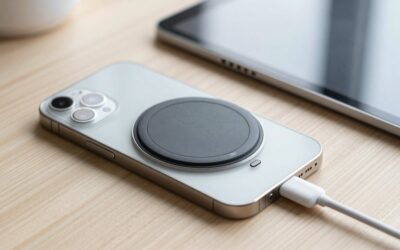
- Wireless charging: 25W versus 15W
- Wired USB-C: 45W versus 30W
- Charging two devices at once
- Thickness, weight, and carry feel
- Durability: the IP54 advantage
- Worked calculation: how many charges you actually get
- Decision matrix by iPhone model and use
- Case and accessory compatibility
- Who should skip each
- Pros and cons summary
- Frequently asked questions
One naming note before the comparison. TORRAS sells more than one product under the MiniMag Pro name: a 5,000mAh semi-solid-state version and a 10,000mAh version. This article compares the 10,000mAh MiniMag Pro, because that is the one that matches the INIU SnapGo Air’s capacity class and the one slim Qi2 roundups put side by side with it. TORRAS also sells a separate, non-Pro MiniMag with Qi2.2 25W wireless. That is a different product and is not what the MiniMag Pro figures below describe.
Quick verdict
- Choose the INIU SnapGo Air if you own an iPhone 16 Plus, 16 Pro Max, or a newer model that supports 25W Qi2.2 charging, want the fastest wireless top-ups, want a built-in USB-C cable, and care about the lower price tier.
- Choose the TORRAS MiniMag Pro if you want a dust and water resistance rating on a magnetic power bank, you use the battery outdoors or in a bag with drinks and gear, or your phone is an iPhone 12 to 15 class device that will only pull 15W wirelessly.
- Skip both if you want the thinnest possible pack. Both are around half an inch thick, roughly double the thickness of the ultra-slim 5,000mAh packs that exist in 2026.
Specs side by side
The figures below come from the makers’ product pages and from Android Central’s 2026 roundup of slim Qi2 power banks, which lists both products in one comparison table. Where sources disagree, the discrepancy is flagged in the notes column.
| Spec | INIU SnapGo Air (P781) | TORRAS MiniMag Pro (10,000mAh) | Notes |
|---|---|---|---|
| Capacity | 10,000mAh | 10,000mAh | Equal on paper |
| Wireless output | Up to 25W (Qi2.2) | Up to 15W (Qi2) | 25W needs a compatible iPhone on iOS 26 or later |
| Wired USB-C | Up to 45W output, up to 27W input | 30W input and output | Some reviews of the TORRAS line list 22.5W; check the exact listing |
| Dimensions | 4.1 x 2.8 x 0.5 in | 4.08 x 2.76 x 0.57 in | Near-identical footprint |
| Weight | About 195g | About 195g | TORRAS marketing text lists a different ounce figure than its own spec table |
| Magnet grip | 13N | 13N | Same stated pull force |
| Built-in cable | Yes, short USB-C GoCord | No, standard cable supplied | INIU also carries a second USB-C port |
| Display | Digital battery readout | Digital battery readout | Both show percentage |
| Ingress protection | Not rated | IP54 dust and splash | TORRAS only |
| Body | Anodized aluminum | PC+ABS with aluminum alloy | Both metal-accented |
| Cell type | Not specified as solid-state | Marketed as semi-solid-state | TORRAS cites 2,000+ cycles |
| Price tier | Mid-range | Premium | INIU is the lower of the two |
Verified facts and what could not be confirmed
Both products exist and are on sale in 2026. The INIU SnapGo Air is covered by multiple outlets, including Android Authority, TechRadar, Digital Trends, and Pocketables, and INIU sells it directly as model P781. The TORRAS MiniMag Pro is listed on TORRAS’s own site and by major retailers and was reviewed by MacSources and Android Central.
A few items could not be confirmed to a standard worth printing as fact, so treat them as open questions:
- Kickstand support. Neither maker lists a built-in kickstand on the products compared here. INIU’s coverage highlights the built-in cable and a carry-friendly design; TORRAS sells kickstand accessories as a separate product line. If a kickstand matters, check the specific listing.
- Case compatibility lists. Neither maker publishes a definitive per-case list. Magnetic power banks attach through the phone’s magnet ring, so the practical rule is that a case must be MagSafe or Qi2 magnetic. Thick non-magnetic cases will weaken or break the grip.
- Exact TORRAS wired wattage. Android Central and the retailer listing say 30W, while another review of the MiniMag line quotes 22.5W. The 30W figure from the retailer and the roundup is used here.
- Real-world runtime. Neither product has independent lab measurements of delivered watt-hours in the sources reviewed. The calculation below is an estimate from stated specs.
How we chose what to compare
This comparison is based on research of maker specification pages, retailer listings, and published reviews rather than personal use. The criteria below are the ones that most change what a buyer experiences with a magnetic power bank, ordered by how often they decide the purchase:
- Wireless wattage your phone can actually accept.
- Thickness and weight when pocketed or clipped to a phone.
- Wired USB-C output for tablets, earbuds, and fast cable charging.
- Behavior when charging two devices at once.
- Durability features such as ingress protection.
- Price tier relative to what you gain.
Wireless charging: 25W versus 15W
This is the biggest practical gap. The SnapGo Air supports Qi2.2 at up to 25W. INIU states that iPhone 16 Plus, iPhone 16 Pro Max, and later models, apart from the 16e, reach that speed on iOS 26 or later. iPhone 12 through 15 models on iOS 17.4 or later charge at the Qi2 limit of 15W. INIU claims an iPhone can reach 50% in about 33 minutes at 25W.
The TORRAS MiniMag Pro is a 15W Qi2 device. On a phone that supports 25W, you leave speed on the table. On a phone limited to 15W, there is no difference between the two on paper, which is why TechRadar noted that an iPhone 13 Pro only takes 15W of magnetic charging no matter how capable the power bank is.
One caution applies to both: magnetic wireless charging is the slow, lossy option. A MacSources review of the TORRAS MiniMag line observed only about 20% added battery in roughly 1 hour 15 minutes over magnetic charging in its situation, and concluded that the cable was the faster route. Heat, phone use during charging, and case thickness all reduce wireless speed.
Wired USB-C: 45W versus 30W
The SnapGo Air’s USB-C output reaches 45W, which is enough for a tablet, a small laptop at reduced speed, or an iPhone at its fastest cable rate. It recharges itself at up to 27W; TechRadar reported a full recharge in about 1 hour 46 minutes, and INIU states 1.8 hours.
The MiniMag Pro is rated at 30W in and out, which is still more than any current iPhone needs from a cable. For phone-only owners, 30W versus 45W rarely matters. It starts to matter if you carry an iPad, a handheld console, or a thin laptop.
Built-in cable versus a separate cable
The SnapGo Air includes a short built-in USB-C cord, which removes the most common failure of a slim power bank: forgetting the cable. The MiniMag Pro ships with a standard USB-C cable, which is more flexible for length and replacement but easy to lose.
Charging two devices at once
This is where INIU’s headline numbers shrink. Per INIU, each USB-C port can deliver 45W when it is the only thing in use, but using both USB-C ports together, USB-C plus wireless, or all three drops the combined output to 15W maximum. Android Central’s reviewer reported a similar pattern: with one USB-C connection active alongside wireless charging, USB-C falls to about 10W and wireless to about 5W.
In other words, the SnapGo Air is a one-device-at-a-time fast charger. If you regularly charge a phone magnetically while also topping up earbuds by cable, expect the fast-charging advantage to disappear. No comparable multi-port breakdown was found for the MiniMag Pro, so assume a conservative split there as well.
Thickness, weight, and carry feel
On paper, the two are almost twins: roughly 4.1 inches tall, 2.8 inches wide, and 195g. INIU lists 0.5 inch thick; the TORRAS Pro is listed at 0.57 inch (about 14mm). The difference is about a millimeter or two, which is not enough to change how either feels in a pocket. Android Central noted the MiniMag Pro may not be as slim or light as the thinnest competing pack, but it carries twice that pack’s capacity.
Anything under about 15mm and around 200g is workable clipped to the back of a phone for short stretches. Beyond roughly an hour of one-handed use, 195g on the back of a phone is noticeable regardless of which brand you pick.
Durability: the IP54 advantage
The TORRAS MiniMag Pro is rated IP54, meaning protection against limited dust ingress and splashing water from any direction. Android Central’s reviewer called a Qi2 power bank with that rating unheard of. The SnapGo Air has no ingress rating in its published specs, although INIU describes a multi-layer safety system (Temp Guard 3.0 with 18-layer SmartProtect) for temperature and electrical protection.
IP54 is not waterproof. It will not protect against submersion, and it is not a substitute for care at a beach or pool. It does matter for trail walks, festival bags, kitchens, and commutes in rain.
Battery chemistry and lifespan
TORRAS markets the MiniMag Pro as using a semi-solid-state battery and cites 2,000 or more charge cycles. That is a manufacturer claim, and no independent cycle-life measurement was found. INIU does not make the same chemistry claim for the SnapGo Air. If long-term lifespan is a priority, the TORRAS claim is a reason to consider it, but treat it as marketing until independently verified.
Worked calculation: how many charges you actually get
The 10,000mAh label is measured at the cell voltage, not at the 5V or 9V a phone sees, so it overstates what you can use. This estimate shows how to convert it into phone charges. Assumptions are stated so you can swap in your own numbers.
- Convert pack energy. A lithium cell is typically rated at about 3.7V. 10,000mAh x 3.7V = 37,000 mWh, or 37 Wh.
- Apply conversion efficiency. Boosting voltage and wireless transfer both lose energy. Assume about 85% efficiency for a cable and about 65% for magnetic wireless charging. That gives roughly 31.5 Wh by cable or 24 Wh wirelessly. Pack Hacker’s estimate that the SnapGo Air delivers closer to 6,500mAh of usable capacity (about 24 Wh) is consistent with the wireless figure.
- Pick a phone battery. Assume a phone with a battery of about 4,000mAh at 3.85V, or about 15.4 Wh. Substitute your own phone’s rating.
- Divide. Wired: 31.5 / 15.4 = about 2.0 full charges. Wireless: 24 / 15.4 = about 1.6 full charges.
Now apply charging speed. Suppose the phone accepts about 80% of the rated wireless wattage on average, ignoring the slowdown near full. For 0 to 50%, the phone needs about 7.7 Wh:
- SnapGo Air on a 25W-capable iPhone: 25W x 0.8 = 20W, so 7.7 / 20 = about 0.39 hours, or roughly 23 minutes in the ideal case. INIU’s own figure is 33 minutes, which is a better guide because it includes real losses.
- MiniMag Pro, or either bank on a 15W-limited iPhone: 15W x 0.8 = 12W, so 7.7 / 12 = about 0.64 hours, or roughly 38 minutes before losses.
Takeaway: both banks deliver about the same number of charges because they share a 10,000mAh label. What the INIU changes is how fast you get them, and only on a phone that can accept 25W. On a 15W phone, expect similar speed from either one.
Decision matrix by iPhone model and use
| Your situation | Better pick | Why |
|---|---|---|
| iPhone 16 Plus, 16 Pro Max, or newer on iOS 26+ | INIU SnapGo Air | Only one of the two offers 25W Qi2.2 |
| iPhone 12 to 15 series | Either; TORRAS if you want IP54 | Phone limits wireless to 15W, erasing INIU’s speed edge |
| iPhone 16e | Either | INIU excludes the 16e from the 25W tier |
| iPad or tablet by cable | INIU SnapGo Air | 45W output versus 30W |
| Hiking, festivals, rainy commutes | TORRAS MiniMag Pro | IP54 rating |
| Forget cables often | INIU SnapGo Air | Built-in USB-C cord |
| Charge phone and earbuds at once | Neither is ideal | Combined output drops sharply on INIU; no better data for TORRAS |
| Lower price tier | INIU SnapGo Air | Cheaper tier and higher speed |
Case and accessory compatibility
Both power banks rely on a magnetic ring in the phone, so the case decides the outcome. Cases labeled MagSafe-compatible or Qi2-compatible have the magnet array built in and attach at full strength. Standard cases without magnets usually allow only a weak hold or no hold. Very thick rugged cases and wallet attachments add distance between the magnets and reduce both grip and charging efficiency.
Both banks list a 13N magnet. That is enough to hold a phone in a pocket or bag, but a heavy phone with a bulky case can slide under hard use. If you cycle or jog with it attached, add a strap or leave it in a bag instead.
Who should skip each
Skip the INIU SnapGo Air if
- You own a 15W-limited phone and want a rating for dust or splashes.
- You regularly charge several devices at once.
- You prefer a replaceable separate cable over a built-in one.
Skip the TORRAS MiniMag Pro if
- You own a 25W-capable iPhone and want to use it.
- You need 45W from the USB-C port for a tablet or laptop.
- You are shopping at the lower price tier, since the TORRAS is the pricier of the two.
Pros and cons summary
INIU SnapGo Air
- Pros: 25W Qi2.2 wireless, 45W wired output, built-in cable, lower price tier, positive coverage across several outlets.
- Cons: Output collapses when multiple outputs are active, no ingress rating, 25W benefit limited to newer iPhones.
TORRAS MiniMag Pro (10,000mAh)
- Pros: IP54 rating, semi-solid-state battery with 2,000+ cycle claim, 30W wired, digital readout.
- Cons: 15W wireless only, higher price tier, slightly thicker, multiple similarly named models cause confusion.
Frequently asked questions
Which is better, the INIU SnapGo Air or the TORRAS MiniMag Pro?
The INIU SnapGo Air is better for most iPhone owners because it offers faster wireless and wired charging at a lower price tier. The TORRAS MiniMag Pro is better if you need IP54 protection.
Both have the same 10,000mAh rating and near-identical size, so the choice is speed and price versus durability.
Do both power banks support Qi2 charging?
Yes, both are Qi2-class magnetic power banks, and the INIU SnapGo Air steps up to Qi2.2 for 25W on supported iPhones. The TORRAS MiniMag Pro is a 15W Qi2 model.
Qi2.2 speed also requires a compatible phone and a recent iOS version.
Will 25W wireless charging work on my iPhone?
Only on newer models. INIU says iPhone 16 Plus, 16 Pro Max, and later (excluding the 16e) reach 25W on iOS 26 or later; iPhone 12 to 15 charge at 15W.
On a 15W phone, the INIU and TORRAS are effectively equal in wireless speed.
Is the TORRAS MiniMag Pro waterproof?
No, it is rated IP54, which covers dust and splashes but not submersion. Do not use it in water or leave it in rain for long periods.
The INIU SnapGo Air has no published ingress rating, so the TORRAS is the safer pick in wet conditions.
Can I charge a phone and another device at the same time?
You can, but speed drops. INIU states combined output falls to 15W when more than one output is active, and Android Central observed a similar split.
For simultaneous charging, plan on slower speeds from either power bank.
How many iPhone charges does a 10,000mAh magnetic power bank give?
Roughly 1.5 to 2 full charges for a typical phone. The label overstates usable energy because of voltage conversion and wireless losses.
Wired charging is more efficient than magnetic charging, so expect nearer two charges by cable.
Does a phone case block magnetic power bank charging?
Non-magnetic or very thick cases can weaken the grip and reduce charging efficiency. Use a MagSafe or Qi2-compatible case for a full-strength hold.
Both power banks specify a 13N magnet, so the same case rules apply to each.
Is the TORRAS MiniMag Pro the same as the MiniMag?
No. TORRAS sells a MiniMag Pro in 5,000mAh and 10,000mAh versions and a separate MiniMag with 25W Qi2.2. Their specs differ.
Always check capacity and wireless wattage on the exact listing before buying.
Write Your Review
No reviews yet. Be the first to share your experience!